
Key Takeaways
- The #1 reported scam is the Moped Bag-Snatching (Scippatori).
- 3 of 7 scams are rated high risk.
- Use app-based ride services (Uber, Bolt) or official metered taxis instead of unmarked vehicles.
- Never accept unsolicited offers from strangers near tourist sites in Naples.
⚡ Quick Safety Tips
- Carry your bag on the building side of the sidewalk and wear it crossbody to defend against scippatori on mopeds; never dangle your phone while walking.
- Know the fixed taxi rates before arriving (airport to city center: 16 to 23 euros by zone) and only use licensed taxis from official stands.
- Avoid lingering in Piazza Garibaldi outside the train station; walk purposefully to your destination, and do not engage with anyone offering games, petitions, or help with tickets.
- Leave luxury watches and visible jewelry at home; Naples' street thieves specifically target high-value visible accessories.
Jump to a Scam
The 7 Scams
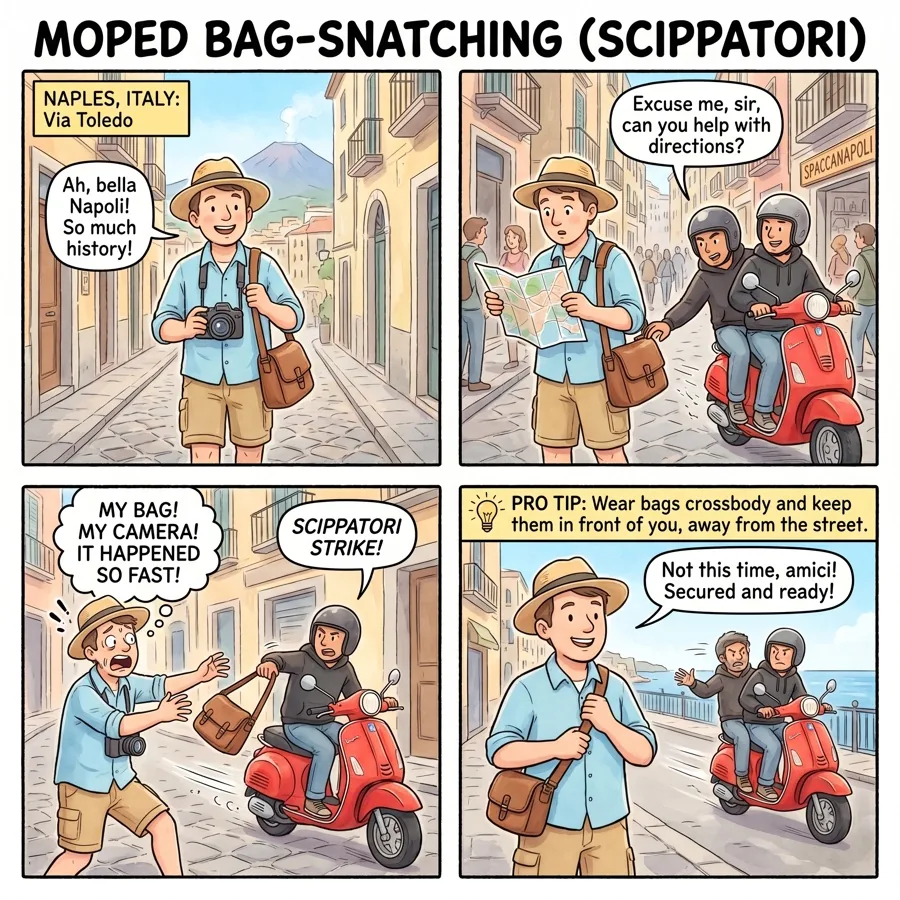
Naples scippatori work two-rider Vespa teams across Via Toledo, Spaccanapoli, Corso Umberto I, the Quartieri Spagnoli, and the streets near Napoli Centrale, snatching bags, phones, and watches as the scooter accelerates past — one British tourist had a €35,000 Rolex torn from his wrist on Via Toledo in broad daylight; carry your bag crossbody on the building side of the sidewalk, walk facing oncoming traffic, and never hold a phone or wear a luxury watch on the street.
You're walking along Via Toledo or Spaccanapoli with your phone in hand or a shoulder bag on your road-side arm. A Vespa with two riders accelerates past from behind. The passenger on the back reaches out and grabs your bag strap or phone in a single fluid motion, and the scooter is gone before you can turn. Naples is the historic home of the scippatori — bag-snatch teams who work the narrow streets between the centro storico and Napoli Centrale, picking off pedestrians with brutal efficiency. The technique is so practiced that one British tourist was filmed having a €35,000 Rolex torn from his wrist by scippatori on a moped in broad daylight on Via Toledo.
The danger goes beyond financial loss. Victims wearing crossbody bags have been dragged along the street when the strap did not break — the scippatori are described as desperate and sometimes violent, and they prefer streets with escape routes through Naples' labyrinthine alleys where no police car can follow. They target anything visible and valuable: luxury watches, expensive handbags, the latest iPhone held casually by a tourist consulting Google Maps. The Quartieri Spagnoli and Spaccanapoli are the highest-density zones because the narrow one-way streets give the scooter an exit no pursuit can match.
While the frequency of scippatori attacks has decreased from its peak decades ago, the threat remains real, particularly in the streets between the historic center and the train station. Local Polizia Municipale and Carabinieri have increased patrols, but the architecture defeats them: a Vespa needs three seconds to clear a Quartieri Spagnoli alley that's too narrow for any car. Always carry your bag crossbody on the building side of the sidewalk (never the road side), walk facing oncoming traffic so you can see scooters approaching, never hold a phone or wear a luxury watch openly on the street, and if a scooter grabs your bag let go immediately — being dragged by a strap is the most common serious-injury scenario. Save 112 (Carabinieri) or 113 (Polizia di Stato), and report any incident at the Polizia office inside Napoli Centrale (Galleria Centrale) for the police-report number your insurance will require.
Red Flags
- You hear a scooter accelerating behind you on a narrow street, especially with two riders
- You are walking on the road side of the sidewalk with a bag on your outer shoulder
- Your phone is in your hand or dangling from a wrist strap while walking along busy streets
- You are wearing expensive visible jewelry or a luxury watch on the street
- A scooter passes slowly as if sizing you up, then circles back
How to Avoid
- Always carry your bag on the building side of the sidewalk, not the road side, and wear it crossbody.
- Do not walk and text or hold your phone while strolling along streets; stop in a doorway or shop if you need to use it.
- Leave expensive watches and jewelry at your hotel; visible luxury items are primary scippatori targets.
- Walk facing oncoming traffic so you can see approaching scooters.
- Use a bag with a slash-proof strap; if a scooter grabs your bag, let go rather than risk being dragged.
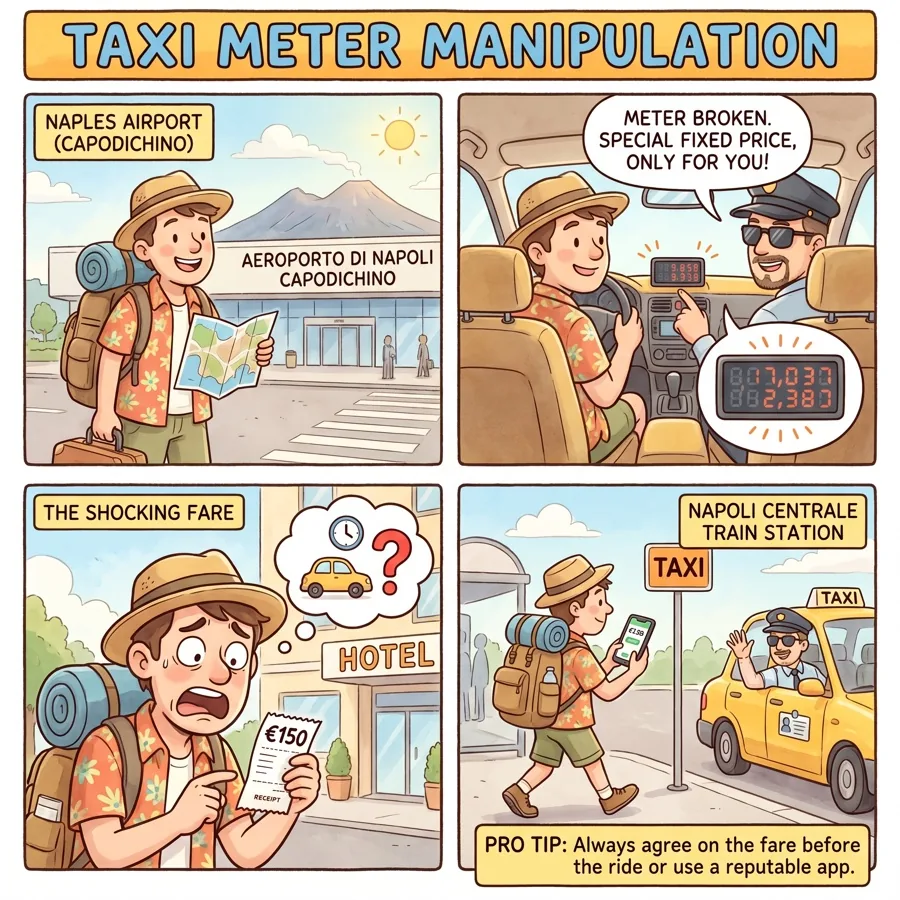
Naples taxi drivers from Capodichino Airport, Napoli Centrale, Piazza Municipio (cruise port), and Piazza Garibaldi quote €40+ flat fares with 'broken meter' or apply Tariffa 2 nighttime rates during daytime — but the city's posted fixed airport fares to the centro storico are €16–€23 by zone (boards visible at the rank), and Free Now or Uber give GPS-tracked routes with upfront pricing; demand the meter on or insist on the posted flat rate before bags go in the boot.
You arrive at Capodichino Airport, walk to the taxi rank, and a driver waves you to his car. He doesn't turn on the meter. Ten minutes later you reach your hotel and the fare is €40 for a trip that should have cost €15–€20. Another common trick: the driver claims the meter is broken and quotes an inflated flat rate. Others take deliberately long routes when passengers are clearly tourists unfamiliar with Naples geography. The mechanic varies but the outcome is consistent — a 2x to 3x markup on a route the city has actually fixed-priced for exactly this reason.
A more sophisticated version involves the driver turning on the meter but pressing a button that applies the nighttime tariff (Tariffa 2) during daytime hours, roughly doubling the cost. Other drivers claim supplements for luggage, holiday rates, or airport fees that are either fabricated or exaggerated. At the cruise port in Piazza Municipio, unofficial taxis without proper licenses wait alongside legitimate ones, sometimes offering what appears to be a lower price that increases dramatically during the ride. Naples does have fixed fares from Capodichino Airport to the city center — around €16–€23 depending on the zone, posted at the taxi stand on a visible board — and these are the only legitimate quotes.
Knowing these rates before you land is your strongest defense, because the negotiation has to happen at the curb in 30 seconds with luggage in hand. Take taxis only from official ranks (roof light, displayed tariff card on the dashboard, license plate visible) and demand the meter is running before the car moves. For airport runs, insist on the posted €16–€23 city-zone flat rate at the Capodichino taxi stand — never accept 'broken meter' or 'flat fare' quotes above €25 to the centro storico. Screenshot your route on Google Maps before getting in, use Free Now or Uber for GPS-tracked transparent pricing, and if overcharged, get the taxi license number and file a complaint with the Comune di Napoli at +39 081 7951111 or via SUAP online.
Red Flags
- The driver does not start the meter when the trip begins or claims the meter is broken
- The driver quotes a flat fare significantly above the posted fixed rates for your route
- The taxi does not have an official license plate, roof light, or displayed tariff card inside
- The driver takes an obviously circuitous route through unfamiliar streets
- Unexpected surcharges appear at the end for luggage, nighttime rates, or holiday supplements
How to Avoid
- Know the fixed-rate fares in advance: airport to city center is 16 to 23 euros depending on zone; these are posted at taxi stands.
- Only use taxis from official stands with proper licensing, roof lights, and displayed tariff cards.
- Insist the meter is running before the car moves; if the driver refuses, exit and find another taxi.
- Screenshot the route on Google Maps before getting in so you can spot unnecessary detours.
- Consider using the Free Now or Uber app for transparent pricing and GPS-tracked routes.
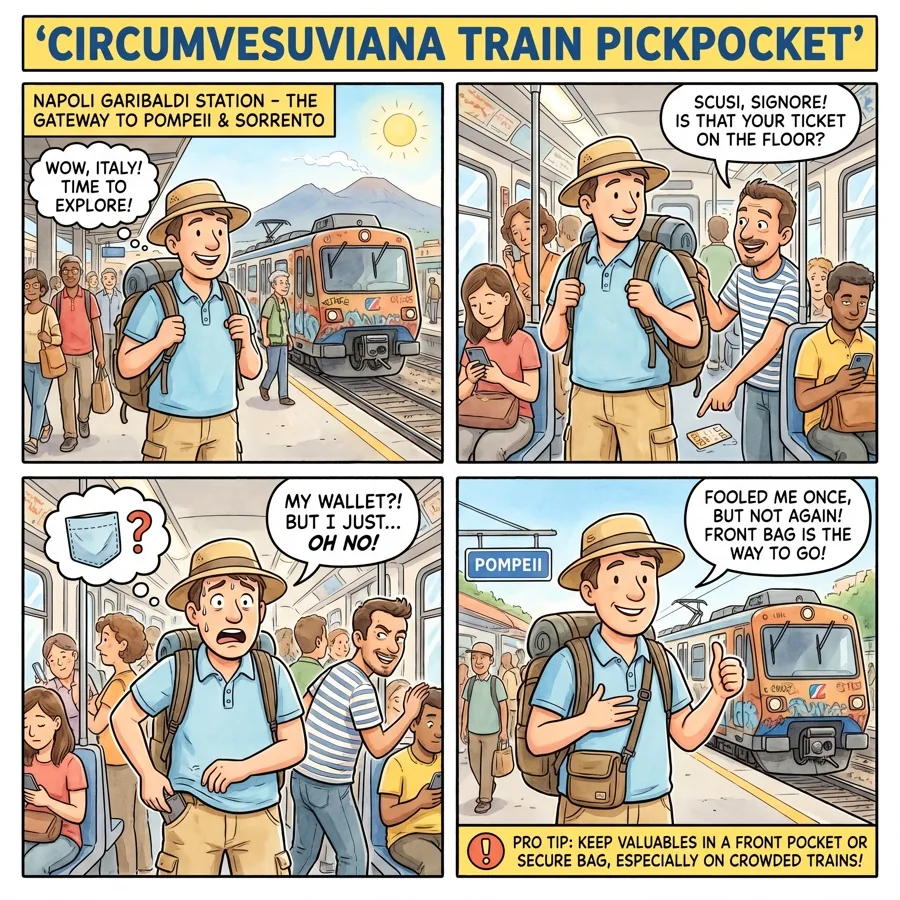
Organized pickpocket teams target the Circumvesuviana commuter trains running Naples → Pompeii → Sorrento — with stroller-block-the-doorway plays at boarding, suitcase-arson diversions inside crowded carriages, and crowd-press tactics on aging trains with no security cameras; Rick Steves' Europe forum maintains a running warning thread, and Campania Express reserved-seat tickets (€8 on the Sorrento route) are the most reliable defense.
The Circumvesuviana is the commuter line connecting Naples to Pompeii and Sorrento, packed daily with tourists carrying cameras, wallets, and phones. Organized pickpocket teams specifically target this route. One well-documented tactic involves a young couple with a baby stroller who position themselves at the train door as you are trying to exit at Pompeii Scavi or Sorrento. The father blocks the doorway with the stroller and asks for help lifting it; as you bend down or squeeze past, the mother positioned behind you picks your pocket. The whole sequence takes about eight seconds.
Another reported tactic is even more extreme: thieves have created diversions by setting a passenger's suitcase on fire inside the carriage. In the panic and confusion that followed, accomplices worked through the crowd stealing phones and wallets. The Circumvesuviana trains are often overcrowded with standing room only, creating the perfect environment for physical contact that masks theft. Rick Steves' Europe forum has an entire thread dedicated to warnings about the route, and the trains themselves are aging and crowded, with stations lacking the security cameras and staff presence of the Naples Metro.
Experienced travelers recommend keeping everything zipped and in front of your body for the entire journey, especially during station stops where boarding/exiting commotion masks the lift. Keep all bags zipped and in front of your body for the entire Circumvesuviana journey (especially Pompeii Scavi and Sorrento boarding/exiting), stand with your back against a wall not in the open aisle, and never help strangers with strollers or luggage at the doorway — let them manage while you protect your belongings. For the Sorrento route, buy Campania Express tickets (€8 reserved seat, runs alongside the regular service) for far less crowded carriages and assigned seating; for any theft, file the denuncia at the Polizia office in Napoli Centrale within 24 hours for insurance documentation.
Red Flags
- A person with a stroller or large object blocks the train door and asks you for help at your stop
- Someone creates an unusual commotion, argument, or distraction inside the crowded carriage
- Groups of people press unusually close to you during boarding or alighting
- You feel someone brush against your bag or pockets more than seems natural in the crowd
- A stranger is overly helpful or friendly on a crowded train, engaging you in conversation while others move behind you
How to Avoid
- Keep all bags in front of your body with zippers facing you for the entire Circumvesuviana journey.
- Stand with your back against the wall or a seat rather than in the open aisle where you can be surrounded.
- Be extra alert at station stops, especially Pompeii Scavi and Sorrento, where tourist exits are predictable.
- Do not help strangers with strollers or luggage at the door; let them manage while you protect your belongings.
- Consider buying first-class Campania Express tickets for the Sorrento route, which offers reserved seating and less crowding.

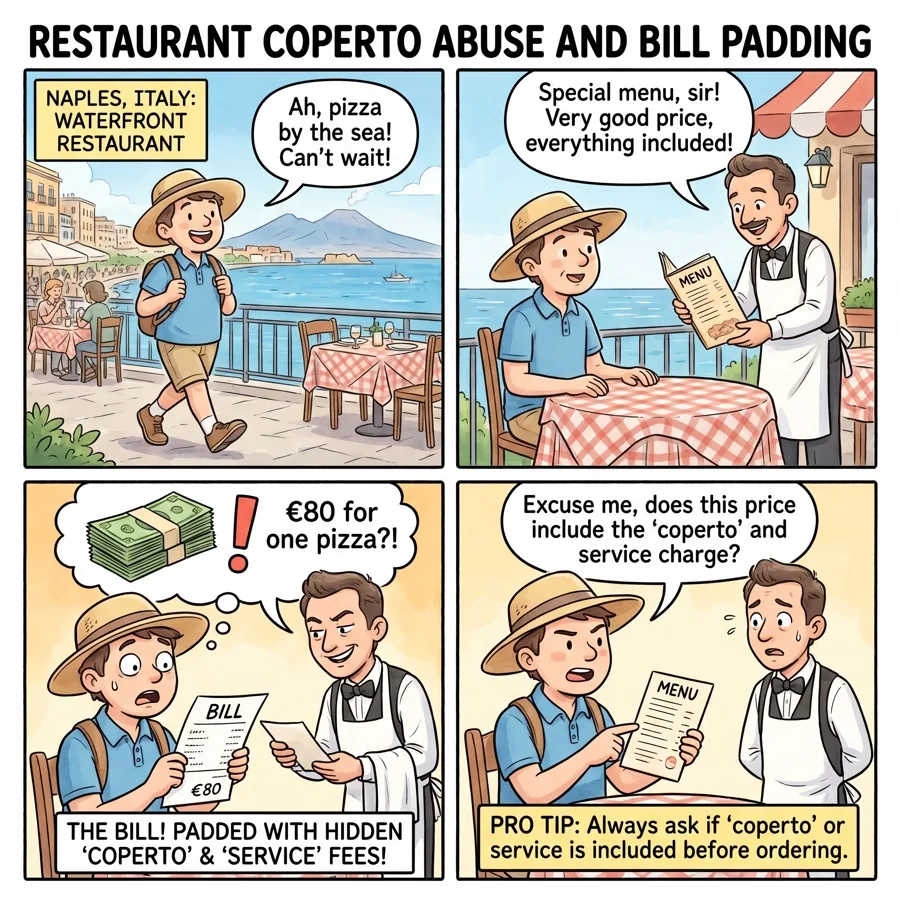
Naples tourist restaurants near Piazza del Plebiscito, Via dei Tribunali, the cruise port (Piazza Municipio), and Borgo Marinari pad bills with €5–€8-per-person 'coperto' (legitimate range is €1–€3 with bread included), unrequested bread, olives, and tapas at €3–€10 each, and €30–€50 'fish of the day' specials with no posted price; demand a printed menu with prices before sitting, refuse welcome items explicitly, and require a ricevuta fiscale (tax receipt) at the end.
A family of four sits down at a waterfront restaurant near the cruise port and orders pizza and pasta. The bill arrives with a coperto (cover charge) of €8 per person, a bread charge they never requested, a servizio (service charge) of 15 percent, and two items they did not order. The total is nearly double what they expected. When they question it, the waiter says the coperto and servizio are mandatory and the bread was automatic. None of those claims is legally enforceable, but the verbal back-and-forth at the cash register is the moment most travelers fold and pay.
Legitimate coperto in Naples ranges from €1 to €3 per person and typically includes bread for the table. Anything above that, especially combined with an additional servizio, is a tourist trap. Restaurants near the cruise port and major piazzas exploit the fact that cruise passengers have limited time and will not come back — they hide prices in tiny font, list specials verbally at inflated rates, or simply add items to the bill and hope tourists do not check. One particularly insidious trick is the off-menu recommendation: the waiter suggests a 'special dish' or the fresh fish of the day without mentioning the price; when the bill arrives, it is €30–€50 for a dish that equivalent restaurants charge €15 for.
Italian law requires restaurants to issue a ricevuta fiscale (official tax receipt), and a refusal to issue one is itself a Guardia di Finanza-actionable offense. Always ask for a printed menu with prices before sitting; if there are no visible prices or the daily special is verbal-only, walk out. Refuse any bread, olives, or 'welcome' tapas the moment they arrive ('no, grazie'), question any coperto above €3 per person, and demand a ricevuta fiscale (tax receipt) rather than a handwritten total — Italian law requires it, and a refusal lets you complain to the Guardia di Finanza. Walk 2–3 streets inland from cruise port exits and main piazzas to find restaurants serving local repeat customers at honest prices (Borgo Marinari proper, Vomero, and Chiaia have many).
Red Flags
- The menu has no prices, or the waiter recommends a daily special without stating the cost
- Bread, water, or olives appear on your table without being ordered
- The restaurant is located directly at a cruise port exit or facing a major tourist piazza
- The coperto listed exceeds three euros per person or a servizio is added on top of a coperto
- The bill is handwritten on a slip of paper rather than an itemized printed receipt
How to Avoid
- Always ask for a printed menu with prices before sitting down; leave if there are no visible prices.
- Ask the price of any verbal recommendation before ordering, especially the catch of the day or daily specials.
- Send back bread, olives, or anything placed on your table that you did not request.
- Request a ricevuta fiscale (official tax receipt) rather than accepting a handwritten total.
- Walk two or three streets away from cruise port exits and main tourist piazzas to find restaurants that depend on local repeat customers.
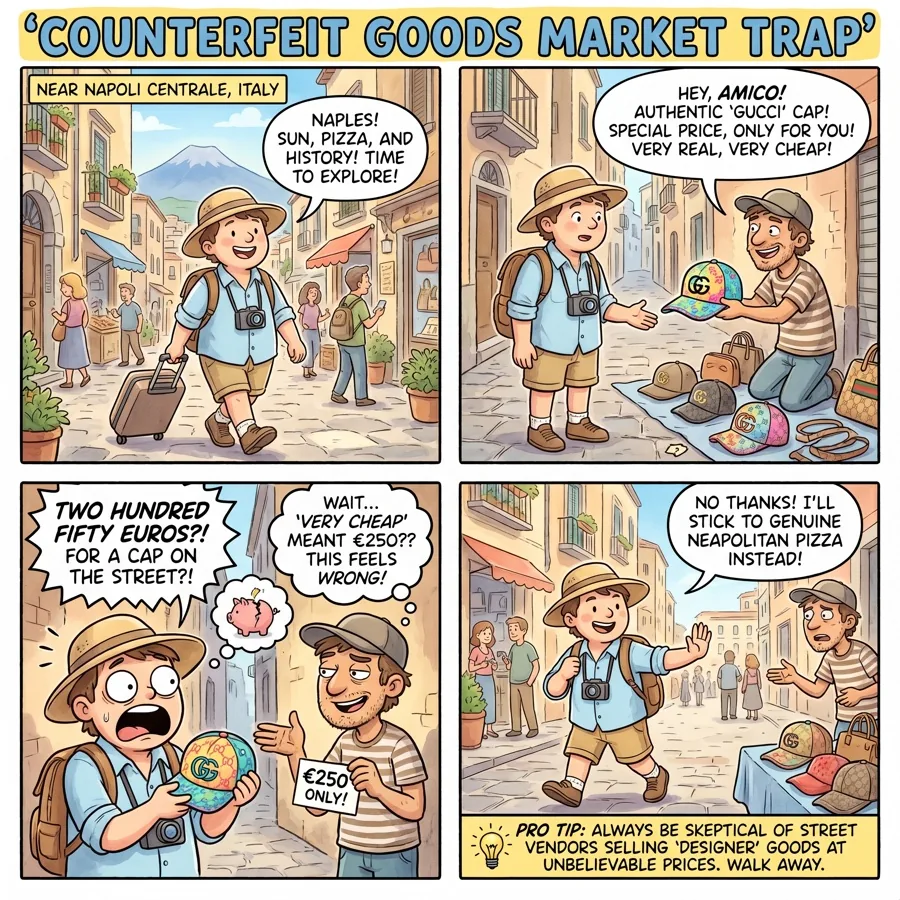
Naples is Europe's counterfeit capital with an estimated €6–7 billion annual market controlled by the Camorra — street vendors near Napoli Centrale, Forcella, and Via Foria sell fake Gucci, Fendi, Hermes, and Louis Vuitton from blankets and blue plastic bags, and Italian customers face fines up to €10,000 for purchase (a Dutch tourist was fined €2,900 for a single fake Prada bag); buy authentic Italian leather only at established shops in Vomero or Chiaia.
Near Napoli Centrale, a tourist spots a vendor selling what appear to be Gucci baseball hats, Fendi wallets, Hermes belts, and Louis Vuitton shoes at a fraction of retail. The vendor is friendly, the goods look convincing, and the price seems like an incredible deal. What the tourist does not realize: buying these counterfeit items is a crime in Italy that can result in a fine of up to €10,000. The blankets are arranged for fast pack-up — every vendor along Corso Umberto I and in the Forcella alleys can dismantle their stand into a blue plastic bag in under five seconds when a police patrol appears.
Naples is the counterfeit capital of Europe, with an estimated €6–7 billion annual market linked directly to the Camorra, the region's organized crime syndicate. A 2022 police investigation found that street vendors pay the mafia up to €200 weekly for permission to operate their stands, or are forced to purchase their merchandise from Camorra suppliers. Between 2018 and 2022, Naples police seized nearly 100 million counterfeit items worth over €470 million — and a Dutch tourist was caught with a single fake Prada bag and fined €2,900 on the spot.
The vendors themselves face little consequence — they're often classified by Italian law as 'low-level distributors' with the real liability falling on the buyer. Do not purchase any branded goods from street vendors in Naples — Italian law fines buyers up to €10,000 for counterfeit purchases, and Naples police have seized nearly 100 million counterfeit items worth €470M in the last reporting period. Walk past blankets and plastic-bag stands without engaging or handling goods (engagement creates social pressure to buy); for authentic Italian leather, buy from established shops in the Vomero or Chiaia neighborhoods with proper invoices listing the brand name. Remember every euro you spend funds the Camorra organized crime syndicate directly.
Red Flags
- Designer-brand goods are being sold from blankets on the street or from plastic bags rather than a proper shop
- The prices are a fraction of normal retail for items bearing luxury brand logos
- The vendor is near a train station or in a back alley rather than a commercial shopping district
- The vendor can pack up and disappear in seconds, indicating awareness of police patrols
- Other tourists are being encouraged to buy as a group, creating social pressure
How to Avoid
- Do not buy any branded goods from street vendors; it is illegal in Italy to purchase counterfeit items, and fines reach ten thousand euros.
- Remember that you are funding organized crime: the Camorra controls the counterfeit market in Naples.
- If you want authentic Italian leather goods, buy from established shops in the Vomero or Chiaia neighborhoods.
- Politely decline and keep walking; do not engage in bargaining or handling the goods.
- If police approach and you have a counterfeit item, you have no legal defense; ignorance of the law is not accepted.
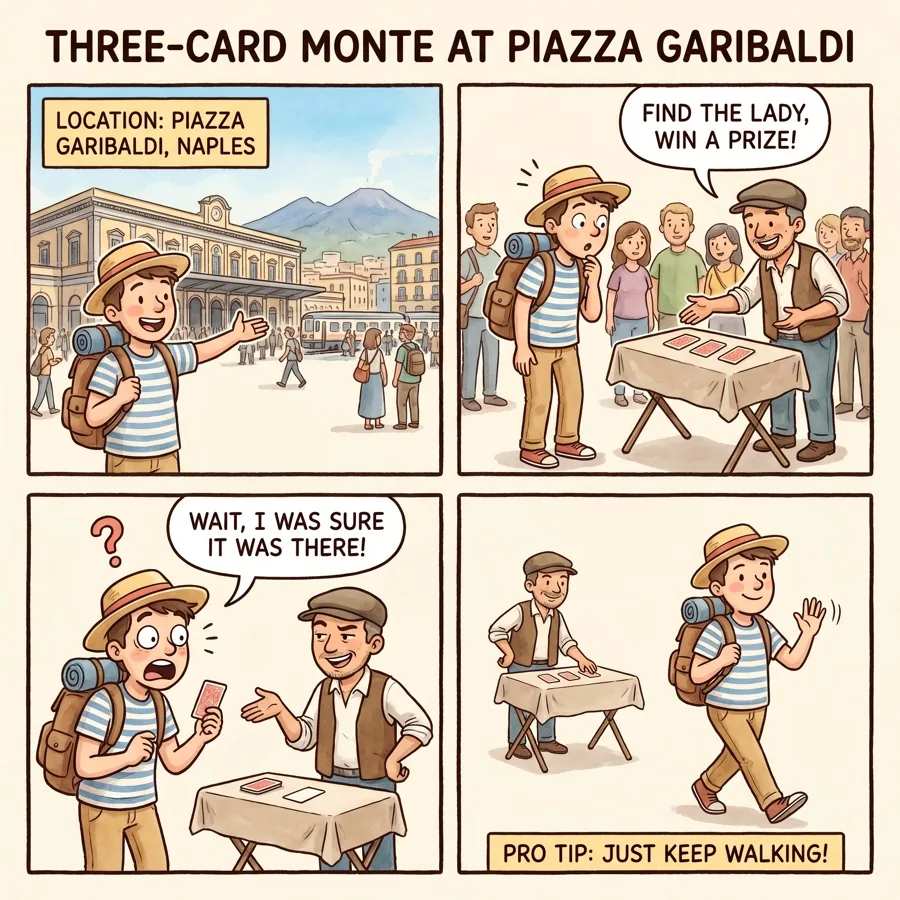
Three-card monte teams operate at Piazza Garibaldi outside Napoli Centrale, on Corso Garibaldi, and occasionally near the cruise port — with a dealer, multiple shills who fake winning, lookouts watching for police, and rovers carrying winnings away; the game is mathematically impossible to win as a non-shill, players who 'win' have been followed and robbed, and a 2024 police bust at Piazza Garibaldi seized only €240 because the operation can dismantle and relocate in under 30 seconds.
Outside Naples' central train station at Piazza Garibaldi, a man sets up a small folding table or cardboard box and begins shuffling three cards. A small crowd gathers. Two people in the crowd bet and win easily — they are shills, planted accomplices designed to make the game look beatable. An unsuspecting tourist places a bet and loses. They try again and lose again. The dealer uses sleight of hand to ensure that no genuine player ever wins, and the bet escalates predictably as the mark tries to recover what they've already lost.
In a 2024 police bust at Piazza Garibaldi, three people were arrested and only €240 was seized — illustrating how the operation moves fast and keeps cash turnover quick. The crew includes the dealer, multiple shills who pretend to win, lookouts watching for police, and rovers who carry winnings away from the table. The entire operation can be dismantled and relocated in under 30 seconds. The danger extends beyond losing your bet: players who appear to be 'winning by luck' (and disrupting the take) have been followed away from the station and robbed, and the operators are connected to organized-crime networks that control the area around the station.
Police crack down periodically, but the games reappear quickly because the low overhead and high profit margin make it worthwhile for the operators. Never play any street card or shell game in Naples — the dealer uses sleight of hand to ensure no genuine player wins, and every visible 'winner' is a planted shill. Do not even stop to watch (presence marks you as a target for both the game and pickpockets in the surrounding crowd); walk directly to your destination when leaving Napoli Centrale, and do not linger anywhere in Piazza Garibaldi. If you've engaged and feel followed afterward, walk into the nearest open shop or restaurant and call 112 (Carabinieri) from inside.
Red Flags
- A crowd has formed around a card game near the train station or a transit hub
- Several people in the crowd are winning and encouraging bystanders to try
- The game is set up on something portable like a cardboard box or folding stool
- Lookouts are positioned at the edges of the crowd scanning for police rather than watching the game
- A friendly stranger encourages you to bet, offering advice on which card to pick
How to Avoid
- Never play any street card or shell game; the game is mathematically impossible to win as a non-shill.
- Do not even stop to watch, as your presence marks you as a potential target for the game or for pickpockets in the crowd.
- Every visible winner is a planted accomplice; this is part of the con, not evidence the game is fair.
- Walk directly to your destination when leaving Napoli Centrale; do not linger in Piazza Garibaldi.
- If you are followed after walking away from a game, enter a shop or restaurant and call 112.
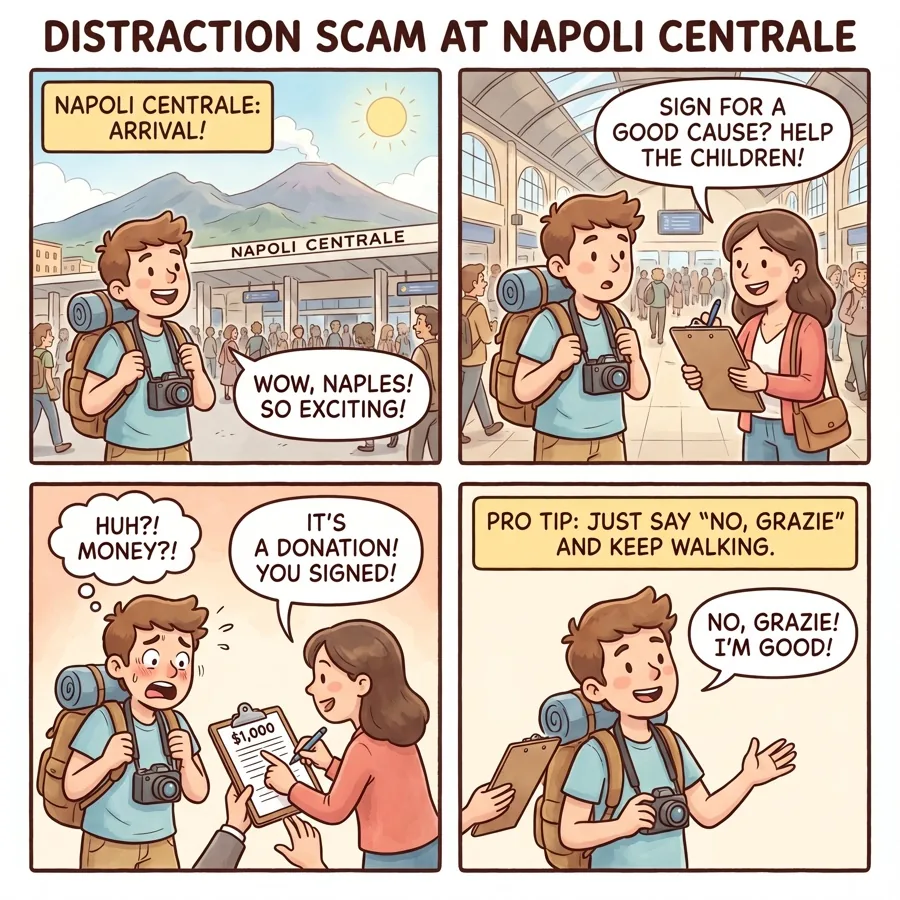
Distraction crews work inside Napoli Centrale and Piazza Garibaldi entrance with clipboard 'deaf children' petitions held at chest level, child-swarm tactics with cardboard visual barriers, and the 'hold this baby' play that forces both your hands occupied — the petition or prop is just a screen for an accomplice behind you opening your backpack or jacket pocket; never stop, never accept anything placed in your hands, and keep bags zipped in front of your body.
Inside the busy Napoli Centrale station, a woman approaches you with a clipboard and a petition about deaf children or environmental causes. She is insistent, holding the clipboard close to your chest while speaking rapidly. While you are focused on the petition and trying to politely decline, her accomplice behind you opens your backpack or reaches into your jacket pocket. The petition itself is just a large prop designed to block your view of your own body — held at exactly the height that obscures your sightline to your hip and waist where most travelers carry their wallet or phone.
Another version involves a group of children surrounding a traveler, tugging at their clothing and creating noise and confusion. One child holds up a piece of cardboard or newspaper as a visual barrier while the others search pockets and bags. Rick Steves' Europe forum documents a particularly disturbing variation where a woman presents a semi-conscious infant and asks you to hold the baby, forcing an instinctive reaction; while your hands are occupied with the child, an accomplice picks your pockets. These distraction scams are most effective in the hectic environment of the train station, where people are already disoriented, carrying luggage, and checking their phones for train times.
The perpetrators specifically target people who look like tourists consulting maps or ticket machines, and the entire mechanic depends on you not breaking eye contact with the prop. Never stop for any clipboard signer, petition collector, or person asking for help inside Napoli Centrale or its forecourt — say 'no, grazie' without slowing your walking pace. Secure all bags before entering the station (zippers closed, bag carried in front, hand on the clasp), never accept any item placed in your hands (especially a baby or animal — that's a deliberate two-hand-occupation play), and use a money belt for passport and primary cards. If surrounded by a child-swarm, shout firmly to draw attention — these crews avoid making a scene and will scatter immediately.
Red Flags
- A stranger approaches with a clipboard, petition, or piece of paper held at your chest level
- A group of children surrounds you creating noise and physical contact simultaneously
- Someone holds a newspaper or cardboard near your body, blocking your view of your own pockets
- A person is overly insistent about getting your attention while you notice movement behind you
- Someone asks you to hold something, creating a situation where both your hands are occupied
How to Avoid
- Never stop for petition signers or clipboard holders in train stations; say no and keep walking.
- Secure all bags before entering the station: zippers closed, bag in front, hand on the clasp.
- If surrounded by children or a group, shout loudly and firmly to draw attention; scammers avoid scenes.
- Never take or hold anything offered by a stranger, especially a baby or animal, as it is a ploy to occupy your hands.
- Use a money belt for your passport and primary cards; keep only small cash in an accessible wallet.
🆘 What to Do If You Get Scammed
📋 File a Police Report
Go to the nearest Carabinieri / Polizia di Stato station. Call 112 (Carabinieri) or 113 (Polizia). Get an official crime report — you'll need this for insurance claims. You can also report online at poliziadistato.it.
💳 Cancel Your Cards
Call your bank immediately. Most have 24/7 numbers on the back of the card (keep a photo saved separately). Block any suspicious transactions before the thieves use your details.
🛂 Lost Passport?
Contact your nearest embassy or consulate. The US Embassy in Rome is at Via Vittorio Veneto 121, 00187 Rome. For emergencies: +39 06-4674-1.
📱 Track Your Device
If your phone was stolen, use Find My (iPhone) or Find My Device (Android) from another device. Don't confront thieves yourself — share the location with police instead.
Frequently Asked Questions
You just read 7 scams in Naples. The book has 142 more across 20 Italian destinations.
Rome's tre-campanelle shell game. Venice's €2,500-a-day pickpocket ring. Florence's fake-leather trade. Capri's Blue Grotto fee-stack. Sardinia's €3,000 sand-in-your-luggage fine. Every documented Italy scam — with the exact scripts, red flags, and Italian phrases that shut each one down. Drawn from Repubblica, Corriere, Il Mattino, and Carabinieri arrest records.
- 149 documented scams across Rome, Venice, Florence, Milan & 16 more cities
- An Italian exit-phrase card you can screenshot to your phone
- Updated annually — buy once, re-download future editions free
- Readable in one flight — $4.99 on Amazon Kindle