Unlicensed Airport Taxi Overcharge: the same scam, in 4 countries.
From Rome Fiumicino flat-rate touts to Bangkok Suvarnabhumi non-meter quotes to Buenos Aires Ezeiza fake remise to Marrakech Menara off-meter petit-taxis, the same five-mechanic family runs at every major tourist airport. The official-rank rule and the rideshare rule defeat every variant.


Unlicensed airport taxi overcharges run five mechanics across 4 countries: Rome Fiumicino flat-rate tout (Italy regulates 50 EUR flat from Fiumicino to anywhere within Aurelian walls; touts quote 80-150 EUR), Bangkok Suvarnabhumi non-meter (drivers refuse meter and quote 500-1,000 baht for what should be 350-450 baht metered), Buenos Aires Ezeiza fake remise (touts quote 80,000-150,000 ARS for what is 35,000-50,000 via legitimate booth or Cabify), Marrakech Menara unlicensed petit-taxi (off-meter 200-400 dirham for what is 80-120 metered), Mexico City MEX terminal tout (curbside 500-1,200 MXN for what is 250-450 from authorized booth or Uber). The universal defenses are two rules: the official-rank rule (walk past everyone at arrivals; walk to the airport official taxi rank with uniformed dispatcher; Italian white TX plate, Bangkok yellow-orange public-taxi rank, Buenos Aires yellow-and-black licensed, Marrakech white petit-taxi, Mexico authorized-taxi booth), and the rideshare rule (pre-book Uber / Bolt / Cabify / Grab / Didi before exiting customs; the app quotes price upfront and is immune to meter-off tactics).
"Taxi to center, signore? One hundred twenty euros, very fast, no traffic."
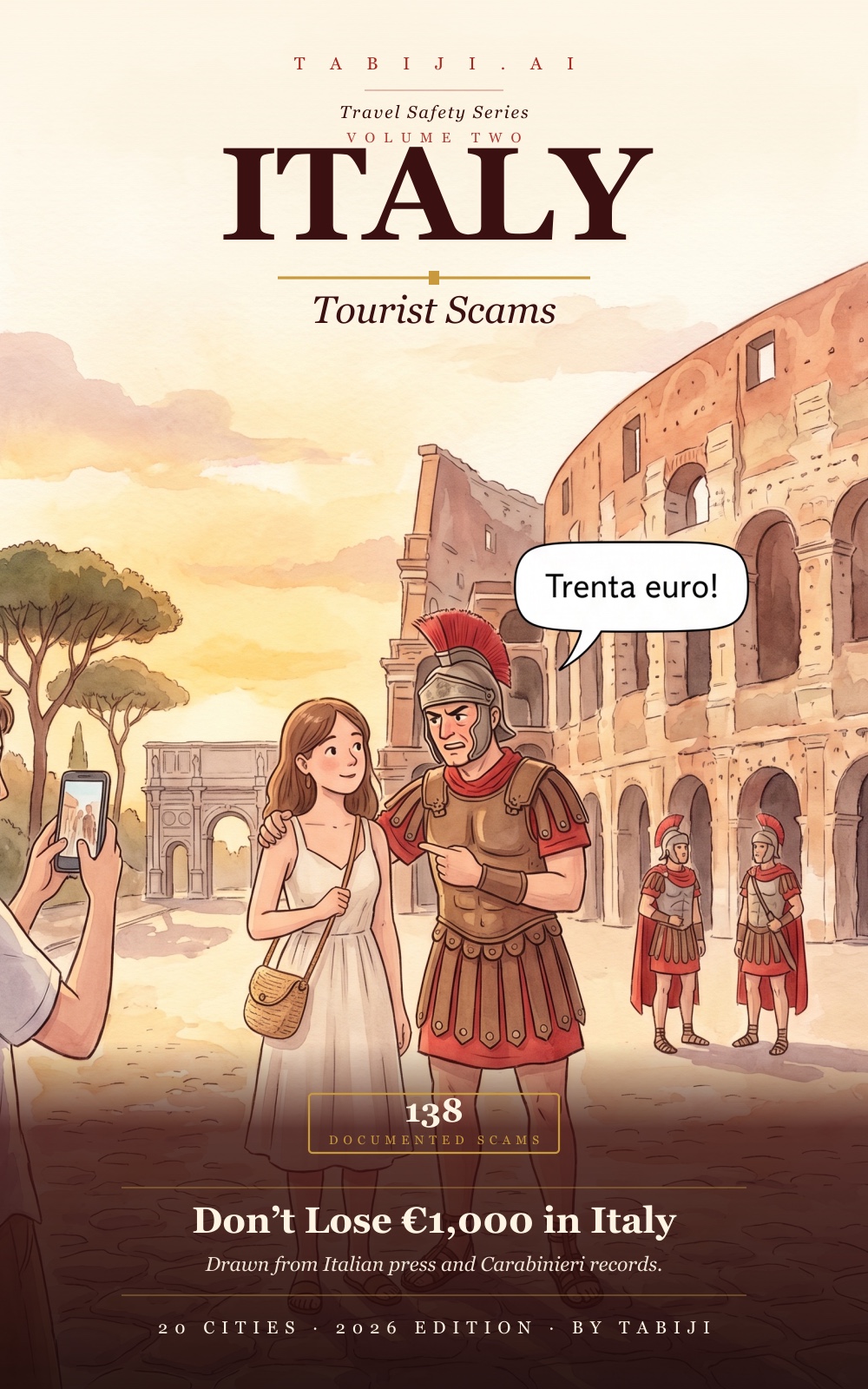
You walk out of customs at Rome Fiumicino Terminal 3, dragging two rolling suitcases. Six meters into the open arrivals concourse, a man in dark slacks and a polo shirt steps in front of you with a smile. He says: "Taxi to center, signore? One hundred twenty euros, very fast, no traffic, very nice car." He gestures behind him toward the parking garage. He is not at any taxi rank. He has no badge. He has no car visible.
You hesitate; you have been awake for thirty hours; the price feels wrong but you do not remember the official rate. You glance past him: thirty meters down the curb, you see the official taxi rank — a uniformed dispatcher in a yellow vest, a line of white sedans with TX plate prefixes and rooftop "TAXI ROMA" signs. The first cab in line is loading another passenger.
You say "no grazie" and walk past him. He follows for ten paces, repeats the offer at "one hundred euros," then drops to "ninety, signore, ninety," then walks back into the concourse to look for the next arriving tourist. You reach the official rank, hand the dispatcher your hotel address (Hotel Aventino), and he points you to the next white sedan. The driver starts the meter (the meter shows the standard fixed-rate display: 50 EUR Fiumicino-Centro). You arrive at the hotel; the meter shows 50.00 EUR; you pay; the driver gives you a printed receipt. Total time including the rank wait: 8 minutes.
This is the Rome Fiumicino flat-rate tout, the most-documented Italian airport-taxi scam. Italy regulates a 50 EUR flat rate for licensed taxis from Fiumicino to anywhere within the Aurelian walls (central Rome) by Roma Capitale ordinance; the 70 EUR difference quoted by the tout is pure overcharge. The Polizia di Stato and Polizia Locale di Roma both run periodic enforcement waves at the airport; touts return after each crackdown. Tourists who do not know the official rate lose 50-150 EUR on the first taxi ride of the trip.
The defense is two rules. The official-rank rule: walk past everyone offering rides at airport arrivals. Walk to the official taxi rank (always signposted, always uniformed dispatcher, always white sedans with TX plate prefixes in Italy); take the next licensed taxi in line. The 30-meter walk produces a 50-300% lower fare. The rideshare rule: pre-book Uber, Free Now, Bolt, or local equivalent before exiting customs. Most major airports have designated rideshare pickup zones; the app shows the zone and quotes the price upfront, immune to meter-off and route-padding tactics.
That is the Rome Fiumicino flat-rate variant of the unlicensed-airport-taxi family, executed at the most-documented Italian airport. The rest of this page is the five-mechanic playbook, the four other places where it runs in different forms (Bangkok Suvarnabhumi non-meter, Buenos Aires Ezeiza fake remise, Marrakech Menara off-meter petit-taxi, Mexico City MEX curbside tout), and the two rules that defeat every variant.
Read the full Rome scam guide →Key Takeaways
The official-rank rule and the rideshare rule
Every variant of the unlicensed-airport-taxi overcharge is defeated by the same two rules. The official-rank rule: walk past everyone offering rides at airport arrivals. Walk to the official taxi rank outside the terminal (always signposted, always uniformed dispatcher); take the next licensed taxi in line. The rideshare rule: pre-book Uber, Bolt, Cabify, Free Now, Grab, Didi, or local equivalent before exiting customs. Rideshare apps quote the price upfront and are immune to the meter-off and route-padding tactics that operator-aligned drivers use.
The first rule addresses the operator-economy asymmetry. Touts at airport arrivals operate without dispatcher oversight, license verification, or meter requirements. They quote flat rates 2-4x the legitimate metered or fixed fare. The 5-minute walk to the official rank denies the tout transaction; the rank-dispatched driver operates under city-license rules with meter or fixed-fare requirements, and any complaint has a recourse path through the airport authority and city taxi office.
The second rule addresses the price-transparency asymmetry. Rideshare apps (Uber, Bolt, Cabify, Free Now, Grab, Didi, Careem, InDrive, local equivalents) quote the trip price before booking; the price is final regardless of route taken or time elapsed. This eliminates the meter-off tactic (Bangkok, Marrakech), the route-padding tactic (Mexico City, Buenos Aires), and the luggage-surcharge invention (Rome, Naples).
The third defense is knowing the official price. Most major tourist airports publish official taxi rates on the airport website or arrivals signage. Rome Fiumicino-to-center: 50 EUR flat (within Aurelian walls). Bangkok Suvarnabhumi-to-Sukhumvit: 250-400 baht meter plus 50 baht airport surcharge plus tolls 50-70 baht. Ezeiza-to-Buenos Aires center: 35,000-50,000 ARS via Cabify or Uber, slightly higher via licensed remise from authorized booth. Marrakech Menara-to-medina: 80-120 dirham. Mexico City MEX-to-Polanco: 250-350 MXN. Knowing the rate before arrival defeats any flat-rate quote that exceeds it.
The fourth defense is plate / decal verification. Italian licensed: white car with TX plate prefix and city-license decal. Bangkok: yellow-orange or pink public taxi with meter visible. Buenos Aires: yellow-and-black licensed taxi or pre-booked Cabify / Uber. Marrakech: white petit-taxi with roof-mounted "TAXI" sign. Mexico City: authorized-taxi booth-issued ticket with car license number matching the booked car. Drivers without correct plates / decals are unlicensed by definition.
The fifth defense, when escalation occurs: report to airport police. Most major tourist airports have police presence at arrivals (Polizia di Stato at Fiumicino, Tourist Police at Suvarnabhumi, Policia Federal at MEX, Royal Gendarmerie at Menara). Reporting touts produces operational consequences (license suspension for licensed-but-overcharging drivers, citation for unlicensed touts) and protects later tourists.
The five mechanics
Unlicensed airport taxi overcharges run five distinct mechanics across the major tourist-airport network. Each has a signature country, a signature tactic, and a signature defense path.
1. Rome Fiumicino / Naples flat-rate tout (Italy)
Italy regulates a 50 EUR flat rate for licensed taxis from Rome Fiumicino (FCO) to anywhere within the Aurelian walls (central Rome); 30 EUR for Ciampino (CIA) to the same area. Naples Capodichino (NAP): about 16 EUR flat to centro storico. Touts at terminal exits offer 80-150 EUR claiming the fixed rate is for short distances or that there is a luggage surcharge. The fixed rate is by Roma Capitale / Comune di Napoli ordinance, regardless of luggage or destination within the zone. Defense: walk to the official taxi rank (signposted, white sedans with TX plate prefix); demand the fixed rate or use the meter; refuse any other price.
2. Bangkok Suvarnabhumi / Don Mueang non-meter (Thailand)
Bangkok taxis are required by law to use the meter; the airport surcharge is 50 baht added at meter total. Drivers at Suvarnabhumi (BKK) and Don Mueang (DMK) terminal exits offer flat-rate quotes (500-1,000 baht) instead of meter, claiming meter is broken or that meter does not apply to airport rides. Actual metered fare to Sukhumvit: 250-400 baht plus 50 baht surcharge plus 50-70 baht tolls. Defense: walk to the official public-taxi rank (Suvarnabhumi level 1, marked PUBLIC TAXI; Don Mueang ground level); demand meter on; refuse any flat-rate offer.
3. Buenos Aires Ezeiza / Aeroparque fake remise (Argentina)
At Ezeiza International (EZE) and Aeroparque (AEP), touts offer "remise" (private hire car) services at flat rates 2-3x the official rate. Some are unlicensed; some are licensed but quoting inflated rates. Legitimate Ezeiza-to-Buenos Aires center fare is about 35,000-50,000 ARS (30-40 USD via Cabify or Uber, slightly higher via licensed remise from authorized booth). Touts quote 80,000-150,000 ARS. Defense: pre-book Uber or Cabify before exiting customs; both are legal in Buenos Aires; designated rideshare zone outside arrivals.
4. Marrakech Menara unlicensed petit-taxi (Morocco)
Marrakech petit-taxis (small khaki-colored Dacia / Fiat sedans with roof "TAXI" sign) are required to use the meter within the city. Drivers at Marrakech Menara (RAK) airport sometimes refuse the meter, quoting flat rates of 200-400 dirham (20-40 USD) for the 6 km ride to the medina. Metered fare: 80-120 dirham (8-12 USD). Some unlicensed cars (without the petit-taxi color or roof sign) also tout. Casablanca Mohammed V (CMN): same pattern at slightly higher distances. Defense: walk to the official petit-taxi stand at Menara (signposted); demand meter on; if no meter, walk to next taxi.
5. Mexico City MEX / adjacent terminal tout (Mexico, adjacent)
Mexico City Benito Juarez (MEX) has authorized-taxi booths (yellow Sitio 300, blue authorized-taxi at terminal 1 and terminal 2). Tourists approached by touts at terminal exits offering rides at flat rates (500-1,200 MXN) are paying 2-4x the legitimate fare (250-350 MXN to Polanco; 350-450 MXN to Roma / Condesa). Some unlicensed touts in Mexico, Caracas, Sao Paulo have committed serious crimes (express kidnapping; Vol 26). Defense: only use the authorized-taxi booth or pre-booked Uber / Didi; refuse all curbside taxi offers regardless of friendly approach.
Where it runs
Unlicensed airport taxi overcharges concentrate at major tourist airports with high-volume international arrivals. The geography below covers the most-documented airports per country.
- Italy: Rome Fiumicino (FCO) Terminal 3 arrivals; Rome Ciampino (CIA); Naples Capodichino (NAP); Milan Malpensa (MXP) Terminal 1 and 2; Milan Linate (LIN); Venice Marco Polo (VCE); Florence Peretola (FLR); Bologna (BLQ); Pisa (PSA); Catania (CTA); Palermo (PMO).
- Argentina: Ezeiza International (EZE) Terminal A; Aeroparque Jorge Newbery (AEP); Cordoba International (COR); Mendoza (MDZ); Bariloche (BRC); Iguazu (IGR); Salta (SLA); Ushuaia (USH).
- Thailand: Bangkok Suvarnabhumi (BKK) level 1 public-taxi rank; Bangkok Don Mueang (DMK); Phuket (HKT); Chiang Mai (CNX); Krabi (KBV); Koh Samui (USM); Pattaya U-Tapao (UTP).
- Morocco: Marrakech Menara (RAK); Casablanca Mohammed V (CMN); Fez (FEZ); Tangier (TNG); Agadir (AGA); Rabat (RBA); Essaouira (ESU).
- Adjacent (also documented): Mexico: Mexico City Benito Juarez (MEX) Terminal 1 and 2, Cancun (CUN), Guadalajara (GDL), Monterrey (MTY). Brazil: Sao Paulo Guarulhos (GRU), Rio de Janeiro Galeao (GIG). Egypt: Cairo (CAI), Hurghada (HRG), Sharm el-Sheikh (SSH). India: Delhi (DEL), Mumbai (BOM), Bangalore (BLR). Vietnam: Hanoi (HAN), Ho Chi Minh City (SGN). Philippines: Manila (MNL).
Four more places, four more airport-taxi variants
Bangkok Suvarnabhumi: the meter-off flat-rate
Bangkok Suvarnabhumi airport, you arrive at 02:00 from a 12-hour flight. You walk through immigration and customs and exit on level 2. A driver in a polo shirt approaches: "taxi sir, meter broken, special price tonight, 800 baht to Sukhumvit, fast, no problem." 800 baht is about 25 USD. You hesitate; you remember Sukhumvit metered should be cheaper.
You walk past him to level 1, where the official PUBLIC TAXI rank is. A uniformed dispatcher hands you a printed slip with the destination address; the next yellow-orange taxi pulls up. The driver activates the meter; the meter shows the airport surcharge (50 baht) added to the meter total. You arrive at your Sukhumvit hotel 35 minutes later; meter total 290 baht, plus 50 surcharge, plus 70 tolls = 410 baht (about 13 USD). You pay; the driver gives you a printed receipt.
Defense: even at 02:00 with no other tourists in sight, walk to level 1 public-taxi rank. The dispatcher is on duty 24/7 at Suvarnabhumi. The Royal Thai Police Tourist Police 1155 dispatch English-language operators 24/7; reporting meter-off touts at the rank produces enforcement actions.
Buenos Aires Ezeiza: the fake-remise booth
Ezeiza International (EZE), you arrive on a 10-hour flight from Madrid. You exit customs into the arrivals concourse. A booth labeled "REMISE OFICIAL" is staffed by a man in a black blazer; he gestures you forward, says: "remise to Buenos Aires center, 120,000 pesos, very good service, fixed price." 120,000 ARS is about 95 USD. You hesitate; you remember Cabify quoted 38,000 ARS earlier (about 30 USD).
You walk past the booth to the curb, open the Cabify app on your phone (Wi-Fi: "Aeropuerto Argentina 2000" connects free). Cabify quotes 38,000 ARS to the address; you book; the car arrives 4 minutes later at the designated rideshare zone. You pay through the app.
Defense: the "remise oficial" booth is not necessarily fake — there are licensed remise companies at Ezeiza — but the booths inflate over the legitimate rate. Cabify and Uber are both legal in Buenos Aires and quote 30-50% lower than booth-quoted remise. Always check both apps before booking remise.
Marrakech Menara: the off-meter petit-taxi
Marrakech Menara, you arrive on an afternoon flight. You exit through customs, walk to the curb. The petit-taxi rank is signposted but a driver intercepts you 10 meters before the rank: "taxi to medina, sir, two hundred dirham, fast, very nice." 200 dirham is about 20 USD. You start walking past him; he drops to 150, then 120. You continue.
At the official petit-taxi stand, the dispatcher (a man in a vest) directs you to the next white petit-taxi (small Dacia, rooftop "TAXI" sign visible). You ask the driver to use the meter; he activates it. The meter shows the standard urban tariff (zone 1, daytime). You arrive at the Bahia Palace area (medina edge) 15 minutes later; meter shows 95 dirham; you pay 100 dirham including small tip. About 10 USD total.
Defense: in Marrakech, the official petit-taxi is the white khaki-colored car with rooftop sign; demand meter on at the stand. The Royal Gendarmerie of Morocco enforces taxi-meter compliance at Menara; reporting off-meter drivers to airport police produces enforcement.
Mexico City MEX: the curbside tout
Mexico City Benito Juarez airport (MEX) Terminal 1 arrivals. You walk through customs. A man in a leather jacket approaches: "taxi senior, very safe, 800 pesos to Polanco." 800 MXN is about 45 USD. You decline; you walk past him toward the authorized-taxi booths. Two more touts intercept on the walk; you decline both.
You reach the yellow Sitio 300 booth. The booth attendant takes your destination, prints a ticket, gives you the car license number; the car is at curb spot 12 (numbered). You walk to spot 12; the licensed driver is waiting. The fare is 280 MXN to Polanco (about 16 USD). You pay through the booth ticket.
Defense: Mexico City MEX has documented unlicensed-taxi crimes including express kidnapping (Vol 26 in this Atlas). The authorized-taxi booth (Sitio 300, yellow; or blue authorized booth at Terminal 2) is the only safe option for first-time tourists who do not have rideshare apps. Pre-booking Uber or Didi (both legal in Mexico City) before exiting customs is the alternative.
Red flags
- Driver inside terminal or curbside before the official rank. Real airport drivers wait at the rank; touts intercept early.
- Flat-rate quote without meter. Most countries (Italy, Thailand, Morocco, Mexico) require meter or fixed published rate.
- "Meter broken" claim. Bangkok-specific tell; refuse and walk to next taxi.
- Driver lacks city-license decal or proper plate format. Italy TX plate, Bangkok yellow-orange car, Marrakech khaki petit-taxi, BA yellow-and-black.
- Booth or driver not at the signposted official rank. Walk past everyone before the signposted rank.
- Driver refuses receipt or printed slip. Real licensed drivers issue receipts on demand.
- Quote is 2-3x higher than the published official rate. Know the rate before arrival; refuse anything significantly above.
- Driver wants to deviate from rideshare app route. Cancel ride; book another.
The phrases that shut it down
Each language below refuses the airport-taxi tout firmly while continuing to walk toward the official rank.
If you got hit
If a tout overcharged you for an airport-to-city ride: file a complaint with the airport authority and city taxi office within 7 days. Italy: ENAC (airport authority) and Roma Capitale Taxi Office for Fiumicino / Ciampino. Argentina: ORSNA (airport regulator) for Ezeiza / Aeroparque; Buenos Aires Direccion General de Habilitaciones (taxi licensing). Thailand: AOT Airport Authority for Suvarnabhumi / Don Mueang; Bangkok Department of Land Transport. Morocco: ONDA (airport authority) for Menara / Mohammed V; Royal Gendarmerie taxi enforcement. Mexico: SCT (transport ministry) for MEX; Mexico City SEMOVI (transport authority).
If you paid by card under duress: file a chargeback within 30 days under "billed amount differs from agreed amount." Visa, Mastercard, Amex accept this category for unlicensed-taxi pricing fraud where the cardholder has documentation (photo of license plate, photo of receipt or absence thereof, photo of driver if safely possible).
If the tout posed serious safety risk (route deviation, refused to stop, multiple passengers): phone airport / city police (Italy 113, Argentina 911, Thailand 1155 English, Morocco 19, Mexico 911). Photograph the license plate and driver before exiting the vehicle if safely possible. Mexico City MEX has documented express-kidnapping incidents from unlicensed taxis; treat any deviation as a potential variant escalation.
Report the tout to the airport authority police substation. Most major airports have a tourist-police presence at arrivals (Polizia di Stato Fiumicino, Tourist Police Suvarnabhumi level 2, Policia Federal MEX). Reporting produces tout-license citations, repeated-offender enforcement, and deters the immediate operator.
Related atlas entries
Sources & references
- Italy: ENAC airport authority; Polizia di Stato 113; Roma Capitale Taxi Office (Fiumicino flat-rate ordinance, 50 EUR within Aurelian walls).
- Argentina: ORSNA airport regulator for Ezeiza / Aeroparque; Buenos Aires Direccion General de Habilitaciones (taxi licensing); Cabify and Uber legal in BA.
- Thailand: AOT Airport Authority Suvarnabhumi / Don Mueang; Tourist Police Bureau 1155 (English-language); Bangkok Department of Land Transport meter requirements.
- Morocco: ONDA airport authority; Royal Gendarmerie taxi enforcement; Marrakech petit-taxi tariff schedule.
- Mexico: SCT (Secretariat of Communications and Transportation); Mexico City SEMOVI; MEX authorized-taxi booth system (Sitio 300, blue authorized).
- Rideshare: Uber, Bolt, Cabify, Free Now, Grab, Didi, Careem, InDrive operate at most major tourist airports with designated pickup zones.
- UK FCO travel advice: Italy, Argentina, Thailand, Morocco, Mexico country pages reference unlicensed airport taxis.
- Tabiji field reports: Rome Fiumicino, Bangkok Suvarnabhumi, Buenos Aires Ezeiza, Marrakech Menara, Mexico City MEX (2024-2026).
Get the full airport-taxi playbook for your destination.
Each Travel Safety atlas covers every documented unlicensed-taxi, tuk-tuk, rideshare, and airport-tout scam in one country, plus the full scam catalog: pickpocket, ATM, restaurant, fake authority, vendor. Buy once, lifetime updates as scams evolve. $4.99 on Kindle.