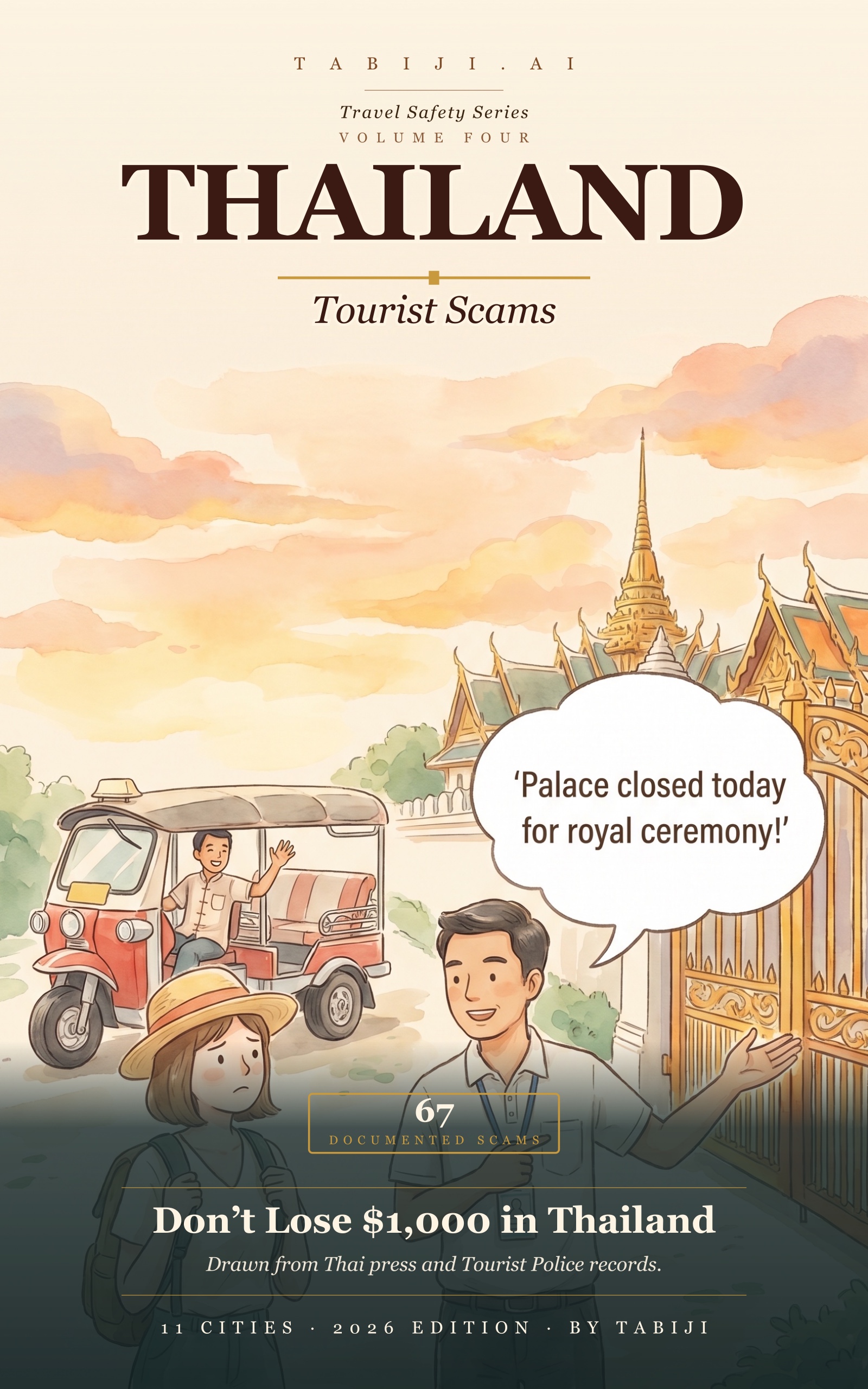
The tuk-tuk detour, temple by temple.
One scam family. Four sub-variants. Nine countries. Drawn from r/Thailand, r/india, and r/cambodia field reports, local-press tourist-police bulletins, and a year of city-by-city research. The "Grand Palace is closed" lie, the gem-shop loop, the all-day $5 tour. And the local-language phrases that shut each one down in 30 seconds.

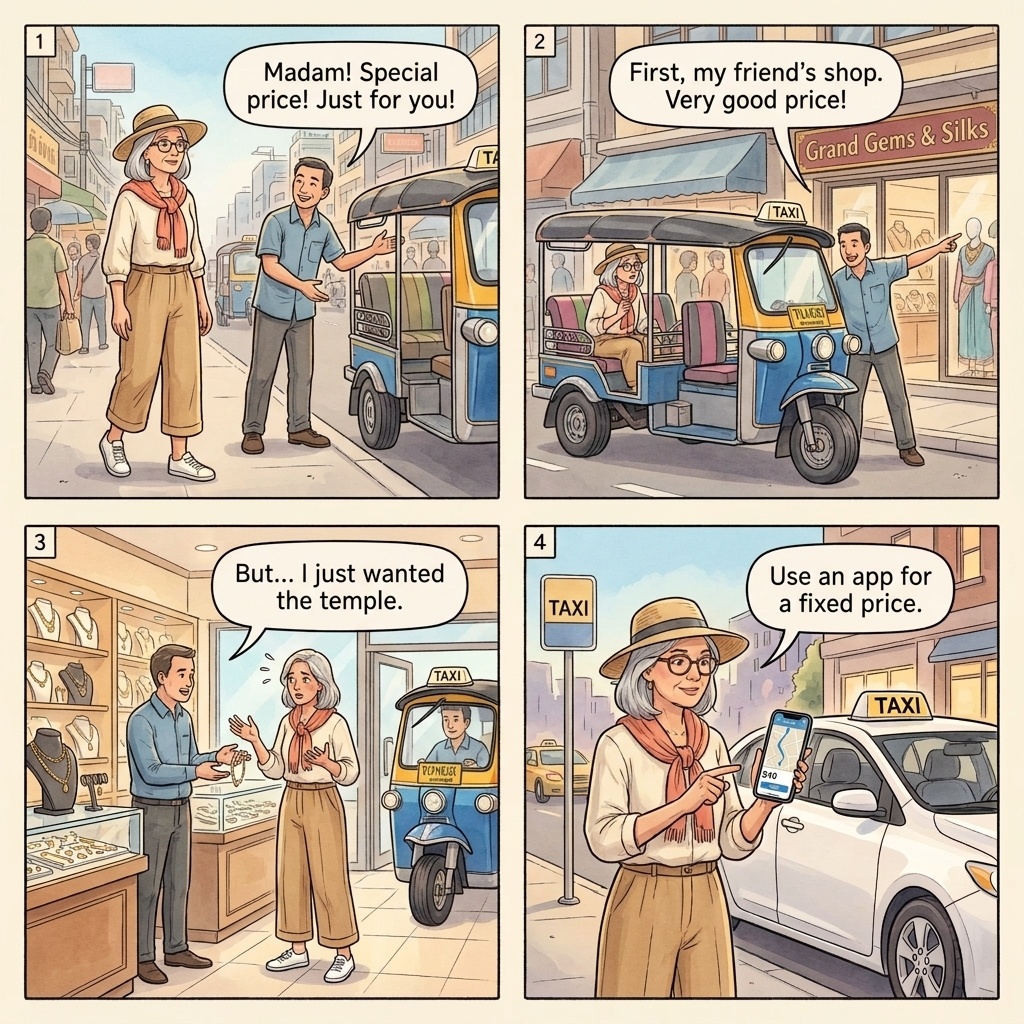
Tuk-tuk and rickshaw detour scams run in nine countries across sixteen documented variants. Four sub-types account for nearly every reported case. Closed-attraction redirects (the "Grand Palace is closed" line at Bangkok, the "Red Fort is closed for a government holiday" line at Delhi). Gem-shop and tailor-shop detours where the driver earns 30–40% commission on anything you buy. Carpet-shop and papyrus-institute loops in Hurghada, Jaipur, and Marrakesh. All-day "$5 tours" pitched on the riverfront in Phnom Penh and outside hotels in Siem Reap. The defense is the same in every country: verify the attraction's hours yourself, refuse any tuk-tuk priced under the legitimate floor, and use Grab or Uber or the local app for point-to-point trips so the driver cannot route you through a shop.
"The Grand Palace is closed today. Tuk-tuk, twenty baht, hidden temples."
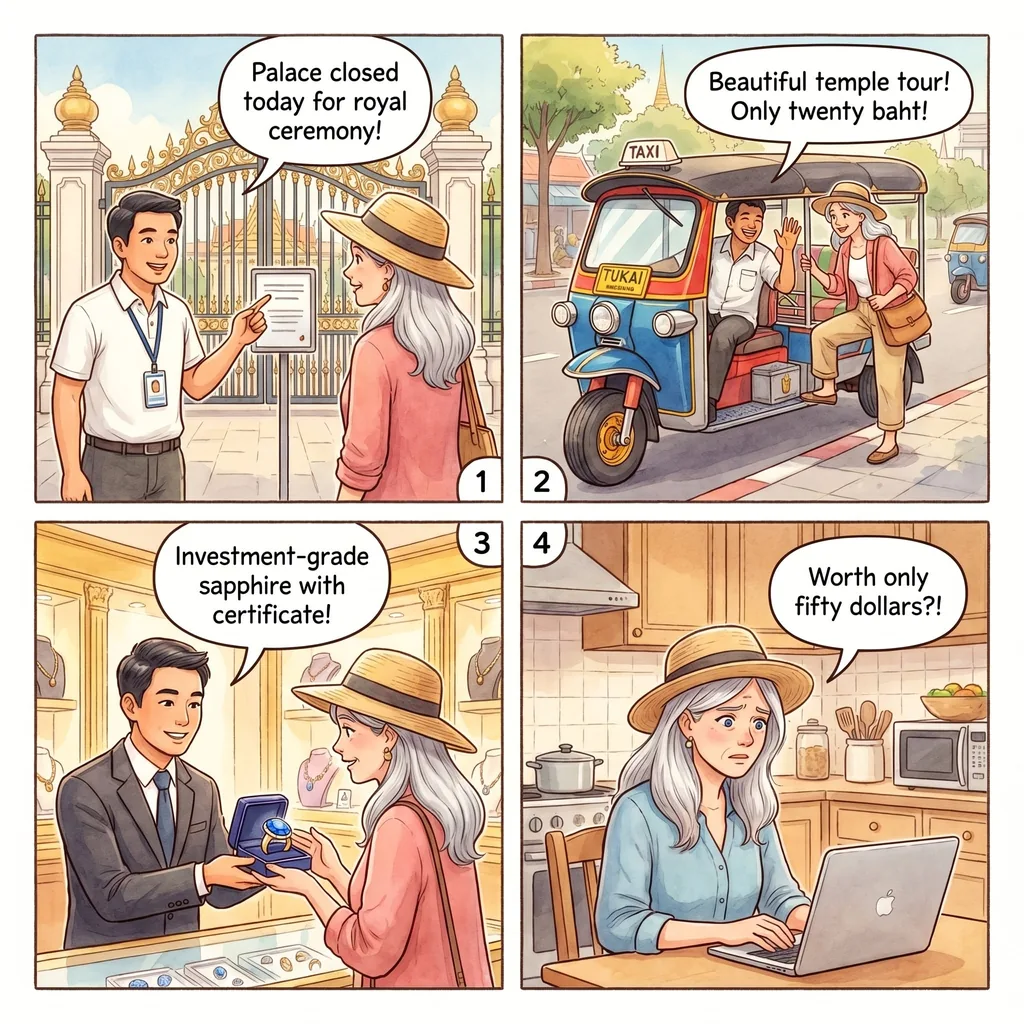
You walk up to the Grand Palace entrance on Thanon Na Phra Lan at 9:30 in the morning and a friendly man in a pressed shirt (laminated tourism-office lanyard, perfect English, introducing himself as a teacher) falls into step. "Welcome, sir, where are you from?" Before you can orient yourself he shakes his head. The Grand Palace, he explains, is closed until 1 p.m. for a royal ceremony. But he can help. There is a beautiful tour of "hidden temples" that fills the time perfectly; a tuk-tuk is just there, twenty baht, half-day loop.
You climb in. The first stop is a small wat you have never heard of. Then the driver pulls up at a "lucky Buddha" temple where a "lucky monk" tells you it is your auspicious day to buy gemstones, because the government, he explains, has declared today a tax-free export day for sapphires. By the time you exit the third stop you have signed a credit-card slip for 63,000 baht in sapphires destined for "shipping to your home address" and a 17,500-baht polyester suit that will arrive at your hotel mismatched at the shoulders the day before your flight home.
The Grand Palace was never closed. It is never closed mid-day for a royal ceremony. Royal ceremonies close specific halls, not the complex, and royalgrandpalace.th posts actual closure dates weeks ahead. r/Thailand runs a recurring warning pinned at the top of every "first-timer in Bangkok" megathread, and a post titled "I filmed the Grand Palace is closed scam in Bangkok" is the canonical evidence. The driver's twenty-baht fare was real; the rest of his revenue came from your sapphire receipt.
That is the Bangkok variant of one global script. The rest of this page is what just happened to you, why it works, and the exact phrases that shut it down: in eight languages, across nine countries.
Read the full Bangkok scam guide →Key Takeaways
The universal mechanism
The driver is not the principal. The shop is. Every variant of the tuk-tuk and rickshaw detour scam rides the same five-step social engineering. The driver's fare is the loss leader, sometimes literally a quarter of one US dollar. His revenue comes from a 30–40% commission paid by the gem store, the tailor, the silk village, or the carpet showroom on whatever you buy. Recognize the pattern and the local accent becomes obvious thirty seconds in.
- The fixer intercepts you on the walk in. A man in a pressed shirt (sometimes with a laminated tourism lanyard, sometimes claiming to be a teacher or "palace officer") falls into step before you reach the gate. He greets you, asks where you are from, asks where you are going. The premise of legitimate tourism is that you find the entrance yourself; the friendly stranger at the gate is the first move. The first 30 seconds tell you everything.
- The lie is delivered with a sympathetic tone. "The Grand Palace is closed today for a royal ceremony." "The Red Fort is closed for a government holiday." "Angkor Wat is shut at this gate, only the back entrance is open." Each lie is verifiable in 60 seconds on royalgrandpalace.th, asi.nic.in, or angkorenterprise.gov.kh, but the fixer is counting on you to take his word at the curb. The lie is the load-bearing element of every variant.
- The tuk-tuk is conveniently waiting. "But I can help. There is a hidden-temples tour, a tuk-tuk is just there, twenty baht." A driver pulls up before you have even decided. The price is impossibly low: 20 baht in Bangkok, $5 in Phnom Penh, 50 rupees in Delhi. You climb in because the math feels right and the alternative is uncertain. The price is the tell. At those prices, the driver's revenue comes entirely from shop commissions.
- The shop loop begins, disguised as sightseeing. The first stop is a real wat or a real monument; the second is a "lucky Buddha" temple or a "free demonstration"; the third is a gem store, a tailor, a silk village, or a papyrus institute where a salesman in a pressed shirt offers tea and runs a 20-to-40-minute pitch. By the time you exit you have signed for 63,000 baht in sapphires, $400 of "antique" carpets, or a polyester suit destined for international shipping. Tea is the tell. If the driver pulls into a shop you never asked for, get out before the door closes.
- The paper trail dissolves. The receipt is in the shop's name, not the driver's. The shop is a legal Thai or Cambodian or Indian business; refusing the charge is a credit-card dispute against a real merchant who delivered "goods as described." The driver vanishes the moment you pay, untraceable from a 20-baht ride. The Bangkok Tourist Police can recover partial refunds from a small list of cooperating gem dealers, but the recovery cost is high and most travelers eat the loss. That is why the script keeps working.
The four sub-variants
Different countries lean on different shops within the same family. Here are the four documented globally. Recognize the script in 30 seconds and you can shut it down before the tea pours.
1. The Closed-Attraction Redirect
A friendly fixer at the entrance to a major monument tells you it is "closed today" (for a royal ceremony at the Grand Palace, a government holiday at the Red Fort, a "VIP visit" at Angkor Wat) and offers a tuk-tuk tour instead. The lie is verifiable in 60 seconds on the official site, but the fixer counts on you to take his word at the curb.
What it feels like: a graceful, helpful intercept by an English-speaking stranger in a pressed shirt who saves you from "a wasted morning."
Most reported at: Bangkok Grand Palace, Delhi Red Fort, Siem Reap Angkor gates, Jaipur City Palace.
2. The Gem-Shop Detour
The route ends at a "tax-free export day" gem store where a salesman in a pressed shirt explains that today is a one-day government program. Sapphires, rubies, "lucky stones": the prices are 5–10× retail and the certificates are worthless outside the shop. The driver earns a 30–40% commission on whatever you sign for.
What it feels like: a charming back room with tea, a glass-topped cabinet, and a salesman who knows exactly when you are flying home.
Most reported in: Bangkok Bang Rak gem stores, Colombo Pettah, Galle Fort, Jaipur Johari Bazaar.
3. The Carpet, Tailor & Papyrus-Shop Detour
Same mechanic, different inventory. In Hurghada and Luxor it is a "government-certified papyrus institute"; in Marrakesh and Istanbul it is a back-room carpet showroom; in Bangkok Sukhumvit it is a "Super 120 wool" tailor; in Jaipur it is a marble-inlay workshop. The script is identical: tea, a 20-minute demonstration, an unbeatable family price, and a driver waiting outside on commission.
What it feels like: a cultural experience that morphs into a sales pressure scene, and the door is somehow always behind a salesman.
Defense: walk out the moment you realize you did not ask to be there. Tea you have not poured is not tea you owe a purchase for.
4. The All-Day "$5 Tour" Bait-and-Switch
A driver near your hotel offers a "full day, just $5" tour with a laminated map. The price is real but half the day is spent at gem stores, silk villages, and "family" shops outside town. By dinnertime you have seen three temples and four shops; the four shops are where the money is.
What it feels like: a generous deal that quietly compresses your sightseeing into a shopping itinerary disguised as a temple tour.
Defense: pay $20–25 for a real half-day tuk-tuk hire booked through your guesthouse, hand the driver a written list of stops, and refuse every detour.
Where it runs
The tuk-tuk and rickshaw detour scam is concentrated across South and Southeast Asia, with a North African branch in Egypt and Morocco. The eight countries below account for nearly every documented incident in our archive.
| Country | Documented variants | Iconic city pattern |
|---|---|---|
| 🇹🇭 Thailand | 5 | Bangkok Grand Palace gem-and-tailor tour · Sukhumvit Soi 11 tailor · Chiang Mai night-bazaar tuk-tuk |
| 🇮🇳 India | 4 | Delhi Red Fort closed-today rickshaw · Paharganj guesthouse-full · Jaipur Johari Bazaar gem store |
| 🇰🇭 Cambodia | 3 | Phnom Penh $5 day-tour commission loop · Siem Reap Angkor silk-village detour |
| 🇱🇰 Sri Lanka | 3 | Colombo Pettah gemstone steering · Galle Fort tuk-tuk mafia · Negombo airport overcharge |
| 🇪🇬 Egypt | 2 | Hurghada El Dahar papyrus institute · Luxor East Bank carpet workshop |
| 🇮🇩 Indonesia | 2 | Bali bemo "temple tour" silk-shop loop · Yogyakarta Malioboro becak driver commissions |
| 🇳🇵 Nepal | 1 | Kathmandu Thamel rickshaw "festival closed" thangka-shop redirect |
| 🇧🇩 Bangladesh | 1 | Dhaka Sadarghat CNG auto-rickshaw mosque-redirect tour |
Bar width is data-bound at 24 pixels per documented variant. Thailand, India, and Cambodia together account for 12 of 16 total variants, or three-quarters of the regional atlas.
Four more cities, four more variants
The Bangkok scene above showed the canonical closed-attraction redirect. Here are four more cities where the same mechanism plays out with regional accents: Delhi (Red Fort rickshaw redirect), Phnom Penh ($5 day-tour commission loop), Siem Reap (Angkor silk-village detour), and Colombo (Pettah gem-shop steering). Each links to the full city scam guide.
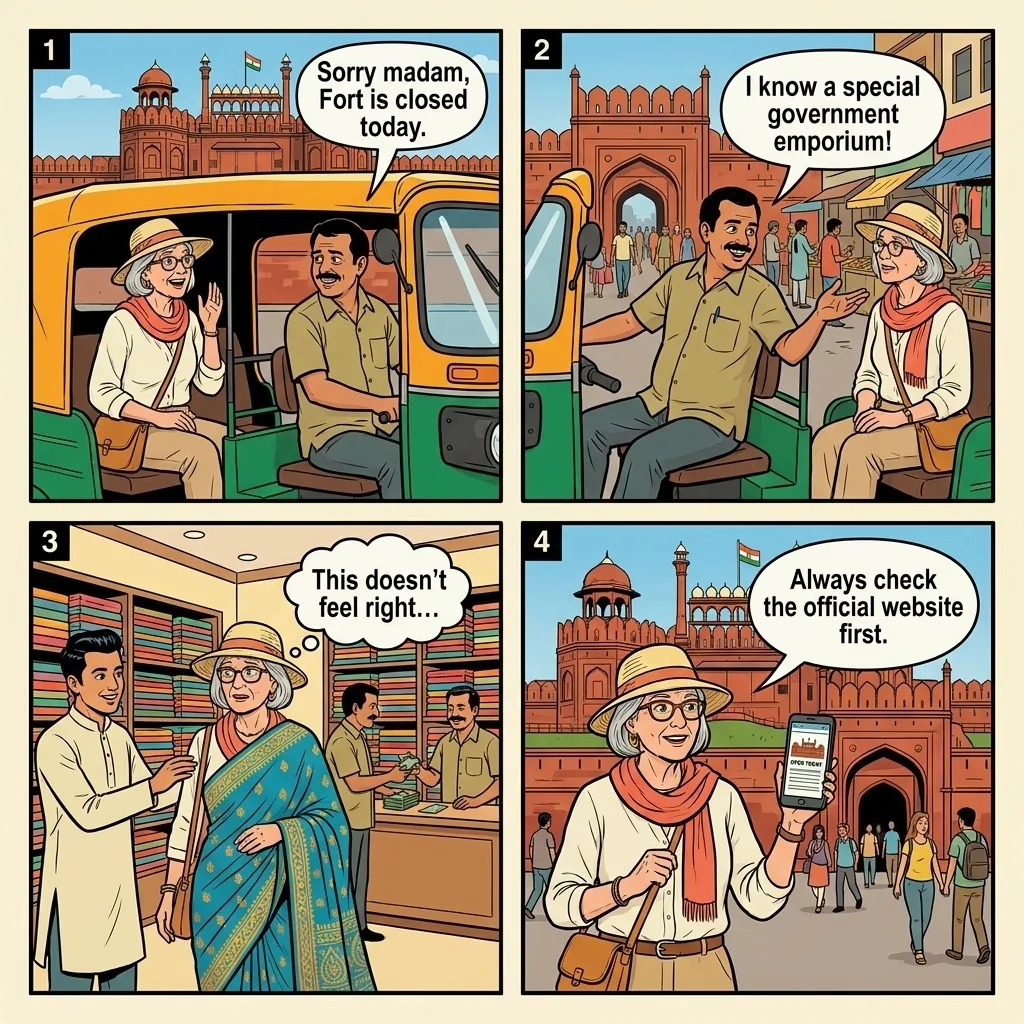
You climb into an auto-rickshaw at Connaught Place at 10:30 in the morning and ask for the Red Fort. The driver is friendly, agrees to 200 rupees on the meter, and starts north on Chandni Chowk. As you approach the Lal Qila gate he slows, points up at a vague "official notice" you cannot read, and tells you the monument is closed today: "government holiday," sometimes phrased as a VIP visit, sometimes as a "Republic Day rehearsal." He shakes his head sympathetically: a wasted morning. But he can help. He knows a "government emporium" in Karol Bagh with the same handicrafts you would have bought near the Fort, special end-of-month prices, only fifteen minutes away. The Red Fort is open every day except Mondays, posted in English and Hindi at asi.nic.in, and the closure he just described does not exist. The "government emporium" pays him 30–40% commission on whatever you sign for: a marble-inlay box that retails at 800 rupees becomes a 6,000-rupee "antique," a silk pashmina marked at 1,200 rupees becomes a 9,000-rupee "Kashmiri export-quality" purchase. The defense is to verify hours yourself before leaving the hotel, refuse any "closed today" claim at the gate, and use Uber or Ola for the actual ride. Both apps operate citywide and route you direct. If you must take a street auto-rickshaw, demand the meter ("meter chalu kar do, bhaiya"), photograph the dashboard rate card, and refuse any "better idea" detour the moment it is suggested.
Read the full Delhi scam guide →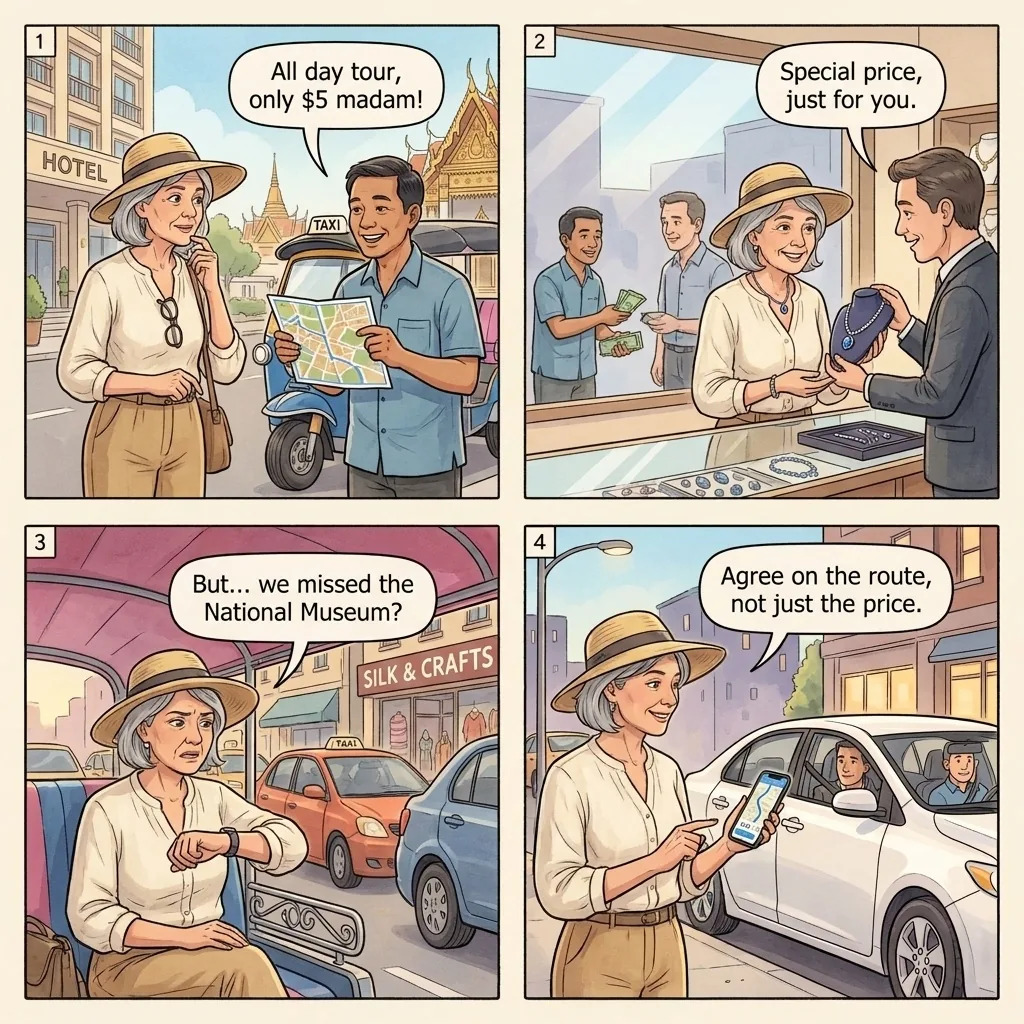
You step out of your hotel near Wat Phnom on your first morning in Phnom Penh and a tuk-tuk driver leaning against his ride waves you over with a wide smile and a laminated map of the city. "Full day, mister, just $5. Royal Palace, Wat Phnom, Russian Market, Killing Fields, Genocide Museum. Better than Grab. Grab cannot wait for you." The price is genuinely real and so is some of the route; the scam is the half of the day spent at "silk villages" twenty minutes outside town, "gem family workshops" near the Russian Market, and a "tax-free export" pearl shop where a salesman in a pressed shirt offers tea and runs a 30-minute pitch on freshwater pearls "from the family farm in Battambang." A pearl strand that retails at $40 in Bangkok becomes a $400 "wholesale family price" in Phnom Penh. Travelers report this version pinned at the top of r/cambodia "first-timer in Phnom Penh" megathreads almost monthly. The fix is straightforward: pay $20–25 for a real half-day tuk-tuk hire booked through your guesthouse, hand the driver a written list of stops on the morning of the tour, and decline every "small detour" politely but firmly. If you have already lost money to a pressure-sale shop, dial 117 for police, photograph the receipt, and contact your card issuer the same day. Cambodian Tourist Police can sometimes recover partial refunds from a small list of cooperating shops; the recovery cost is high but not impossible.
Read the full Phnom Penh scam guide →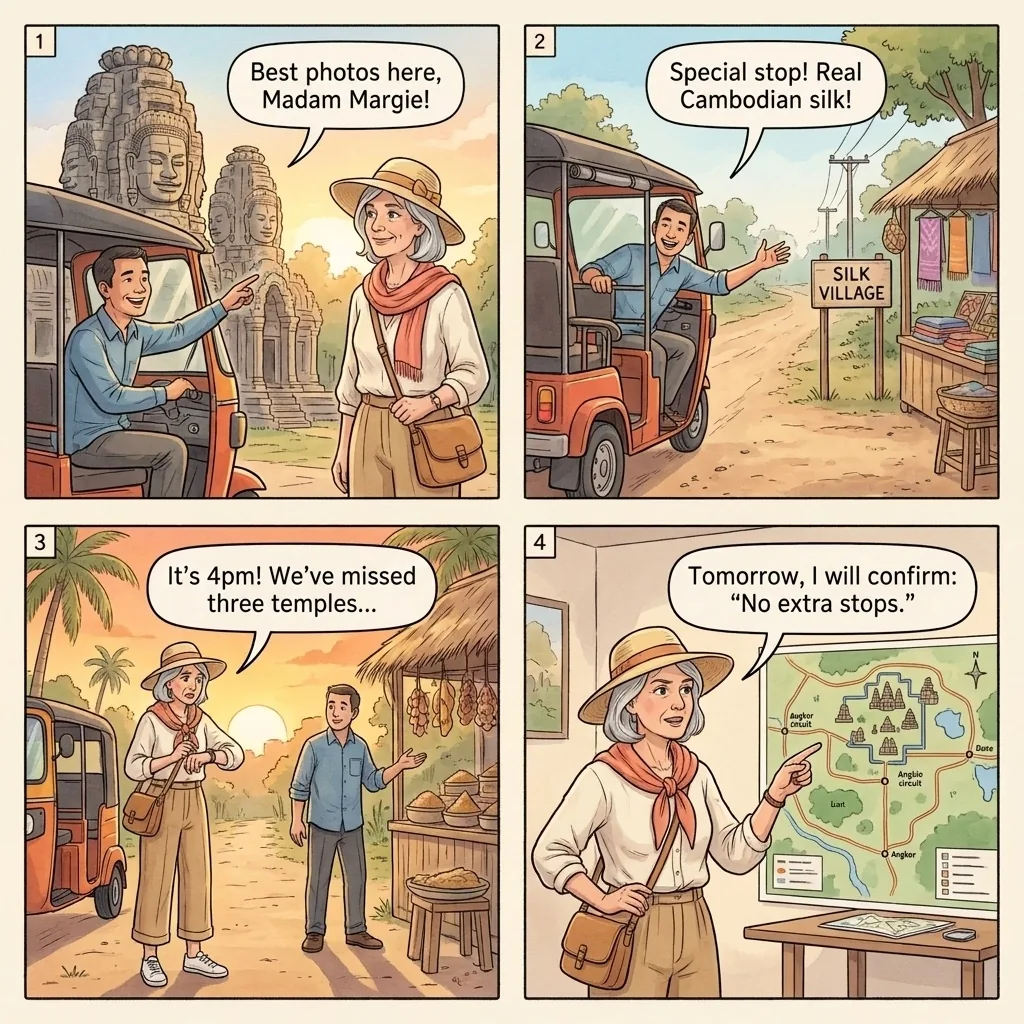
You hire a tuk-tuk at five in the morning to catch sunrise at Angkor Wat, and the driver (booked through your guesthouse for $20 for the full day) is friendly and prompt. Sunrise is everything you hoped. By mid-morning you have done the small circuit: Bayon, Ta Prohm, Banteay Kdei. Around 11 a.m. he announces a "small extra" stop he wants to recommend: a "silk village" half an hour out of Siem Reap where his cousin's family weaves traditional Cambodian silk, just a quick visit. The cousin runs a $200 silk-scarf workshop where a salesman explains the dyeing process for 25 minutes and then guides you toward a price list with discounts for "today only." The scam is not that the silk is fake (some of it is real Cambodian silk, woven on real looms) but that you are paying 4–6× the Russian Market price, and the driver earns 30–40% commission on whatever you sign for. The same pattern runs at "palm-sugar workshops," "stone-carving demonstrations," and "floating villages" outside Siem Reap. The defense, per r/cambodia veteran advice: hand your driver a written list of temples on the morning of the tour and say plainly: "These stops only, no shopping detours." Book through your guesthouse so the driver is accountable to the booking record. If your driver tries to add a silk village, palm-sugar workshop, or floating-village detour, decline politely but firmly. If pressure escalates, dial Tourist Police on 097-778-0002.
Read the full Siem Reap scam guide →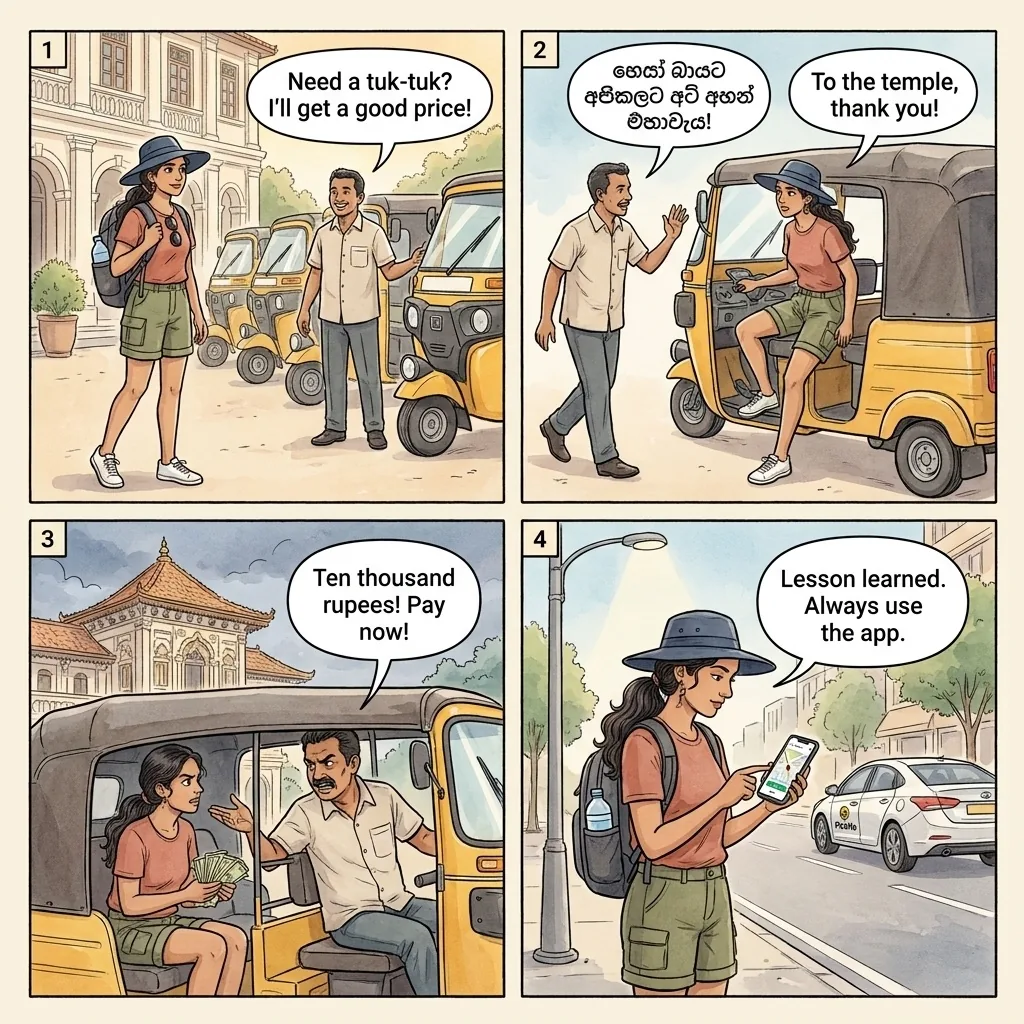
You step out of your hotel near Galle Face Green looking for a tuk-tuk to the Pettah market, and a well-dressed local on the pavement catches your eye. He recognizes your nationality, mentions an article in The Sunday Times about your country, and starts walking with you. Within minutes he has guided you toward a "famous Sri Lankan gem family" he says he knows personally, and an empty tuk-tuk pulls up alongside, as if by coincidence. The driver and the steerer are a team. The shop is in Pettah's narrow lanes near St. Lucia's Cathedral; inside, a salesman explains that today is a "tax-free export day" for Ceylon sapphires, and the appraisal certificate is "GIA-equivalent." A blue-sapphire ring that retails at $200 becomes a $1,400 purchase, payable on Visa with "shipping included." The driver earns a 30–40% commission and the steerer earns 10%. The Tuk-Tuk Mafia around Old Galle Face is organized and territorial; locals on r/srilanka have posted about drivers physically blocking PickMe app drivers who enter their territory. The fix is simple: use PickMe (Sri Lanka's ride-hailing app) for every trip. Price is fixed before you ride, the route is on the app map, and there is no English-speaking "helpful local" in the loop. If a stranger volunteers to "negotiate a tuk-tuk for you," that is the opener. Walk away.
Read the full Colombo scam guide →Red flags
If two or more of these signals show up in the first sixty seconds at the gate or curb, walk away. The compounding rule: a single signal can be coincidence; two signals are a script.
- A friendly stranger at the entrance tells you the monument is "closed today" for a ceremony or holiday
- The stranger wears a laminated "tourism office" or "palace officer" lanyard with no verifiable agency name
- A tuk-tuk is already waiting and the driver offers an improbably cheap price (20–50 baht, $5, 50 rupees) for a multi-stop tour
- The "tour" itinerary mixes one or two real temples with multiple "demonstrations" or "family workshops"
- The driver insists on adding a "silk village," "gem family," or "papyrus institute" stop you did not request
- A salesman offers tea before you have even browsed the merchandise
- The shop claims "today only" tax-free export prices or "government-certified" papers
- Credit-card receipts are printed in the shop's name, not the driver's, and "shipping" is included
- Your driver vanishes the moment you exit the shop, or is replaced by a different driver
The phrases that shut it down
Memorize one phrase per country before you fly. Refusal works because it signals you know the script. Drivers and fixers running the closed-attraction line retreat from informed travelers.
If you got hit
You're back at your hotel. The receipt in your bag is for $1,400 in sapphires you do not need, or a polyester suit "shipping in 48 hours," or a $400 silk scarf from a Phnom Penh "family workshop." Don't beat yourself up. The script is engineered to work on smart, traveled, well-prepared people: if it didn't, the shops wouldn't keep paying drivers commissions. Here is what to do, in order, while it is still fresh.
Find the receipt and photograph it on a flat surface. Photograph the shop's storefront if you can find it on Google Maps. Note the driver's tuk-tuk number if you have it. Then call the local tourist police within 24 hours. The report number is what your travel-insurance carrier and your card issuer need to process a claim. Most cities in this atlas operate a dedicated tourist-police line:
- Bangkok: Tourist Police 1155 (24/7, English-speaking). They keep a list of cooperating gem dealers and can sometimes recover partial refunds.
- Delhi: Indian Police 100, all-India emergency 112. The U.S. Embassy in New Delhi at Shantipath, Chanakyapuri is at +91 11-2419-8000 for passport-related emergencies.
- Phnom Penh: Cambodian Police 117, emergency 119. The U.S. Embassy in Phnom Penh is at +855 23 728 000; the UK Embassy at +855 23 427 124.
- Siem Reap: Tourist Police 097-778-0002, also reachable at 117. Keep their number saved before visiting Angkor.
- Colombo: Sri Lankan Tourist Police 1912; emergency 119; police 119/110.
- Hurghada / Cairo: Egyptian Tourist Police 126; tourism complaints +20 2-2391-2644.
For credit-card pressure-sale charges, open a dispute with your issuer the same day. Most major card networks recognize the "tuk-tuk gem-shop" pattern and reverse charges when you submit a tourist-police report number plus a photo of the receipt. American Express has the strongest record on this category; Visa and Mastercard reverse roughly 60% of well-documented cases within 30 days. The window is short: file within 60 days of the charge, ideally within 7.
Bring three things to the report: the receipt, a photo of the shop's storefront, and any record of the tuk-tuk (driver's name, vehicle number, your guesthouse booking record if you went through them). Even if the shop is never closed, the report puts your incident in the city's incident database. Cities do track these. The Bangkok Tourist Police arrested 18 gem-shop touts in 2024 from exactly this kind of paper trail.
Related atlas entries
Sister entries in the Scam Atlas. More entries shipping through Q2 2026; for now, browse the city-by-city archive.
Sources
- Bangkok Post, continuing coverage of Grand Palace gem-tour and Sukhumvit tailor-shop scams (2018–2025).
- The Nation Thailand, "Tourist Police arrest 18 Bang Rak gem-shop touts" (2024).
- The Hindu, "Delhi Police shuts down Karol Bagh emporium ring" (2023, with continuing coverage of Paharganj guesthouse-full hustle).
- Phnom Penh Post, "Five-dollar tuk-tuk tour: how the riverfront scam targets first-day arrivals" (2024).
- The Sunday Times Sri Lanka, multi-year coverage of Pettah gemstone steering and Old Galle Face tuk-tuk mafia (2019–2025).
- Al-Ahram Weekly, papyrus-institute and Hurghada El Dahar shop-tour coverage (2014–2024).
- Royal Thai Tourist Police, Grand Palace district enforcement bulletins (2020–2025).
- Cambodian Tourist Police, Angkor Park complaint register (2022–2024).
- r/Thailand, r/india, r/cambodia, r/srilanka, r/travel: continuing thread monitoring 2023–2026, including the pinned r/Thailand "Grand Palace closed scam" megathread, canonical evidence).
Get the full tuk-tuk playbook for your destination.
Each Travel Safety atlas covers every documented scam in one country: the tuk-tuk script you just read, plus 50 to 100 more, with the exact local-language phrases that shut each one down. Buy once, lifetime updates as scams evolve. $4.99 on Kindle.