
Key Takeaways
- The #1 reported scam is the Dotonbori Cabaret Bar Cover Charge.
- 1 of 8 scams are rated high risk.
- Use app-based ride services or official metered taxis — avoid unmarked vehicles near tourist areas.
- Never accept unsolicited offers from strangers near tourist sites in Osaka.
⚡ Quick Safety Tips
- In Dotonbori, be cautious of touts outside bars — while less dangerous than Tokyo's Kabukicho, some bars overcharge tourists who are led in by recruiters.
- Use the Osaka Metro or JR lines instead of taxis — taxi fares in Osaka are legitimate but expensive, and trains go everywhere tourists need.
- At Kuromon Market, prices have risen significantly for tourists — compare stall prices before buying, as some charge 3x for the same sashimi.
- Keep wallets secure in crowds at Shinsekai and Namba — while Osaka is very safe, pickpocketing in dense tourist areas has been increasing.
Jump to a Scam
- High Dotonbori Cabaret Bar Cover Charge
- Low 'Marc the Beggar' Loan Scam
- Low Coin Change Shortchange
- Low Fake Charity Clipboard
- Low Overpriced Tourist Lunch Menus
- Low Counterfeit Brand Goods in Shinsaibashi
- Medium The Post-Expo 2025 Ticket and Myaku-Myaku Merchandise Fraud
- Medium The Dotonbori Pickpocket and Phone-Hold Distraction
The 8 Scams

Cabaret and hostess bars around Dotonbori and Namba use street touts to recruit tourists, then bills arrive at ¥50,000+ with undisclosed cover fees, "table charges," per-snack fees on items placed unrequested, and inflated drink prices — all printed somewhere in Japanese but never explained in English before you ordered.
A friendly tout near Dotonbori or Namba waves you into what looks like a fun lounge — there's no posted English menu, the staff are warm, and you order a few drinks and chat through the evening. When the bill arrives it's ¥50,000. You're charged for an undisclosed cover fee, a "table charge," every snack placed in front of you (the small dish you didn't order is suddenly ¥1,500 each), and drinks at 3–5× normal Osaka prices. The charges were listed somewhere in tiny Japanese print but never explained — and bouncers materialize between you and the door once the bill arrives.
Red Flags
- Tout outside actively inviting you into the venue
- No English menu with clear prices shown before you sit
- Very friendly staff who continuously bring you unrequested items
How to Avoid
- Never enter a bar because someone outside is specifically recruiting you.
- Always ask for an English menu with all charges listed before ordering anything.
- Look up bars on Google Maps or Tabelog before entering rather than following touts.
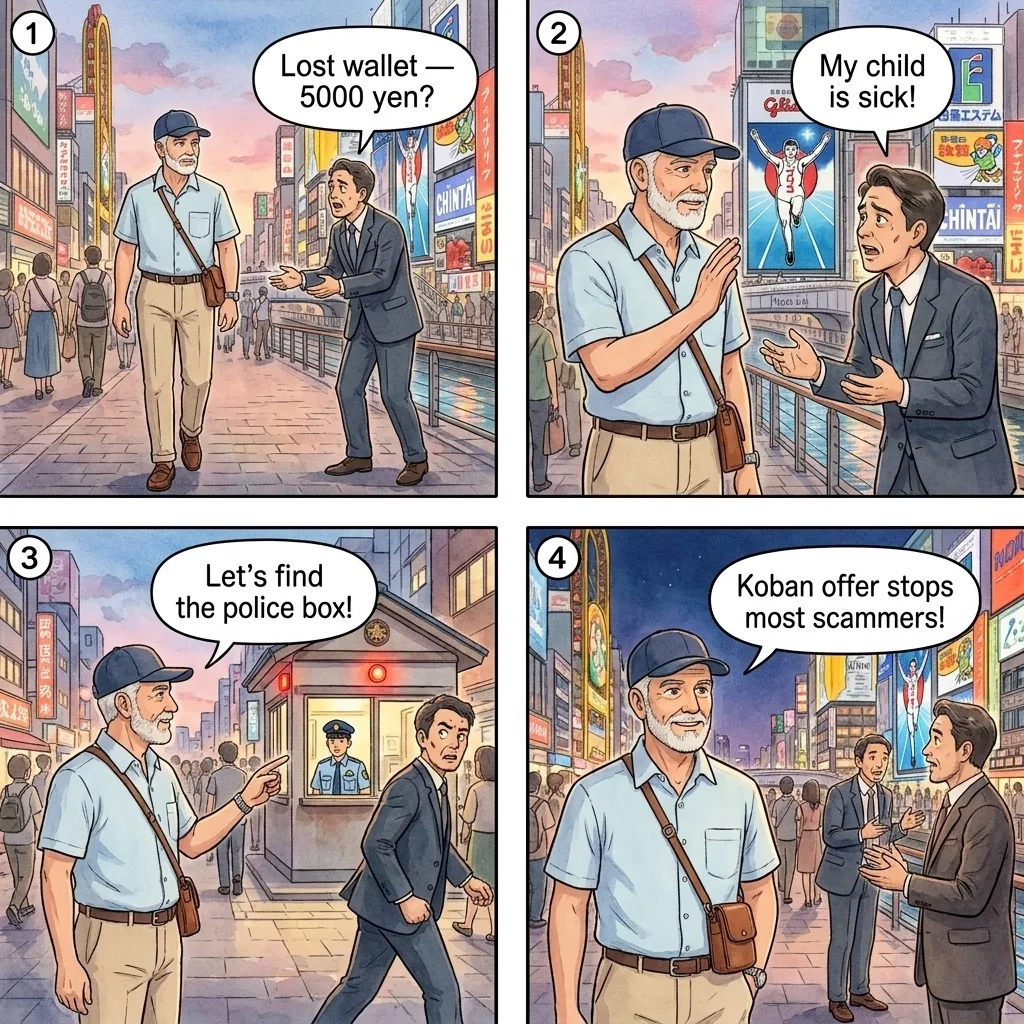
A specific repeat scammer who introduces himself as "Marc" works tourist areas around Shinsaibashi and elsewhere in Japan, claiming to be a fellow traveler who lost his wallet and needs to borrow ¥3,000 to get back to his hotel — promising PayPal repayment that never arrives. He's been spotted running the same script for years and is well-documented on travel forums.
A Western man in his 30s–40s approaches you in Shinsaibashi or another Osaka tourist zone, introducing himself often as "Marc." He explains he's a fellow traveler who lost his wallet and needs to borrow just ¥3,000 to get back to his hotel, promising to repay via PayPal. He's been spotted doing this repeatedly throughout Japan for years and is well-documented on travel forums — searching "Marc Japan scam" returns photos of him from multiple cities and dates. The PayPal repayment never comes.
Red Flags
- Fellow 'tourist' who approaches specifically asking for money
- Story involves a lost wallet or missing phone with a very specific amount needed
- Offers to repay via a digital service — a promise easy to break
How to Avoid
- This specific individual is well-documented — search 'Marc Japan scam' for photos.
- Never lend cash to strangers regardless of how convincing the story.
- Genuine emergencies can be handled by the nearest police box (koban).

Tourist-heavy souvenir shops and market stalls in Namba and Shinsaibashi shortchange the coin portion of yen change ¥100–¥500 per transaction by counting fast and exploiting that foreigners can't quickly distinguish ¥100 (silver, larger) from ¥10 (copper, smaller) coins. Japan is normally extremely honest, but tourist zones break the pattern.
You pay for a souvenir and the cashier counts out your yen change in a mix of coins and bills, placing them quickly in your hand. Japan is normally extremely honest, but at tourist-heavy shops some staff have learned to shortchange the coin portion knowing most foreign visitors can't quickly calculate yen coins. A ¥100 coin and a ¥10 coin look different but foreigners sometimes mix them up.
Red Flags
- Change returned very quickly without being counted aloud
- Mix of many small-denomination coins given as change
- Shop in very high tourist foot traffic area
How to Avoid
- Familiarize yourself with yen coin sizes and values before shopping.
- Count your coins in front of the cashier — this is socially acceptable in Japan.
- Use IC cards (Suica, ICOCA) for transit and cashless payment where possible.


Young people with clipboards work the Shinsaibashi shopping street and busy Osaka tourist zones with "children's charity" or "disaster relief" pitches, displaying emotional photos of suffering kids and pressuring cash donations of ¥1,000–¥5,000 — legitimate Japanese charities never solicit cash donations on the street.
A group of young people with clipboards approaches you claiming to represent a children's charity or disaster relief fund. They show you photos of suffering children and ask for a signature and donation. Japan is generally very safe, but this specific scam appears in busy tourist zones and your donated money goes nowhere near any charity.
Red Flags
- Group approaches tourists specifically rather than locals
- Clipboard petition shown alongside emotional photos
- Donation collected in cash with no receipt offered
How to Avoid
- Legitimate Japanese charities do not solicit cash donations on the street.
- Decline politely and keep walking — 'daijōbu desu' (I'm fine, thanks) works.
- If you want to donate to disaster relief, use official NGO websites.

Restaurants directly adjacent to Osaka Castle and Universal Studios price set lunches at ¥2,500 for what costs ¥800 elsewhere — a 3× tourist premium for identical Japanese fare, with English menus prominently displayed and prices hidden until you're seated. Walking 5 minutes away cuts prices 60%.
You visit Osaka Castle and stop for lunch at a restaurant right at the entrance. A set lunch that would cost ¥800 anywhere else is priced at ¥2,500 here. The food is identical to standard Japanese fare and there's nothing special about the experience except the proximity to the castle.
Red Flags
- Restaurant is physically attached to or directly facing a major tourist sight
- Prices not displayed outside — menu only available after entering
- English menu prominently displayed with simplified 'set meal' options
How to Avoid
- Walk five minutes away from any major sight before choosing a restaurant.
- Use Google Maps to find highly-rated restaurants in the surrounding area.
- Osaka's covered shopping arcades (Tenjinbashisuji, etc.) have excellent cheap food far from tourist premiums.

Shinsaibashi and Amerikamura small-stall and back-alley shops sell counterfeit luxury bags, branded sneakers, and watches at less than half retail price — convincing labels but customs-officer-spottable knockoffs that get confiscated at home borders, with importing them a customs offense in most countries.
A small shop or market stall in Shinsaibashi or Amerikamura offers a luxury bag or branded sneakers at less than half the retail price. The goods look convincing with all the right labels, but they're counterfeit. You bring them home only to have a customs officer confiscate them, or give them as a gift to someone who immediately notices the poor quality.
Red Flags
- Brand-name goods priced significantly below retail without a clear sale reason
- Goods sold from a small shop or market stall rather than an official brand outlet
- Seller is evasive about the product's origin or authenticity
How to Avoid
- If a price seems too good to be true for a luxury brand, it's counterfeit.
- Buy branded goods only from official stores or major department stores like Isetan or Hankyu.
- Importing counterfeit goods back to most countries is a customs offense.

Lookalike "Expo 2025" and Myaku-Myaku merchandise websites — flagged in a March 2025 Trend Micro report — sell counterfeit tickets that fail at gates and "limited-edition" plush merchandise at ¥7,500–¥15,000 that never arrives or comes as overseas knockoffs; the Expo closed October 2025, so any 2026 "ticket" site is a scam.
Osaka Expo 2025 ran from April to October 2025 and drew over 28 million visitors. During the run, fake websites mimicked the official Expo site, harvested card details, and sold counterfeit tickets whose QR codes failed at the gates; a March 2025 Trend Micro report flagged multiple fraudulent domains, and NHK and the Expo Association issued repeated warnings through the summer. Since the Expo closed, the same operators have pivoted to selling counterfeit Myaku-Myaku mascot merchandise through look-alike shops. A typical victim is charged around ¥7,500 to ¥15,000 for a "limited-edition" plush that either never arrives or arrives as a poor knockoff shipped from an overseas counterfeit factory.
Red Flags
- Website claims to sell "Expo 2025" tickets in 2026 — the Expo closed in October 2025
- Myaku-Myaku merchandise priced at ¥7,500+ for a "limited-edition" plush from a non-licensed shop
- Site URL doesn't match expo2025.or.jp (the official Expo Association domain)
- Payment requested via wire transfer or off-platform credit card form
- Social-media ads pushing "official Expo" or "Myaku-Myaku exclusive" merchandise
How to Avoid
- Expo 2025 closed in October 2025—any site selling 'Expo tickets' in 2026 is a scam.
- Buy Myaku-Myaku merchandise only from official licensees (Osaka Tourism Bureau shops and major department stores such as Hankyu, Daimaru, or Takashimaya).
- Never click Expo-themed ads on social media.
- If you've already paid a suspicious site, file a chargeback with your card issuer within 60 days and report the site to the Consumer Affairs Agency hotline on 188.

Pickpocket teams work the Ebisu Bridge Glico sign photo spot (500+ tourists at peak), Namba Walk, Shin-Osaka Shinkansen platforms, the Midosuji Line at rush hour, and Nara Park — they lift phones from back pockets and use a "hold my phone while I take a photo" distraction so an accomplice can rifle your bag. A 2025 NTV report featured a serial thief rearrested for a ¥35,000 wallet lift who told police "Japanese people are easy targets."
Thieves target dense crowds at Dotonbori's Ebisu Bridge Glico sign photo spot (500+ tourists) and Namba Walk. Phones in back pockets vanish; a classic distraction involves asking you to hold someone's phone while taking a photo — while distracted, an accomplice rifles your bag. A 2025 NTV report featured a 41-year-old serial thief rearrested after CCTV caught him stealing a ¥35,000 wallet from a backpack; he told police "Japanese people are easy targets."
Red Flags
- Crowded conditions at the Glico sign photo spot, Namba Walk, or Midosuji Line during rush hour
- A stranger asks you to hold their phone while they pose for a photo
- Someone presses against you in a tighter crush than the actual crowd density requires
- You feel a slight tug at your backpack zipper or rear pocket
- A group of strangers begins moving with you in unison through a dense space
How to Avoid
- Wear a cross-body bag with zipper forward or money belt under clothes.
- Never put valuables in back or open jacket pockets.
- At Glico Bridge, stand with back to wall, not in crowd center.
- Don't hand your phone to strangers—ask uniformed staff instead.
- On Midosuji Line during rush hour, wear backpack on front.
🆘 What to Do If You Get Scammed
📋 File a Police Report
Go to the nearest Japanese Police (Keisatsu) station. Call 110. Get an official crime report — you'll need this for insurance claims. You can also report online at keishicho.metro.tokyo.lg.jp.
💳 Cancel Your Cards
Call your bank immediately. Most have 24/7 numbers on the back of the card (keep a photo saved separately). Block any suspicious transactions before the thieves use your details.
🛂 Lost Passport?
Contact your nearest embassy or consulate. The US Embassy is at 1-10-5 Akasaka, Minato-ku, Tokyo. For emergencies: +81 3-3224-5000.
📱 Track Your Device
If your phone was stolen, use Find My (iPhone) or Find My Device (Android) from another device. Don't confront thieves yourself — share the location with police instead.
Frequently Asked Questions
You just read 8 scams in Osaka. The book has 52 more across 9 Japanese destinations.
Tokyo's ¥130,000 Kabukichō bar trap. Osaka's "friendly local" tea-house honeypot. Nara's aggressive deer. Kyoto temple donations. Every documented Japan scam — with the exact scripts, red flags, and Japanese phrases that shut each one down. Drawn from Japanese press, embassy advisories, and real traveler reports.
- 60 documented scams across Tokyo, Osaka, Kyoto, Nara & 5 more cities
- A Japanese exit-phrase card you can screenshot to your phone
- Updated annually — buy once, re-download future editions free
- Readable in one flight — $4.99 on Amazon Kindle