
Key Takeaways
- The #1 reported scam is the Ballarò Market Pickpocketing.
- 2 of 7 scams are rated high risk.
- Use app-based ride services (Uber, Bolt) or official metered taxis instead of unmarked vehicles.
- Never accept unsolicited offers from strangers near tourist sites in Palermo.
⚡ Quick Safety Tips
- Keep phones and valuables in secure pockets when in crowded areas.
- Use only licensed taxis or app-based ride services.
- Book tours and tickets through verified operators with online reviews.
- Keep a copy of your passport separate from the original.
Jump to a Scam
The 7 Scams
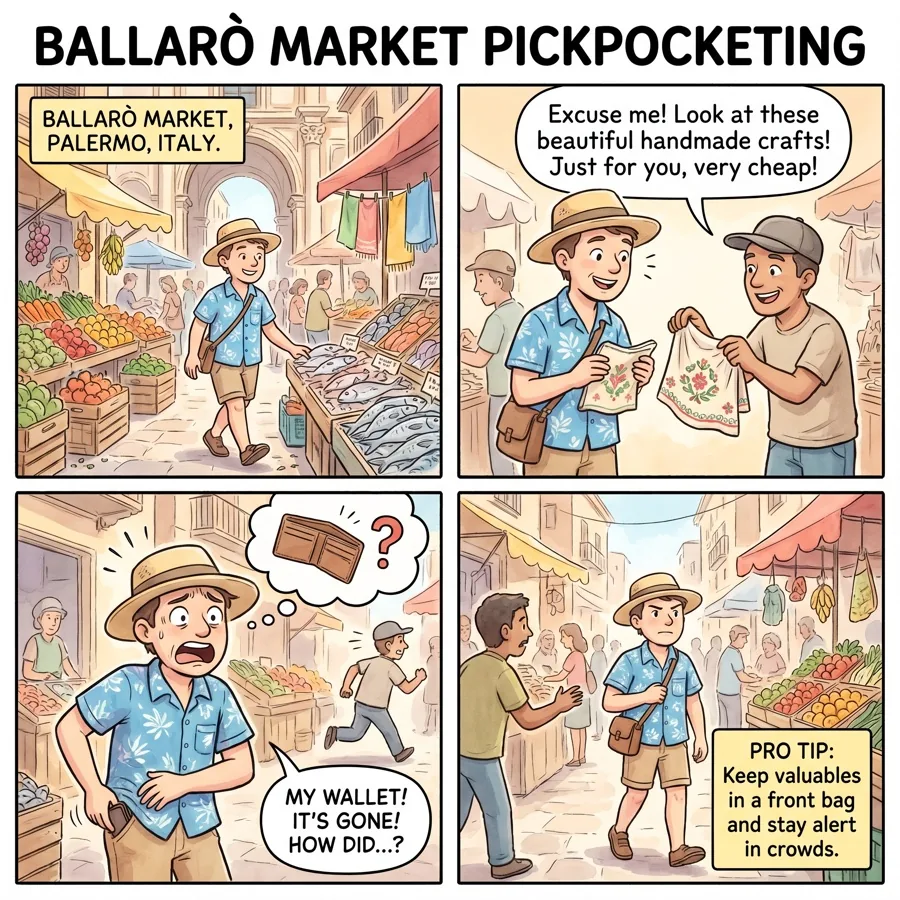
Pickpocketing and bag-snatching account for roughly 65% of tourist-related incidents in Palermo (TravelSafe Abroad), with Ballarò Market the daytime danger zone, La Vucciria the nighttime equivalent, and crowded city buses serving the centro storico the third front; scooter-based bag-snatching adds the road-side risk — wear a crossbody bag in front, never a back pocket for phone or wallet, and walk on the building side of sidewalks.
You are weaving through Ballarò Market in central Palermo, captivated by the piles of fresh fish, dangling swordfish heads, and vendors shouting prices. The stalls are packed shoulder-to-shoulder and the narrow alleyways funnel everyone into a slow-moving stream of bodies. You feel a gentle bump from behind — nothing unusual in a crowd this dense. Twenty minutes later, when you reach for your wallet to buy arancini from a street vendor, it is gone.
Pickpocketing and bag-snatching account for roughly 65 percent of tourist-related incidents in Palermo, according to TravelSafe Abroad's safety analysis. Ballarò Market is the single highest-risk location during daytime due to its extreme crowd density, while La Vucciria becomes the danger zone at night. One traveler account from The Happy Holidays blog describes riding a super-crowded bus from their hotel to the train station when the boyfriend realized his wallet had been stolen from his pocket after getting off. City buses, especially routes serving the centro storico, are prime hunting grounds because tourists are pressed against strangers and cannot monitor their pockets.
Scooter-based bag-snatching adds a separate road-side risk — thieves on mopeds ride past and grab shoulder bags from pedestrians walking near the curb, the same scippatori pattern that defines Naples but at lower frequency. Wear a crossbody bag on your front side and keep one hand on it at all times in Ballarò, La Vucciria, and Capo markets — never keep your phone or wallet in a back pocket, and use a money belt or deep zipped front pocket. Visit Ballarò mid-morning rather than at the lunchtime peak crush; walk on the building side of sidewalks (not the curb side) to defend against moped grabs; and if pickpocketed, file the denuncia at Polizia di Stato Palermo Centrale (Piazza Vittoria) within 24 hours for insurance documentation.
Red Flags
- An unnecessary bump or jostle in a crowd, especially from behind or to the side
- Someone presses against you in a market aisle even though there is space to pass
- A group seems to be coordinating movements around you — one blocks your path while others close in
- Your bag zipper has been partially opened without you noticing
- A scooter slows down near you on a narrow street while you carry a visible shoulder bag
How to Avoid
- Wear a cross-body bag on your front side and keep one hand on it at all times in crowded markets.
- Never keep your phone or wallet in your back pocket — use a money belt or deep front pocket with a zipper.
- Visit Ballarò Market during the less crowded mid-morning hours rather than the packed lunchtime rush.
- Walk on the building side of sidewalks, not the road side, to avoid scooter-based bag snatching.
- Leave your passport, extra cash, and spare cards in your hotel safe — carry only what you need for the day.
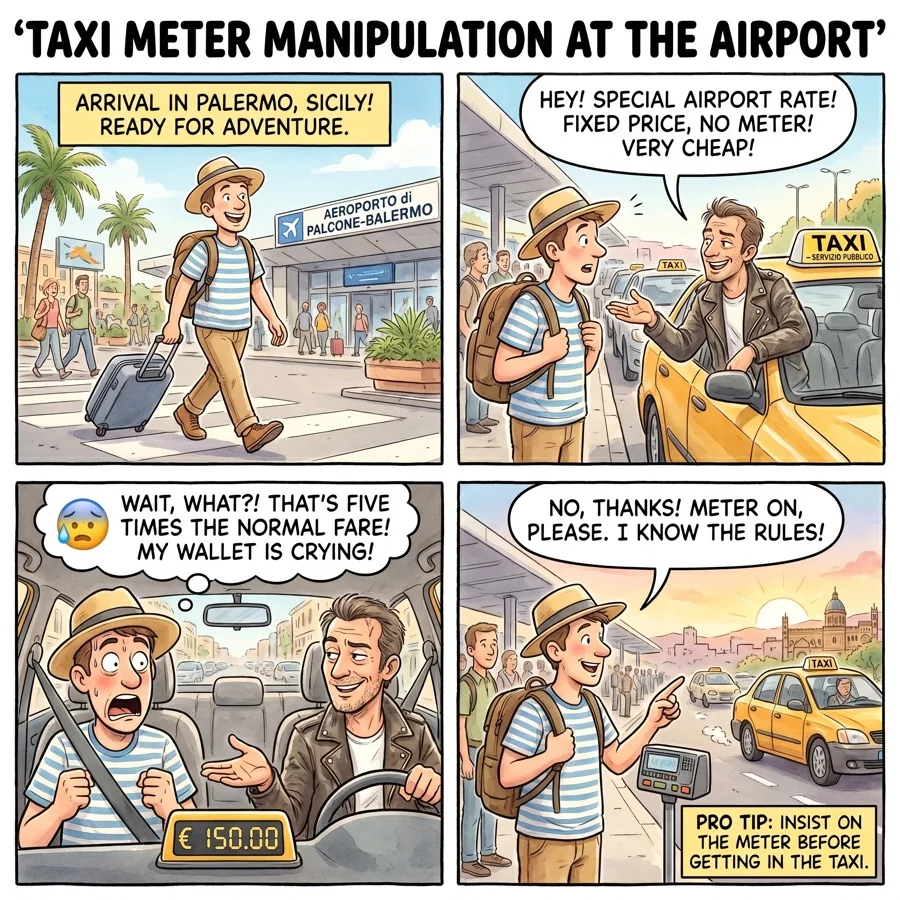
Palermo Falcone-Borsellino Airport (PMO) taxi drivers press a hidden meter button that spikes the fare by €10 at a time whenever passengers are distracted, and unlicensed drivers approach tourists inside the terminal with 'cheaper' offers that end up costing far more than the legitimate rate — the official PMO-to-city-center metered fare is €35–€45 depending on destination; only use taxis from the official outdoor rank, watch the meter throughout, or book FreeNow / IT Taxi for tracked transparent pricing.
You land at Palermo Airport and join the taxi queue outside the arrivals hall. The driver loads your luggage, starts the meter, and pulls onto the highway toward the city center. You gaze out the window at the Sicilian countryside, and when you glance back at the meter a few minutes later, it has jumped by €10 since you last checked. The final fare comes to nearly double what other travelers reported paying for the same 30-kilometer trip — a meter manipulation that's only obvious if you watched the increment, and most arriving travelers don't.
TripAdvisor's Palermo forum and Business Traveler magazine have documented this scam extensively. Drivers press a hidden button on the meter that causes the fare to spike by large increments — typically €10 at a time — whenever the passenger is distracted by scenery or their phone. A separate variant involves unlicensed drivers who approach tourists inside the airport terminal, claiming to offer cheaper fares than the official taxi rank. These drivers charge significantly more than the metered fare once you arrive. One Business Traveler forum post described a late-night arrival at PMO where unlicensed drivers inside the terminal quoted fares several times the legitimate rate.
The official airport-to-city-center metered fare is approximately €35–€45 depending on your exact destination, and any quote significantly above that is overcharging. Use taxis only from the official designated rank outside the arrivals hall — ignore anyone approaching you inside the terminal. Keep one eye on the meter throughout the ride and challenge the driver immediately if the fare spikes by a large round-number jump. Use the FreeNow or IT Taxi app for GPS-tracked rides with transparent pricing, photograph the taxi number, driver ID, and meter reading at the start of the ride for evidence, and know the airport-to-center fare in advance (€35–€45 metered).
Red Flags
- The meter jumps by a large round number like 10 euros in a single increment rather than ticking up gradually
- Someone approaches you inside the airport terminal offering taxi services rather than directing you to the official rank outside
- The driver claims the meter is broken and offers a fixed price that seems high
- The driver takes a route that seems unnecessarily long or goes through residential areas instead of the direct highway
- The car lacks official taxi markings, a visible license number on the door, or a roof-mounted taxi sign
How to Avoid
- Only use taxis from the official designated rank outside the arrivals hall — ignore anyone approaching you inside the terminal.
- Keep one eye on the meter throughout the ride and challenge the driver immediately if the fare spikes by a large amount.
- Use the FreeNow or IT Taxi app to book rides — these are tracked in real time, making meter manipulation far less likely.
- Know the approximate fare in advance: the airport to Palermo city center should cost roughly 35-45 euros.
- Photograph the taxi number, driver ID, and meter reading at the start of the ride so you have evidence if disputed.
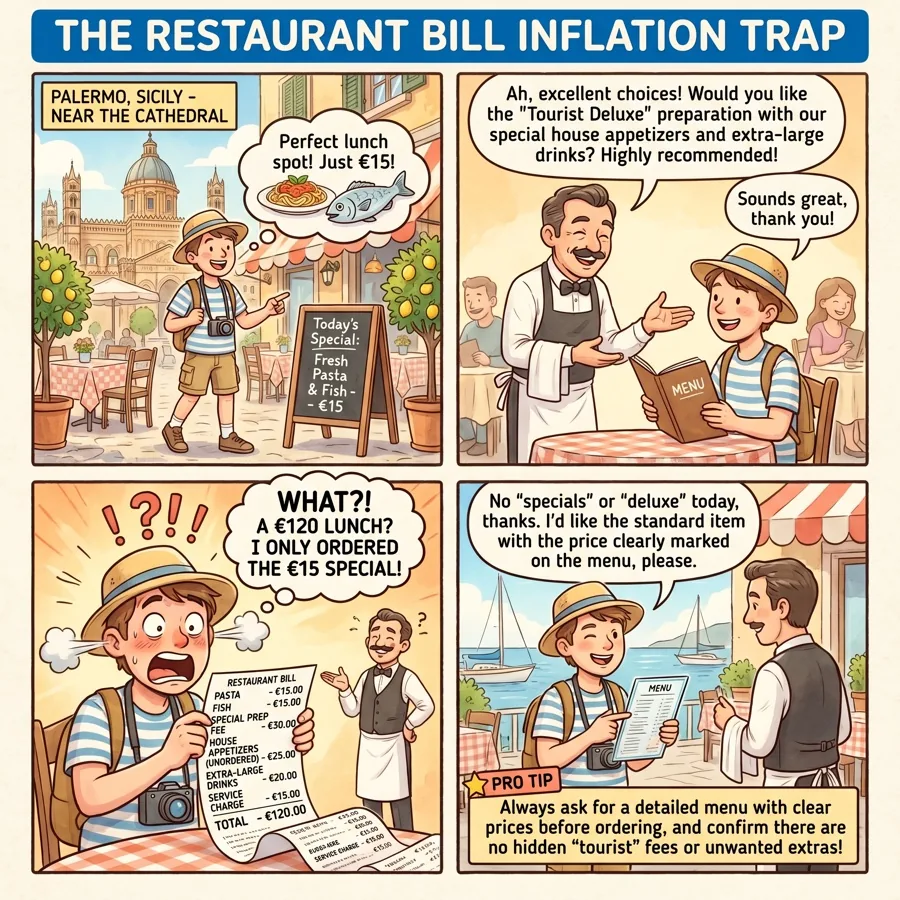
Palermo tourist restaurants near the Cathedral, Quattro Canti, Via Maqueda, and the La Cala waterfront pad bills with €5–€8-per-person 'coperto' (legitimate range €1–€3) stacked on top of a 15% servizio (illegal double-dipping), unrequested 'complimentary' bread and olives that appear charged on the bill, and seafood priced per etto (100g) instead of per kilogram so a €15-listed fish becomes €45 — always demand a menu with the coperto and servizio listed, refuse welcome items, and request a scontrino fiscale (fiscal receipt).
You sit down at an inviting restaurant near Palermo Cathedral and order pasta and fish. The waiter is charming, brings complimentary bread and olives, and suggests a lovely local wine. When the bill arrives, you find a coperto charge of €8 per person, a servizio fee of 15 percent, separate charges for the bread and olives you assumed were complimentary, and the fish priced by weight coming in at three times what you expected.
While the coperto (cover charge) is a legitimate Italian custom typically costing €1–€3 per person, tourist-trap restaurants in Palermo inflate it to €5–€8 and stack it on top of a separate servizio — a practice known as double-dipping that's actively contested under Italian consumer law. A TripAdvisor review of a Palermo restaurant called Sit & Mancia described the experience as a clear scam, with unexplained charges appearing on the bill. Italian consumer-protection guidance notes that legitimate restaurants always list the coperto and servizio on the menu, while scam restaurants hide these details or present them only on an Italian-language menu given selectively to non-Italian-speakers.
Another common trick involves seafood priced per etto (100 grams) rather than per kilogram, so a fish that appears to cost €15 actually costs €150 per kilo and your portion rings up at €45. Always read the full menu including the fine print before sitting down — check for coperto, servizio, and per-unit pricing on seafood. Ask the waiter explicitly whether bread and appetizers are included or charged separately before accepting them; if fish is priced by weight, ask the waiter to weigh it in front of you and confirm the total price before cooking. Eat where locals eat (one block off the major monuments), and always request the scontrino fiscale (fiscal receipt) — restaurants are legally required to issue one, and the request itself keeps pricing honest.
Red Flags
- The restaurant has no visible menu outside or the menu shown at the door differs from the one at your table
- Bread, olives, or appetizers arrive at your table without you ordering them — these are often charged
- Fish or seafood is priced per etto (100g) in small print rather than per kilogram
- The coperto listed on the bill exceeds 3 euros per person, or both coperto AND servizio charges appear
- A waiter or street tout aggressively beckons you inside rather than letting you browse the menu first
How to Avoid
- Always read the full menu including the fine print before sitting down — check for coperto, servizio, and per-unit pricing on seafood.
- Ask the waiter explicitly whether bread and appetizers are included or charged separately before accepting them.
- If fish is priced by weight, ask the waiter to weigh it in front of you and confirm the total price before cooking.
- Eat where locals eat — restaurants a few blocks away from major monuments typically offer honest pricing.
- Always request the fiscal receipt (scontrino fiscale) — restaurants are legally required to issue one and it keeps pricing honest.

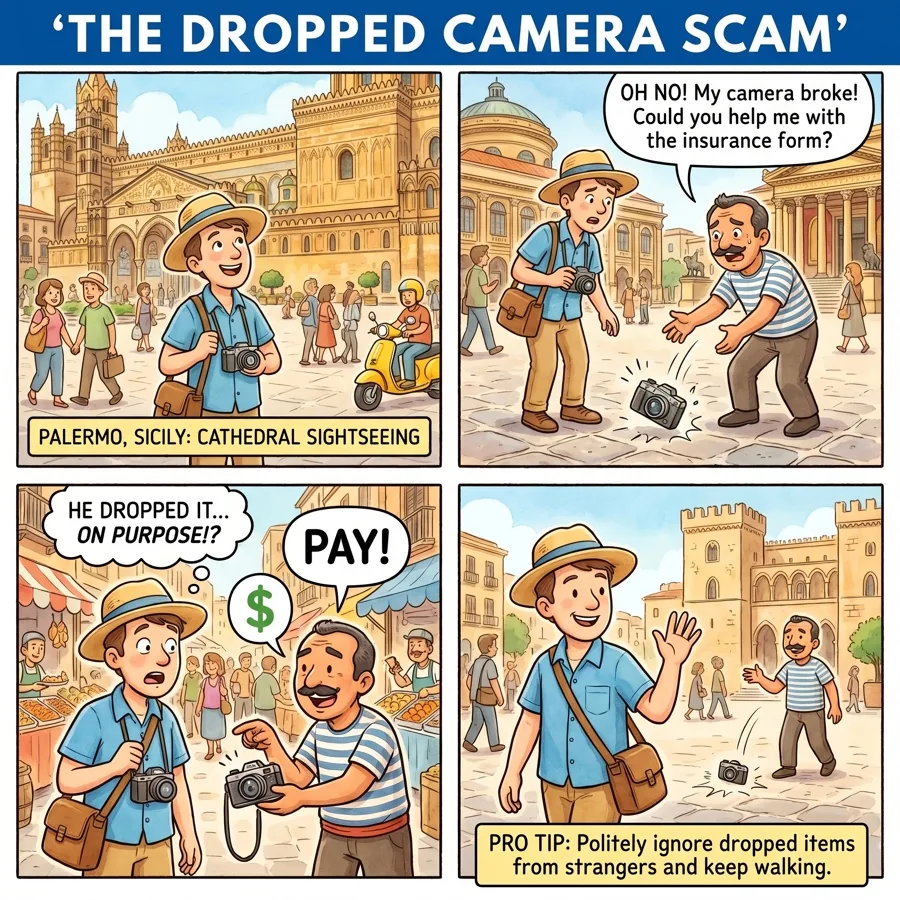
Palermo Cathedral, Teatro Massimo, Piazza Pretoria, and the Norman Palace area host a pre-broken-camera/phone scam — a 'friendly local' asks you to take their photo, fumbles the device deliberately as you hand it back, then demands €100–€300 for damage that was already there; the device is either pre-cracked or a worthless prop, and the demand counts on public-confrontation embarrassment to extract payment, but the scammer always disappears the moment you offer to call 112 (Carabinieri).
You are admiring the golden mosaics outside Palermo Cathedral when a friendly local approaches and asks if you would mind taking their photo. They hand you their camera or phone, you snap the picture, and as you hand it back, they fumble the catch and deliberately drop the device on the pavement. They pick it up, show you the cracked screen or broken lens, and demand you pay for the damage — typically €100–€300. They become loud and aggressive, drawing a crowd, and pressure you to pay on the spot to avoid a scene.
This scam has been documented across Sicily and mainland Italy by multiple travel safety sites. WikiForTravel's Palermo scam guide specifically identifies this as one of the city's most common tourist-targeting schemes. The camera or phone is either already broken before the interaction or is a worthless prop — the cracked screen was pre-existing. A Slovenian travel blog (Gorniško-Popotniški) describes how this exact scenario plays out near popular photo spots: the scammer counts on tourists being embarrassed by the public confrontation and paying quickly to make it stop.
Some variants involve the scammer placing a phone on a wall or ledge near you, then claiming you knocked it off — same payoff, different setup. Politely decline if a stranger asks you to handle their expensive-looking camera or phone — suggest they use a selfie stick instead. If you do take someone's photo, grip the device firmly with both hands and hand it back carefully rather than tossing it. If the scam plays out anyway, refuse to pay and calmly offer to call the police together (112 Carabinieri) — scammers will disappear immediately. Walk away if they become aggressive — they will not follow you to a police station, and you have no legal liability for an accident caused by someone handing you their belongings voluntarily.
Red Flags
- A stranger specifically asks you to take their photo rather than using a selfie stick or asking another local
- They hand you the device awkwardly, almost setting you up to drop it, or fumble as you return it
- The device is an older model that looks like it has seen better days — not something you would cry over
- They immediately become angry and loud, demanding cash rather than calmly assessing the damage
- They refuse to involve police or accept your offer to file an insurance claim, insisting on immediate cash
How to Avoid
- Politely decline if a stranger asks you to handle their expensive-looking camera or phone — suggest they use a selfie stick.
- If you do take someone's photo, grip the device firmly and hand it back carefully with both hands rather than tossing it.
- If the scam plays out, refuse to pay and calmly offer to call the police together — scammers will disappear.
- Walk away if they become aggressive — they will not follow you to a police station or involve authorities.
- Remember that you are not legally liable for an accident caused by someone handing you their belongings voluntarily.
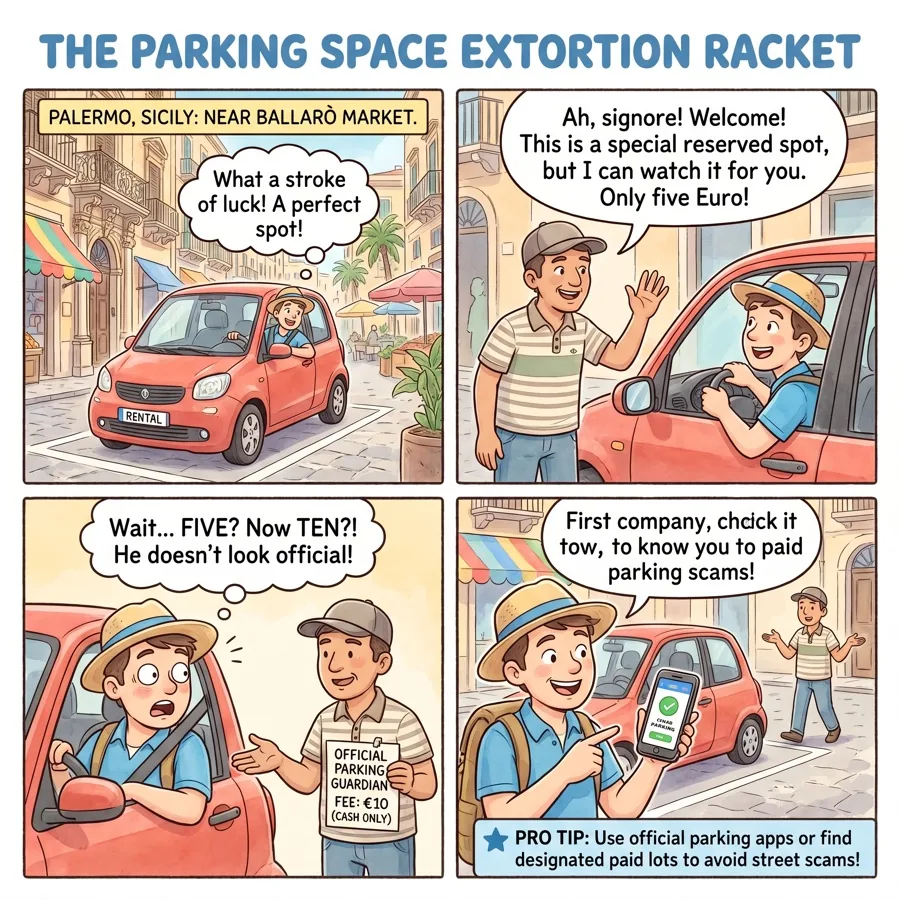
'Abusivi' (unauthorized parking attendants) work the side streets of Palermo's centro storico, near Palermo Centrale station, around Ballarò Market, and along Via Roma — demanding €1–€5 to 'watch' a parking space with no official markings, with implied threats of scratches or slashed tires if you refuse; some are connected to local criminal networks, the practice is technically illegal but rarely enforced, and the only reliable defense is using official AutoSilos garages or clearly-marked blue-line zones.
You drive into central Palermo and find a parking space on a side street. As you step out, a man approaches and tells you he is watching this block and it will cost €2–€5 to park safely. There is no sign, no meter, no official parking markings. If you refuse, he implies something might happen to your car — a scratched door, a slashed tire, a broken mirror. Most tourists pay because the cost seems small and the implied threat feels real.
This informal parking extortion is deeply ingrained in Palermo's street culture and has been documented by multiple travel writers and safety guides. A Slovenian travel blog notes that 'guys in the center of Palermo collect money for parking spaces even when it is nowhere written that it is payable,' and advises simply refusing and parking somewhere else. TravelSafe Abroad's Palermo safety rating flags unauthorized parking attendants as a common nuisance. The practice is technically illegal, but enforcement is rare. Some of these operators are genuinely connected to local criminal networks, while others are simply opportunists who have claimed a stretch of curb.
The typical demand is €1–€5, and most tourists pay rather than risk damage to a rental car — Italian police have periodically cracked down on these abusivi, but the practice persists because it is low-risk and highly profitable. Use official AutoSilos parking garages or lots with clear signage and printed tickets — they exist near the centro storico and accept card. If parking on the street, choose spaces near official parking meters or clearly marked blue-line zones (paid via the EasyPark app or street meter). If approached, politely decline and drive to another spot rather than negotiate — engagement signals you might pay. Avoid side streets in the Ballarò and Albergheria neighborhoods where this practice is most concentrated, and consider going car-free in the centro storico altogether (the historic core is very walkable and Palermo has affordable taxis via FreeNow).
Red Flags
- A man approaches your car the moment you park and claims ownership of the parking area despite no official signage
- He is wearing no uniform and has no official identification or printed receipts
- He mentions that cars get damaged in this area or implies your car will not be safe without his protection
- Other parked cars nearby have small pieces of paper tucked under the wiper — these are the extortionist's markers
- The amount requested varies depending on how touristy you look — locals pay less or nothing at all
How to Avoid
- Use official parking garages or lots with clear signage and printed tickets — AutoSilos near the historic center are reliable.
- If parking on the street, choose spaces near official parking meters or clearly marked blue-line zones.
- Politely decline and drive to another spot if approached — do not engage in negotiation.
- Consider going car-free in Palermo's center — the historic core is very walkable and taxis are affordable.
- If you must park on the street, avoid side streets in the Ballarò and Albergheria neighborhoods where this practice is most common.
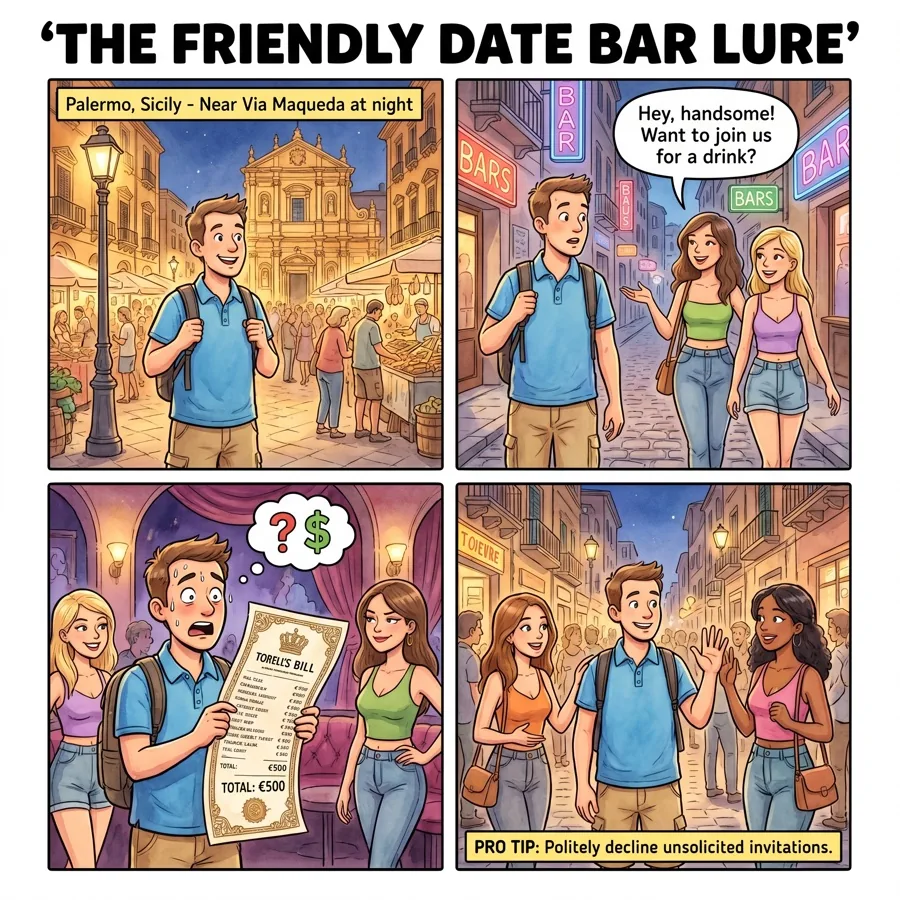
Bottakuri-style bar lures work the Kalsa district, Via Maqueda at night, and the streets near Piazza Pretoria — two attractive 'locals' strike up conversation in English, suggest 'a bar they know,' and the bill arrives at €400–€800 with a doorman blocking the exit and an ATM walk if you can't pay; the bars are unlicensed side-street establishments that exist solely for this scheme, the lure-team gets a cut, and solo male travelers are the dominant victim profile.
You are walking near Via Maqueda on a warm Palermo evening when two attractive and friendly young women strike up a conversation. They speak good English, seem genuinely interested in where you are from, and after ten minutes of easy chat, suggest grabbing a drink at a bar they know nearby. You walk together to a dimly lit place down a side street. The women order cocktails and a bottle of wine, and after a pleasant hour, the bill arrives: €400–€800. A large bouncer appears at the door, and it becomes clear that leaving without paying is not an option. If you cannot pay, they walk you to an ATM.
This scam has been reported across multiple Italian cities and is specifically documented in Palermo by several travel safety sources. WikiForTravel's Palermo guide warns that two 'friendly locals' make small talk and lead tourists to a partner bar where the bill comes in at 5–10× the normal price, with bar bodyguards escorting non-payers to an ATM if needed. The girls or guys receive a cut of the inflated bill, and the bars involved are typically unlicensed establishments in side streets that exist solely to run this scheme — they have no regular local clientele.
The Culture Trip's Italy scam guide confirms the pattern operates across Sicily, with victims typically solo male travelers targeted in the evening hours. Never follow strangers to a bar they suggest — if you want company, invite them to a busy, well-lit venue of your own choosing where you can verify prices first. Be skeptical of overly friendly approaches from attractive strangers in tourist areas, especially at night near Via Maqueda or the Kalsa. Always check the menu and prices before ordering anything at an unfamiliar bar — if there is no visible price list, leave immediately. Keep enough cash for a taxi home but leave your main bank cards at the hotel to limit ATM exposure, and if trapped with an inflated bill, threaten to call 112 (Carabinieri) — these operations are illegal and the staff usually back down rather than face police.
Red Flags
- Strangers approach you on the street and are unusually friendly and flirtatious, steering the conversation toward going for drinks
- They suggest a specific bar rather than letting you choose — the bar is always their partner establishment
- The bar is down a quiet side street with no visible menu, no listed prices, and few or no other customers
- A large doorman or bouncer is positioned near the entrance or exit of the bar
- The women order expensive drinks immediately and encourage you to do the same without discussing prices
How to Avoid
- Never follow strangers to a bar they suggest — if you want company, invite them to a busy, well-lit venue of your own choosing.
- Be skeptical of overly friendly approaches from attractive strangers in tourist areas, especially at night.
- Always check the menu and prices before ordering anything at an unfamiliar bar — if there is no visible price list, leave immediately.
- Keep enough cash for a taxi home but leave your main bank cards at the hotel to limit ATM exposure.
- If trapped with an inflated bill, threaten to call the police (112) — these operations are illegal and the staff will often back down.
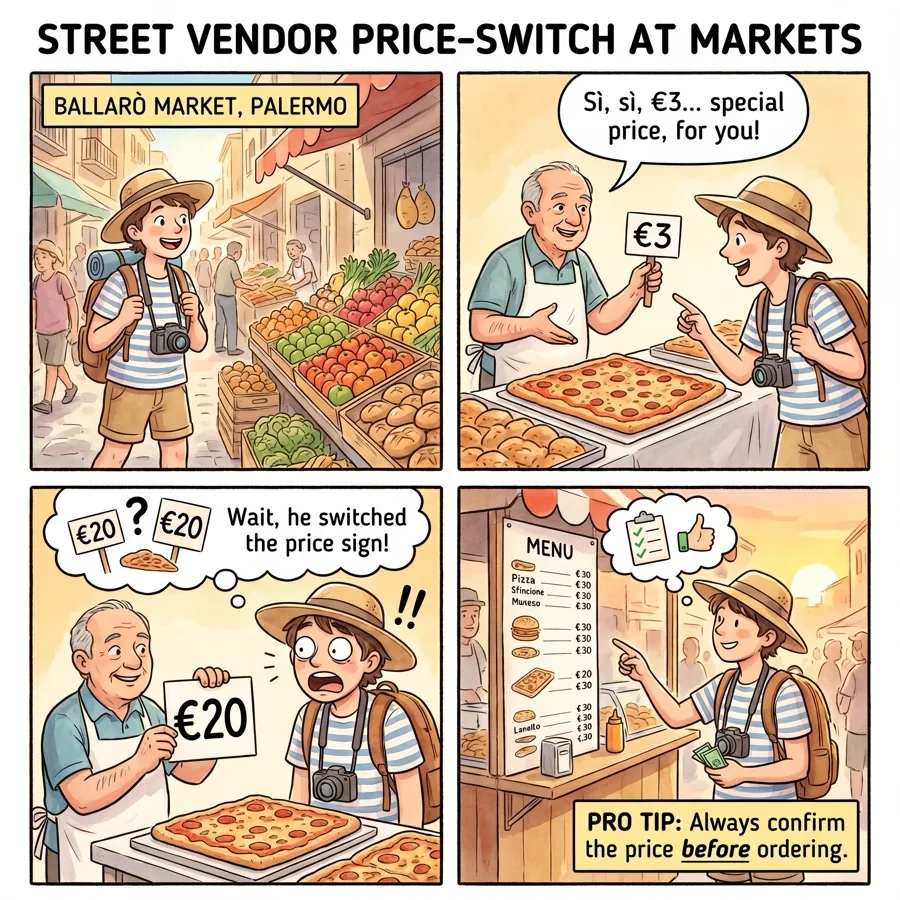
Ballarò, La Vucciria, and Capo market street-food vendors run a price-switch on sfincione (Sicilian pizza), panelle (chickpea fritters), and seafood — handwritten price cards 'refer to a smaller size,' the price was 'per etto' instead of per piece, or the price 'just went up' once the food is bagged in your hands; the markups are typically small (€3–€10) but compound across a market visit, so always confirm price + quantity in writing before the food leaves the counter.
You stop at a street food stall in Ballarò Market and point at the sfincione (Sicilian pizza) and panelle (chickpea fritters). The vendor slices a generous portion, bags it up, and tells you the total is €15. You are pretty sure the handwritten price card said €3 per piece, but the vendor insists the card refers to a smaller size, or claims the price is per etto (per 100 grams), or simply that the price has gone up. You pay because you already have the food in your hands and a queue of people is forming behind you.
Several travel blogs and safety guides document this bait-and-switch pricing at Palermo's famous street markets. Italia by Natalia, a Polish-Italian travel site, warns that some market sellers deliberately avoid displaying prices, counting on tourists who are too embarrassed to haggle once they are holding the food. The key trick is that the price you saw was either for a different item or the vendor changes the quantity without telling you. A Palermo safety guide on Traverve.com notes that street vendors sometimes attempt to overcharge visitors, though these situations are avoidable with awareness.
The amounts involved are typically small — a few euros at a time — but the frustration compounds when it happens repeatedly throughout a market visit. Always ask the price and confirm the total in writing before the vendor starts preparing or bagging your food. If seafood or meat is sold by weight, ask the price per kilogram and request they weigh it on a visible scale before you commit. Carry small bills and coins so you can pay the exact amount rather than handing over a large note and hoping for correct change. Watch what locals pay at the same stall — if they seem to pay less, the vendor is running a tourist tier, and if the final price differs from what was displayed, calmly point to the sign and insist on the advertised price or walk away.
Red Flags
- Prices are not clearly displayed or are handwritten in a way that could refer to multiple items or sizes
- The vendor starts preparing your food before confirming the price or quantity with you
- When you question the total, the vendor claims the displayed price is per weight rather than per piece
- Other tourists nearby are being charged different amounts for apparently the same items
- The vendor becomes impatient or dismissive when you try to clarify pricing before purchasing
How to Avoid
- Always ask the price and confirm the total before the vendor starts preparing or bagging your food.
- If seafood or meat is sold by weight, ask the price per kilogram and request they weigh it on a visible scale before you commit.
- Carry small bills and coins so you can pay the exact amount rather than handing over a large note and hoping for correct change.
- Watch what locals pay at the same stall — if they seem to pay less, the vendor is inflating prices for tourists.
- If the final price differs from what was displayed, politely point to the sign and insist on the advertised price or walk away.
🆘 What to Do If You Get Scammed
📋 File a Police Report
Go to the nearest Carabinieri / Polizia di Stato station. Call 112 (Carabinieri) or 113 (Polizia). Get an official crime report — you'll need this for insurance claims. You can also report online at poliziadistato.it.
💳 Cancel Your Cards
Call your bank immediately. Most have 24/7 numbers on the back of the card (keep a photo saved separately). Block any suspicious transactions before the thieves use your details.
🛂 Lost Passport?
Contact your nearest embassy or consulate. The US Embassy in Rome is at Via Vittorio Veneto 121, 00187 Rome. For emergencies: +39 06-4674-1.
📱 Track Your Device
If your phone was stolen, use Find My (iPhone) or Find My Device (Android) from another device. Don't confront thieves yourself — share the location with police instead.
Frequently Asked Questions
You just read 7 scams in Palermo. The book has 142 more across 20 Italian destinations.
Rome's tre-campanelle shell game. Venice's €2,500-a-day pickpocket ring. Florence's fake-leather trade. Capri's Blue Grotto fee-stack. Sardinia's €3,000 sand-in-your-luggage fine. Every documented Italy scam — with the exact scripts, red flags, and Italian phrases that shut each one down. Drawn from Repubblica, Corriere, Il Mattino, and Carabinieri arrest records.
- 149 documented scams across Rome, Venice, Florence, Milan & 16 more cities
- An Italian exit-phrase card you can screenshot to your phone
- Updated annually — buy once, re-download future editions free
- Readable in one flight — $4.99 on Amazon Kindle