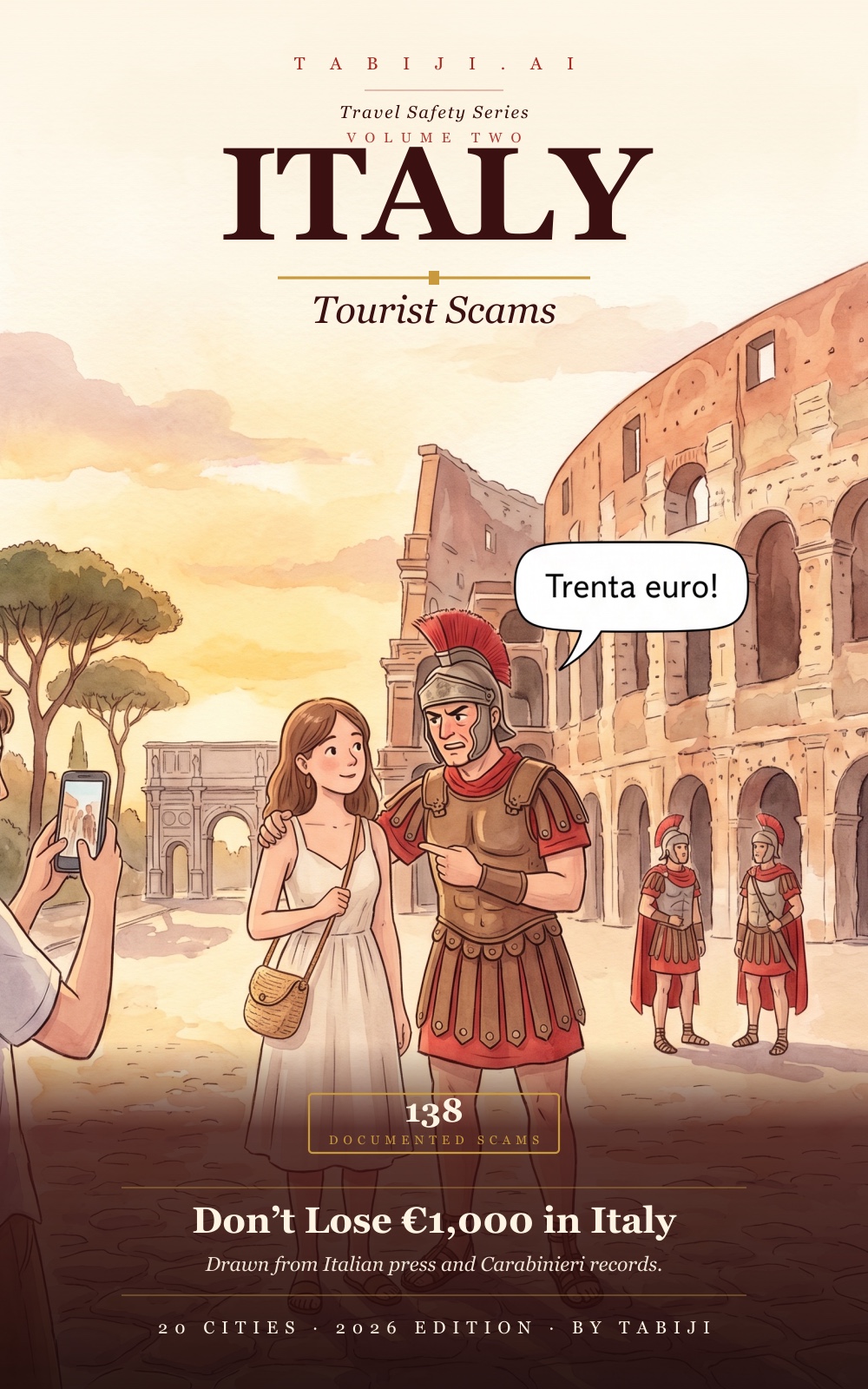
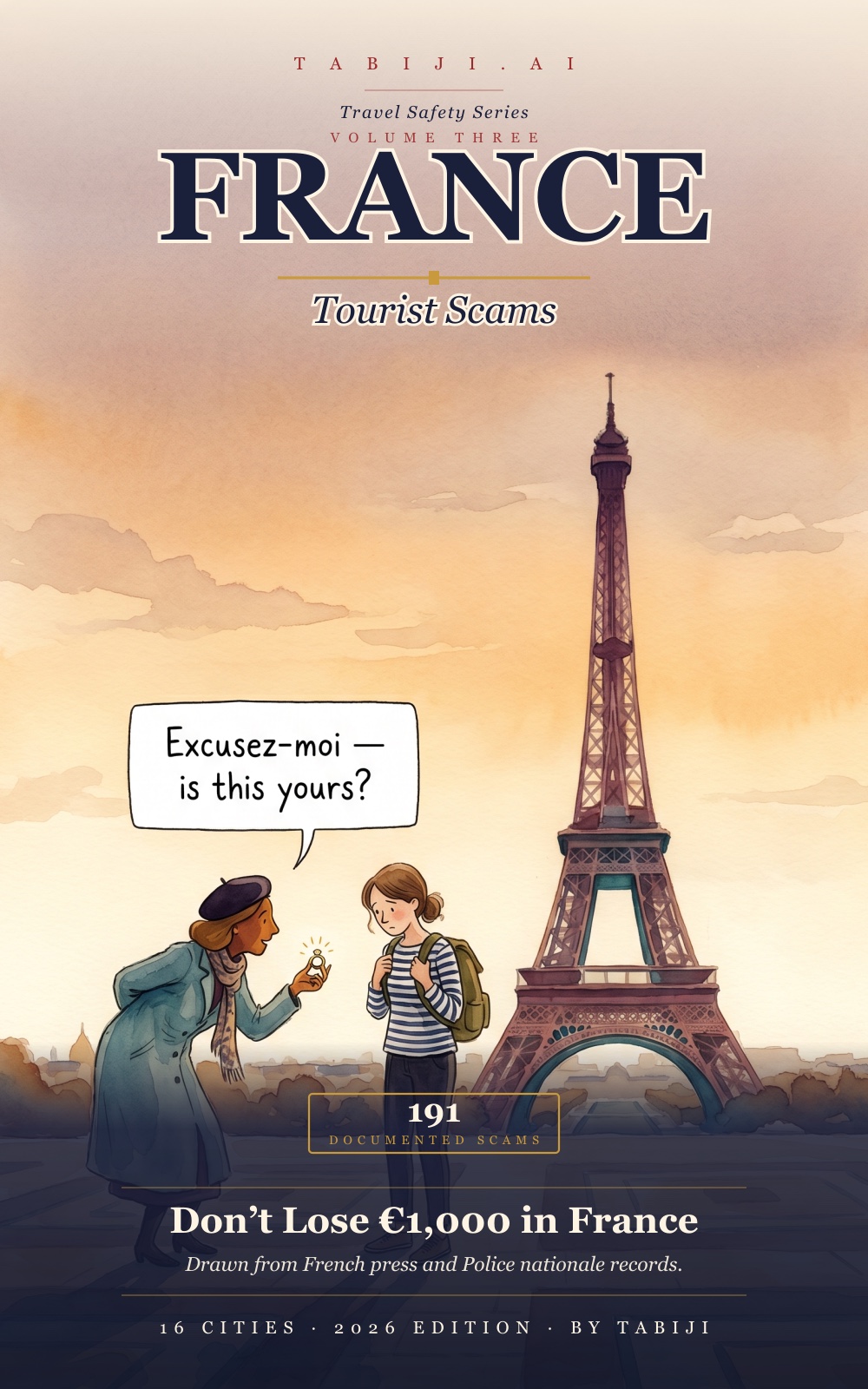
Cover Charge Surprises — Coperto, Otoshi, Couvert: the same scam, in 4 countries.
From a 12-EUR coperto in a Trastevere trattoria to a 5,000-yen otoshi in a Shinjuku izakaya, the same mechanic recurs: a small line item, sometimes named in the local language, sometimes not on the menu. The pre-order rule, the on-menu rule, and the bill-audit rule defeat every variant.


Cover charge surprises run five named variants across 4 countries: Italian coperto (1.50-3.50 EUR legitimate; tourist-trap inflation to 5-12 EUR in Rome Trastevere, Florence Duomo, Venice San Marco; illegal in Lazio since 2006), Japanese otoshi or tsukidashi (300-700 yen legitimate; tourist-trap inflation to 1,500-5,000 yen in Shinjuku Kabukicho, Roppongi), French couvert (largely illegal under Code de la Consommation; service compris is the standard), German Gedeck or Brotzeit (2-5 EUR legitimate; tourist-trap inflation to 8-15 EUR in Munich Marienplatz, Berlin Hackescher Markt), and generic table fee (Spanish cubierto, Portuguese couvert with pre-set bread / olives / tuna pate, Greek mezedes fee, Croatian kuvert). The universal defenses are three rules: the on-menu rule (real cover charges are in writing on the menu; undisclosed = recoverable), the pre-order question (ask before ordering: "is there a coperto / otoshi / couvert / Gedeck?"), and the bill audit (compare bill cover charge to menu disclosure; refuse the difference). Italian Lazio law since 2006, French Code de la Consommation, German Verbraucherzentrale, and the credit-card chargeback corridor are all available recovery paths.
"Coperto dodici euro a persona, signore. It is what we do here."
You and your travel partner sit at a small table on Vicolo del Cinque in Trastevere. The waiter is polite, brings the menu, lists the specials in fast Italian-accented English. You order two primi (cacio e pepe, amatriciana), a half-liter of house red, and water. The bill arrives forty-five minutes later. Total: 84 EUR. You expected about 50.
You read the bill. The pasta is 14 EUR each (you remember the menu listed 12). The wine is 18 (you remember 14). And there is a line at the bottom: COPERTO 12,00 (x 2 = 24 EUR). Twelve euro per person for the coperto.
You pull the menu back over. The coperto disclosure is in small print at the bottom: 2 EUR per person. Not 12. The pasta and wine prices on the menu match what you ordered: 12 and 14, not 14 and 18. The bill is inflated by 30 EUR off-menu.
This is the coperto inflation variant, the most-documented Italian cover-charge scam. The Italian region of Lazio (which contains Rome) has had a law banning the coperto entirely since 2006; many trattorie still charge it citing tradition, but the inflated version is twice illegal: the law banning the coperto, and consumer-fraud statutes against off-menu pricing.
The defense is three rules. The on-menu rule: photograph the menu before ordering; the printed prices are the binding contract. The pre-order question: ask "c'e un coperto?" before ordering; the server's answer becomes the binding price. The bill audit: compare bill to menu line by line; refuse off-menu charges politely; if escalated, call the Italian tourist police (113) or the Carabinieri (112).
That is the coperto inflation variant of the cover-charge-surprise family, executed at one of the most-documented locations in Europe. The rest of this page is the five-named-variant playbook, the four other countries where it runs in different forms (Tokyo Shinjuku otoshi, Paris Quartier Latin couvert, Munich Marienplatz Gedeck, Lisbon Bairro Alto couvert), and the three rules that defeat every variant.
Read the full Rome scam guide →Key Takeaways
The on-menu rule, the pre-order question, the bill audit
Every variant of this family is defeated by the same three rules. The on-menu rule: real cover charges are disclosed in writing on the menu, typically in the footer or in small print. Undisclosed cover charges are illegal in Italy (Lazio region, since 2006), illegal in France (Code de la Consommation), and recoverable as undisclosed charges in Germany (Verbraucherzentrale) and Japan (consumer protection law). The pre-order question: ask before ordering, in the local language, "is there a coperto / otoshi / couvert / Gedeck?" The server's answer becomes the binding price for the bill audit. The bill audit: compare the bill cover charge to the menu disclosure; refuse the difference; escalate to credit-card chargeback if the restaurant will not correct.
The first rule addresses the disclosure asymmetry. Real cover charges have legal frameworks; the variants exploit tourists' unfamiliarity with the local frameworks. Italian coperto in Lazio is legally banned since 2006 (Lazio regional law on consumer protection); many Roman trattorie still charge it citing tradition, but the law makes the charge unenforceable on demand. Inflated coperto (above 3.50 EUR per person) is on its face consumer fraud; correction is mandatory. French couvert was largely abolished by the service compris reform; modern French restaurants charge service compris, not couvert. German Gedeck remains legal but must be on the menu; the Verbraucherzentrale (consumer protection bureau) accepts complaints for undisclosed Gedeck.
The second rule addresses the pre-order asymmetry. Servers cannot legally change the cover charge after the order is placed; their pre-order statement is the binding price. The pre-order question costs nothing and provides court-admissible evidence (your phone-recorded answer) for any later dispute.
The third rule addresses the bill-audit asymmetry. Many tourists do not audit the bill at the table because of language unfamiliarity or social pressure to leave. The audit takes 60 seconds; comparing the cover charge line to the menu disclosure and the dish prices to the menu prices catches 95%+ of off-menu inflations.
The fourth defense, in Portugal, Spain, Greece, Croatia, and southern France: refuse the pre-set platter. Many restaurants in these countries place "free" bread, olives, tuna pate, or small appetizers on the table without asking. Returning the untouched platter before consumption removes the charge from the bill. Once any item is touched (even one olive), the platter is considered consumed and the charge stands.
The fifth defense, when escalation fails: the credit-card chargeback. Visa, Mastercard, and Amex all recognize undisclosed-restaurant-charge as a chargeback category under "item not as described" or "billed amount differs from agreed amount." Italian, French, German, and Japanese consumer-protection laws all support refund of undisclosed restaurant charges; the chargeback corridor is the most efficient path for tourists who cannot return to the restaurant.
The five named variants
Cover charge surprises run five named variants across the major tourist food cultures. Each has a signature country, a signature term in the local language, and a signature legal framework.
1. Italian coperto and pane (Italy)
Per-person charge for table linen, silverware, and bread, traditionally 1.50-3.50 EUR. Tourist-trap trattorie in Rome (Trastevere, Vatican area, Trevi), Florence (Duomo, Ponte Vecchio, Santa Croce), Venice (San Marco, Rialto), and Naples (Spaccanapoli) inflate to 5-12 EUR per person. Lazio region (Rome) banned the coperto entirely in 2006; many restaurants still charge it citing tradition. Defense: photograph menu before ordering; ask "c'e un coperto?"; refuse off-menu inflation; escalate to Carabinieri 112 if needed.
2. Japanese otoshi / tsukidashi (Japan)
Compulsory small appetizer charge in izakaya, traditionally 300-700 yen per person. The dish (pickled vegetables, bean sprouts, octopus salad) arrives with the first drinks. Tourist-trap izakaya in Shinjuku Kabukicho, Roppongi, Shibuya inflate to 1,500-5,000 yen per person without disclosure. Defense: ask "otoshi wa arimasu ka?" (or check the door for English-language signage); look for menu disclosure; refuse the otoshi (decline the dish) at non-izakaya bars where it is not customary.
3. French couvert (France)
Per-person service charge, largely abolished by the service compris reform (the 15% service charge included in the menu price). Tourist-trap bistros in Paris Quartier Latin, Saint-Germain, Champs-Elysees, and the Eiffel Tower area occasionally add a 2-5 EUR couvert without menu disclosure. Code de la Consommation prohibits this. Defense: ask "y a-t-il un couvert?"; if the menu shows service compris, no additional charge is permitted; refuse the couvert and escalate to DGCCRF (consumer fraud bureau).
4. German Gedeck / Brotzeit (Germany, Austria)
Bread-basket fee in Bavarian and Austrian tourist trattoria-style venues, 2-5 EUR per person legitimately. Tourist inflation to 8-15 EUR in Munich Marienplatz, Berlin Hackescher Markt, Vienna Stephansplatz, Salzburg Old Town. German consumer law requires Gedeck disclosure on the menu; absence is recoverable through Verbraucherzentrale. Defense: ask "gibt es ein Gedeck?"; refuse the basket if not disclosed; bill audit before paying.
5. Generic pre-set platter (Spain, Portugal, Greece, Croatia)
Bread, olives, tuna pate, butter, dips placed on the table without asking. Spanish cubierto (Madrid, Barcelona tourist), Portuguese couvert (Lisbon Bairro Alto, Porto Ribeira), Greek mezedes fee (Plaka, Mykonos, Santorini), Croatian kuvert (Dubrovnik, Split). Charges 3-10 EUR per platter. The variant exploits social hesitation to refuse a "free" gift. Defense: as soon as the server places the platter, politely return it untouched ("no gracias, llevar"; "nao obrigado, levar de volta"; "ohi efharisto"); once consumed, the charge stands.
Where it runs
Cover-charge surprises concentrate in tourist-density restaurant districts where the variant's small per-meal capture (5-50 USD) compounds across high turnover. The geography below covers the most-documented locations per variant.
- Italy (coperto): Rome: Trastevere, Vatican area (Borgo Pio), Trevi area, Pantheon, Piazza Navona. Florence: near Duomo, near Ponte Vecchio, Santa Croce, Mercato Centrale. Venice: San Marco, Rialto, Cannaregio tourist strips. Naples: Spaccanapoli, Quartieri Spagnoli. Milan: near Duomo, Brera. Bologna: near Piazza Maggiore. Sicily: Palermo and Taormina tourist strips.
- Japan (otoshi): Tokyo: Shinjuku Kabukicho, Shinjuku Omoide Yokocho, Roppongi, Shibuya Center-gai, Asakusa Sensoji area. Osaka: Namba Doutonbori, Shinsaibashi. Kyoto: Pontocho, Gion. Sapporo: Susukino. The variant concentrates in izakaya touted to tourists; standard Japanese izakaya practice is legitimate.
- France (couvert): Paris: Quartier Latin (5e arrondissement), Saint-Germain (6e), near Eiffel Tower, near Notre-Dame, Montmartre. Marseille: Vieux Port. Lyon: Vieux Lyon. Nice: Promenade des Anglais. The variant is rare in regional France; concentrated in Paris tourist districts.
- Germany (Gedeck) and Austria: Munich: Marienplatz, near Hofbrauhaus, Viktualienmarkt area. Berlin: Hackescher Markt, Friedrichstrasse, Alexanderplatz. Vienna: Stephansplatz, Schwedenplatz, near Prater. Salzburg: Getreidegasse, near Mozart's house. Hamburg: Reeperbahn, Speicherstadt.
- Adjacent (also documented): Spain: Madrid Plaza Mayor and Puerta del Sol, Barcelona Las Ramblas, Seville Cathedral area. Portugal: Lisbon Bairro Alto and Alfama, Porto Ribeira and Lello area. Greece: Athens Plaka and Monastiraki, Mykonos Town, Santorini Oia. Croatia: Dubrovnik Old City, Split Diocletian's Palace area, Hvar Town.
Four more places, four more cover-charge variants
Tokyo Shinjuku Kabukicho: the 4,000-yen otoshi
You walk into an izakaya off Yasukuni-dori. The English-language menu lists drinks at 600-1,200 yen each, small plates at 500-1,500. Two beers and three small plates total 5,400 yen on the menu. The bill arrives at 13,400 yen. The line at the bottom reads OTOSHI 4,000 (x 2 = 8,000).
This is the inflated otoshi variant. Real Shinjuku izakaya otoshi is 300-700 yen per person; the 4,000-yen version is six to ten times the normal range, and the door had no English signage disclosing it. The Tokyo Metropolitan Government Bureau of Industrial and Labor Affairs (consumer protection division) accepts complaints about inflated otoshi at tourist-trap izakaya; the chargeback corridor is also available.
Defense: before sitting at any izakaya, ask in Japanese "otoshi wa ikura desu ka?" (how much is the otoshi?); look at the door for the otoshi disclosure (legitimate izakaya post it). If the otoshi is over 1,000 yen, walk out before sitting; once you have sat down and the otoshi dish has been served, the charge applies.
Paris Quartier Latin: the surprise couvert
Bistro on Rue de la Huchette, 9pm. The menu lists prix fixe at 32 EUR with service compris (in larger French restaurants, 15% service is included in menu prices by default). You order. The bill arrives at 39 EUR per person. The added 7 EUR is itemized as COUVERT (3 EUR) and SERVICE (4 EUR). Both should be impossible: service is already compris, and couvert is largely abolished.
This is the couvert-on-top-of-service variant. Code de la Consommation Article L. 121-7 prohibits adding charges not disclosed at the menu. The DGCCRF (Direction generale de la concurrence, de la consommation et de la repression des fraudes) is the French consumer-protection bureau; tourist-trap bistros in the Quartier Latin and Saint-Germain are documented in DGCCRF's annual fraud reports.
Defense: photograph the menu before ordering; verify "service compris" or "service inclus"; refuse any added couvert or service charge in the bill; if the bistro refuses correction, pay by credit card with chargeback intent and file the chargeback within 30 days.
Munich Marienplatz: the 12-EUR Gedeck
Bavarian-style restaurant near Marienplatz. The waiter brings a basket of bread and pretzels along with the menus. You eat one pretzel. The bill arrives with a GEDECK 12,00 line per person (24 for two). The menu disclosed Gedeck at 3 EUR per person.
This is the inflated Gedeck variant. German consumer law (BGB § 307 on transparency in standard contract terms) requires the Gedeck to match the menu disclosure. The Verbraucherzentrale Bayern accepts complaints; recovery rates for documented over-billing are high.
Defense: photograph the menu before any bread arrives; if the bread basket lands without you ordering it, return it (politely, "kein Gedeck bitte") before eating; if you have eaten, the disclosure-amount charge stands but inflation above the menu is recoverable.
Lisbon Bairro Alto: the pre-set platter
Tasca off Rua do Diario de Noticias, 8:30pm. The waiter places three small plates on the table without asking: bread with butter, olives, a small tuna pate, and grilled chorico. The menu does not mention the platter. You eat one olive. The bill itemizes: COUVERT 8,50 (which here means the platter, not service).
This is the Portuguese pre-set couvert variant. The Portuguese Direcao-Geral do Consumidor (consumer protection) requires the pre-set platter to be disclosed and offered, not placed without consent. Returning untouched: the charge does not apply. Eating any item: the charge applies but at the disclosed price (typically 4-7 EUR for one platter).
Defense: as soon as the platter lands, decide. If you do not want it, say "nao obrigado, levar de volta" before any item is touched. If you do want it, ask "quanto custa o couvert?" (how much is the couvert?) so you have the price in writing before consumption.
Red flags
- Cover charge not on the menu. Real coperto, otoshi, couvert, Gedeck are disclosed in writing. Absence is the variant by definition.
- Server adds charge after order is placed. Servers cannot legally change the cover charge after the pre-order question. Their stated answer is binding.
- Pre-set bread / olives / tuna placed without asking. Portugal, Spain, Greece, Croatia. Return untouched before consumption to remove the charge.
- Cover charge over 3.50 EUR per person in Italy. Above this is non-traditional; in Lazio, any coperto is legally banned.
- Couvert in Paris with service compris on the menu. Service compris cannot be charged twice. The added couvert is illegal under Code de la Consommation.
- Otoshi over 1,000 yen at Tokyo tourist izakaya. Real otoshi is 300-700 yen; the inflated version targets tourist unfamiliarity.
- Tourist-only English-language menu without local-language equivalent. Cover-charge inflation often hides on tourist-only menus that locals do not see.
- Server refuses to correct the bill at the table. Real restaurants correct mistakes immediately. Refusal indicates the variant is policy, not error.
The phrases that shut it down
Each language below asks the pre-order question or returns the pre-set platter. The server's answer is the binding price.
If you got hit
If the bill arrived with an inflated or undisclosed cover charge and the restaurant refused correction at the table: pay by credit card if possible (avoid cash for any disputed bill). Photograph the menu (footer, small print, dish prices), the bill (every line), and the cover-charge line specifically. File a credit-card chargeback within 30 days under "billed amount differs from agreed amount" or "item not as described." Visa, Mastercard, and Amex all accept this category for restaurant over-billing; recovery rates are high when documentation is complete.
For Italian restaurants violating the Lazio coperto ban or charging inflated coperto: file a complaint with the Carabinieri (112) at the time, or with the Italian consumer protection ministry (Direzione Generale per il Mercato, la Concorrenza, il Consumatore, la Vigilanza e la Normativa Tecnica) afterwards. For French restaurants violating Code de la Consommation: file with DGCCRF (signal.conso.gouv.fr). For German violations: file with Verbraucherzentrale Bayern, Berlin, etc. For Japanese violations: file with the Tokyo Metropolitan Government Bureau of Industrial and Labor Affairs.
If the restaurant refused to let you leave until the bill was paid: phone tourist police on the spot (Italy 113, France 17, Germany 110, Japan 110). Photograph the entrance, the staff, and the bill. The bill-blocked-at-exit pattern is rare in cover-charge disputes (typical of bar bill traps, not coperto cases) but if it happens, treat it as the bill-trap variant covered in Vol 33.
Related atlas entries
Sources & references
- Italy: Lazio regional consumer-protection law (2006) banning coperto in Lazio region.
- Italy: Carabinieri 112, tourist police 113 for off-menu over-billing.
- France: Code de la Consommation Article L. 121-7 on transparency in restaurant pricing; DGCCRF (Direction generale de la concurrence, de la consommation et de la repression des fraudes), signal.conso.gouv.fr.
- Germany: BGB § 307 on transparency in standard contract terms; Verbraucherzentrale (consumer protection bureau, regional offices).
- Japan: Tokyo Metropolitan Government Bureau of Industrial and Labor Affairs (consumer protection division); Consumer Affairs Agency.
- Portugal: Direcao-Geral do Consumidor; ASAE for restaurant-pricing fraud.
- Tabiji field reports: Rome Trastevere, Tokyo Shinjuku, Paris Quartier Latin, Munich Marienplatz, Lisbon Bairro Alto (2024-2026).
Get the full restaurant scam playbook for your destination.
Each Travel Safety atlas covers every documented coperto, otoshi, couvert, and tourist-trap-restaurant scam in one country, plus the full scam catalog: pickpocket, taxi, ATM, vendor, fake authority. Buy once, lifetime updates as scams evolve. $4.99 on Kindle.