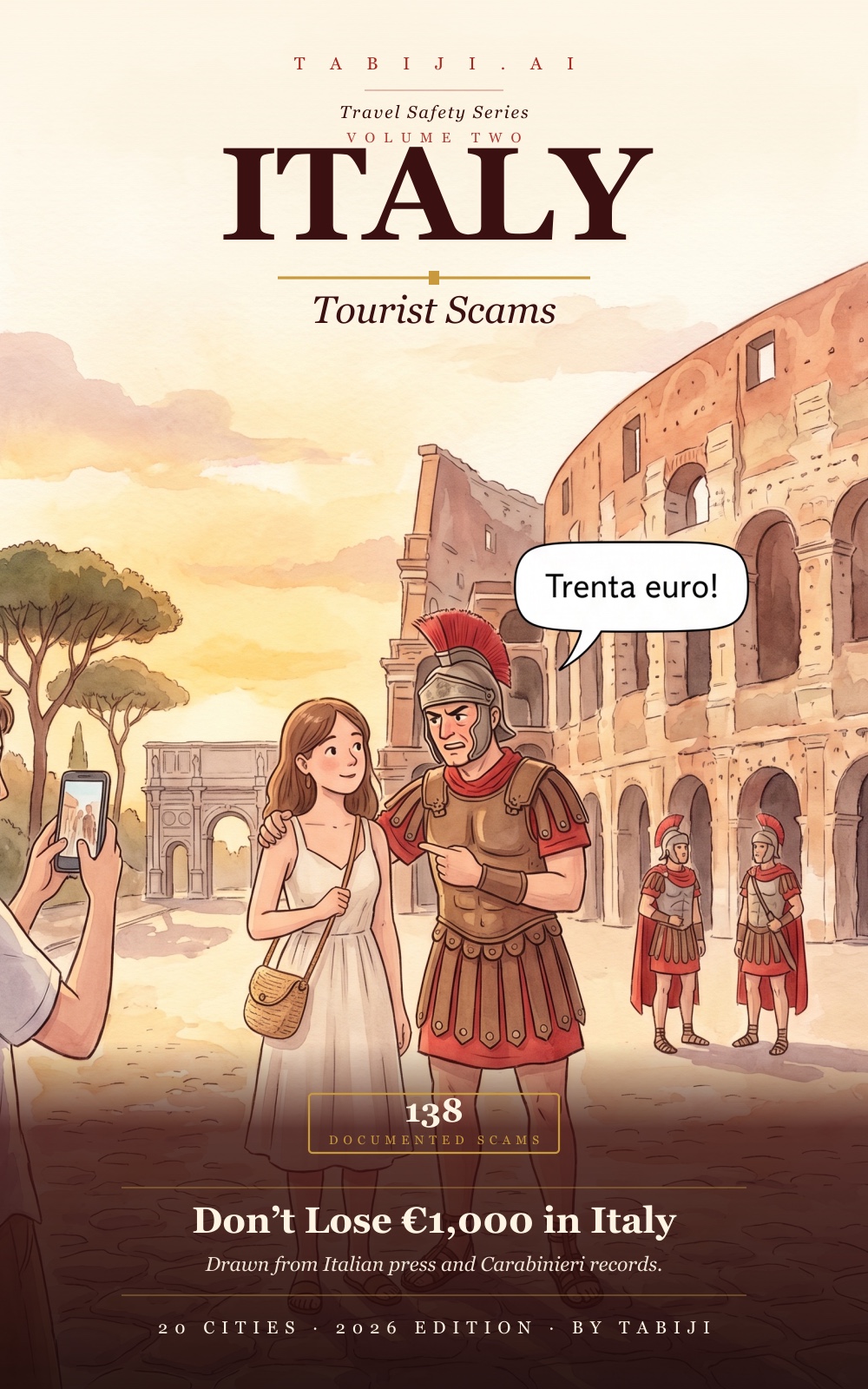
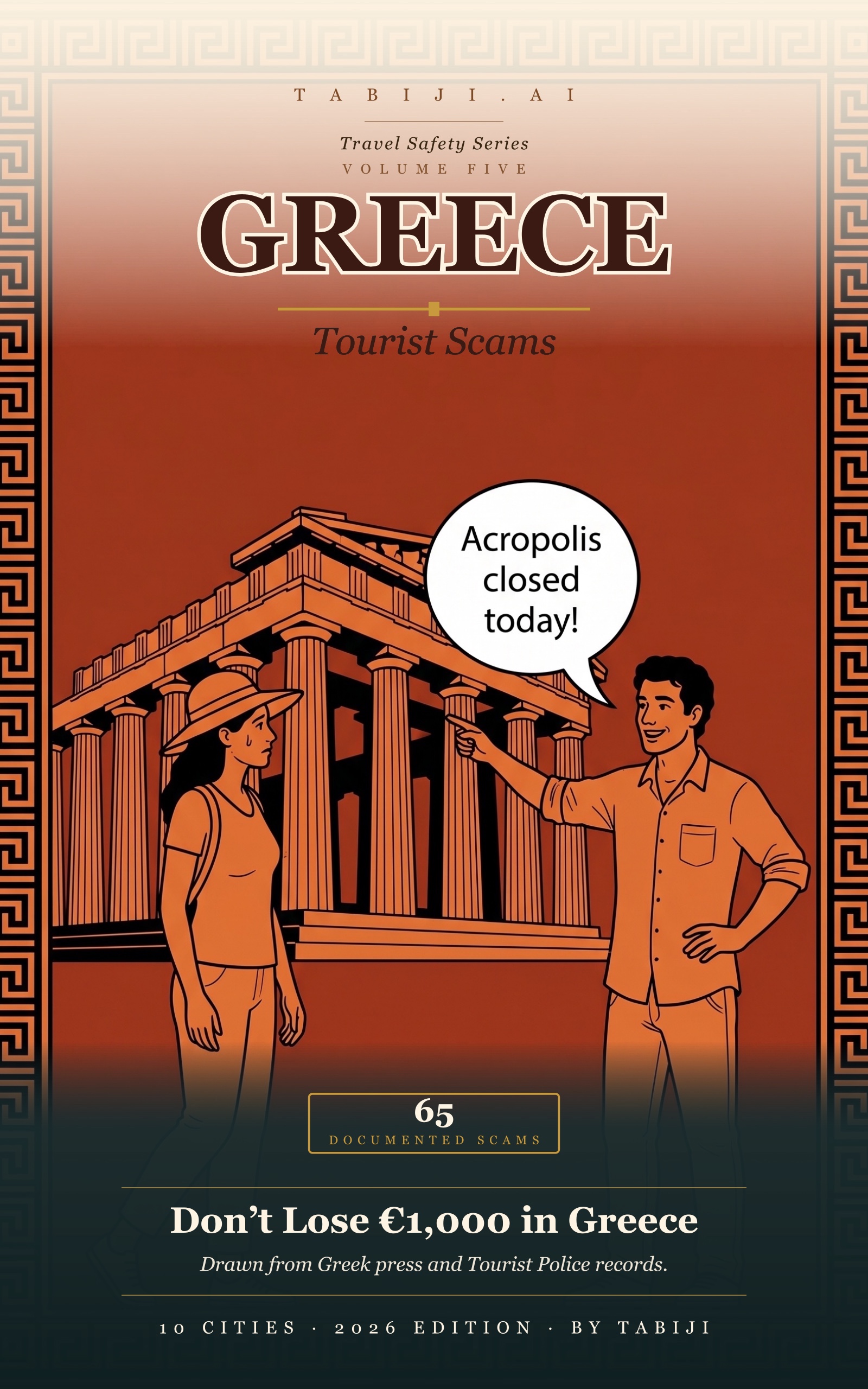
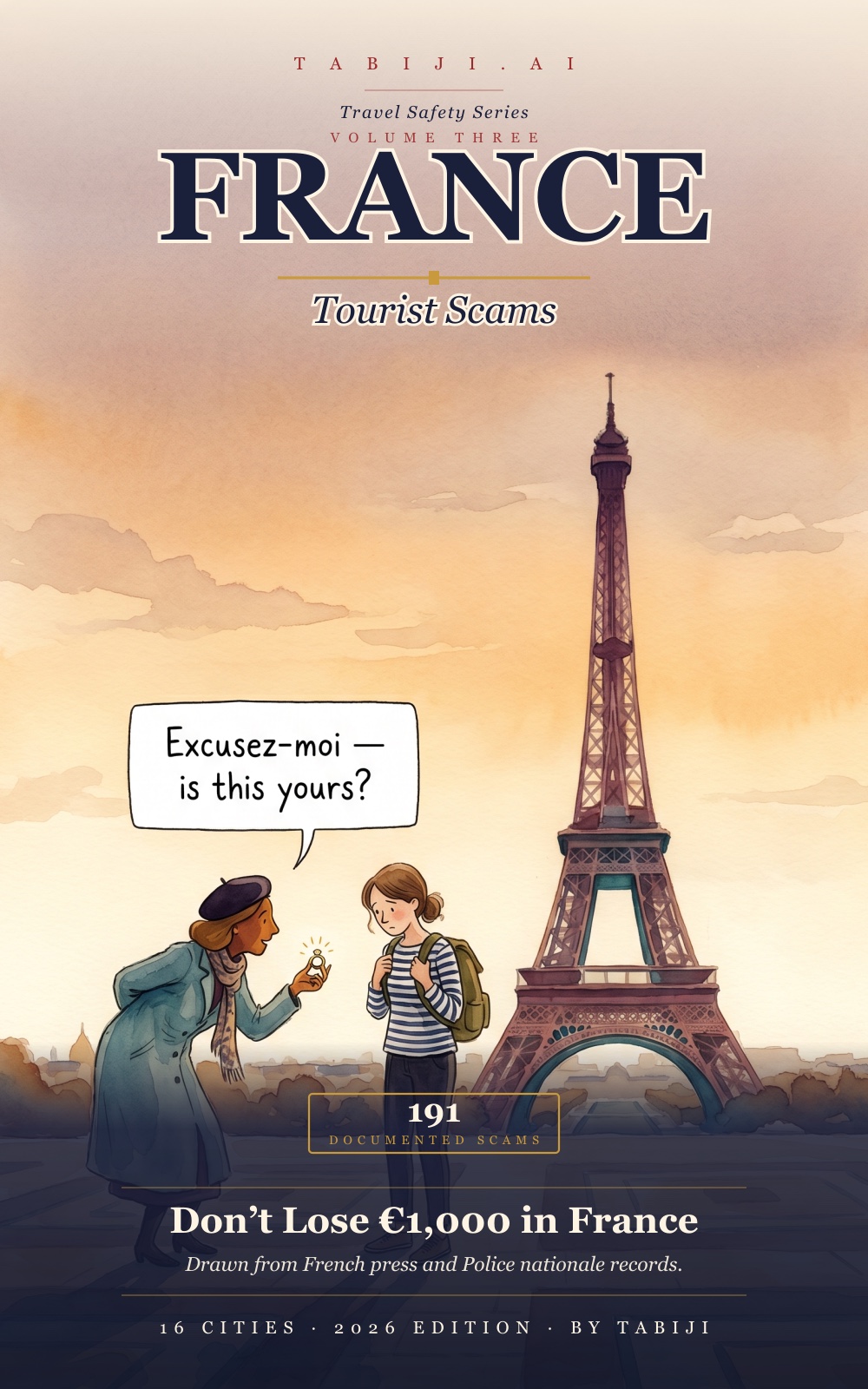
Tourist-trap restaurants, four ways the postcard view costs you 4x.
A 1.3-kilo fish at a Venice San Marco trattoria for 117 EUR. A no-prices menu in a Rome Trevi alley with a 90 EUR bill for two pasta. An Athens Plaka tour-bus restaurant your guide insisted on. A Paris cafe directly facing the Eiffel Tower with 9 EUR mineral water. Four mechanics across 19 countries, defeated by the same five-second rule: if there are no posted prices, walk away.


Tourist-trap restaurants run four mechanics across 19 countries: pesce-al-etto fish-by-weight, no-prices menu, tour-guide kickback referral, and monument-adjacent 3-5x markup. The universal defense is one five-second rule: if there are no posted prices on the menu, on a chalkboard, or on a separate price card, walk away. The defense in depth is verbal price confirmation before the order goes to the kitchen, refusal of guide-recommended restaurants, and the 200-meter walk from any monument to where locals eat.
"L'orata e di 1.3 chili, signor. Sono 117 euro per il pesce."
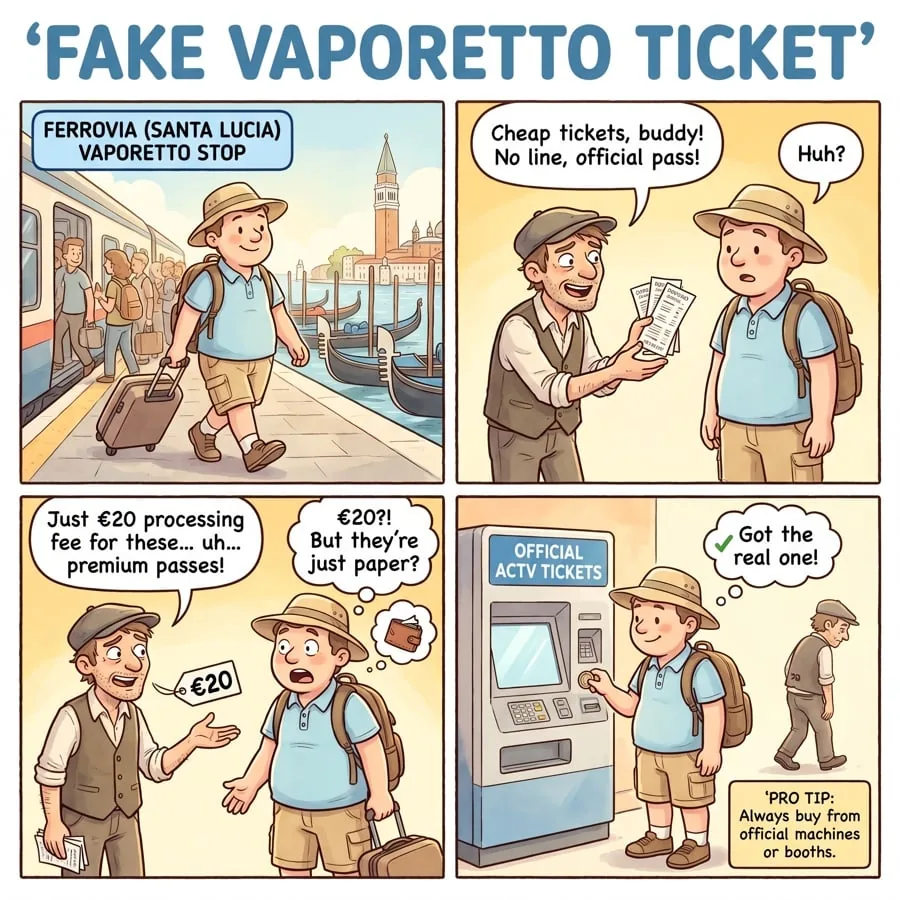
You walk south from Piazza San Marco at 8pm on a Friday, looking for a place to eat. A trattoria with a small terrace on a side rio (a canal) has a chalkboard outside reading "ORATA FRESCHISSIMA · 9 euro." Below in smaller print: "AL ETTO." You do not notice the second line. A waiter waves you in: "Prego, signori, abbiamo una tavola per due." You sit. You order the orata; the waiter says "perfetto, ottima scelta." You also get a half-liter of house white. You do not see prices on the menu for either, but the chalkboard outside said 9 euros, and the wine seemed routine. You eat well, drink well, leave a 30-euro deposit on the table for what should be a 35-40 euro meal.
The bill arrives. It says: "Orata, 1.3 kg, 9 EUR/etto = 117 EUR. Vino della casa 0.5L = 18 EUR. Coperto 2 = 8 EUR. Totale 143 EUR."
You ask the waiter to explain. He shrugs and points to the menu where, in small print at the bottom of the seafood section, it says "tutti i prezzi del pesce sono al etto." He gestures toward the chalkboard outside; you can see now in the streetlight that "AL ETTO" is in the same color as the price, just smaller. The orata weighed 1.3 kilograms. At 9 EUR per 100 grams, that is 117 EUR for one fish. The math is technically disclosed; the framing was the trap.
You take ninety seconds to think. You ask: "L'orata pesava quanto? Posso vedere lo scontrino della pesatura?" (How much did the fish weigh? Can I see the weighing receipt?) The waiter goes to the kitchen, comes back with a thermal-printed weighing tag from the bilancia: 1,310 grams. He is technically correct. The fish was indeed 1.3 kilograms. You pay 143 EUR. You walk back to your hotel feeling cheated and stupid; the bilancia receipt says you should not.
That is the canonical pesce-al-etto variant of the tourist-trap restaurant family, executed at one of the most-documented locations on Earth. The rest of this page is the four-mechanic playbook, the four other cities where it runs in different forms (Rome, Athens, Paris, Barcelona), and the pre-order rules that defeat every variant.
Read the full Venice scam guide →Key Takeaways
The pre-order rules
Tourist-trap restaurants depend on you committing to the meal before knowing the price. The trap closes at the bill, when the food is already eaten and you cannot leave without paying. The defensive routine is a single trained habit: every price is verbalized before the order goes to the kitchen. The trap falls apart instantly because the restaurant cannot complete the play without the post-meal price reveal.
- If there are no posted prices, walk away. A restaurant displaying no prices on the menu, on a chalkboard, or on a separate price card is a tourist-trap red flag and a near-universal predictor of overcharging. Walk away. There are always priced alternatives within 50 meters in any tourist zone in Europe.
- Ask the price of every item before ordering. Before any waiter writes anything down, ask the price of each item: "quanto costa la pasta? quanto costa il vino? quanto costa il coperto?" The waiter must say the number out loud. The verbal price is your contract; refuse to be told prices only after the bill arrives.
- For fish: confirm price-per-kilo AND total weight in advance. Pesce-al-etto means priced per 100 grams. Restaurants that quote 9 EUR/etto bring out 1.3kg fish and charge 117 EUR. Before the fish goes to the kitchen, confirm two numbers: the price-per-etto AND the total weight that will be cooked. Refuse the fish unless both are stated. Most fish-by-weight scams die at the verbal-confirmation step.
- Refuse guide-recommended restaurants. If a tour guide, hotel concierge, or unsolicited stranger insists you eat at a specific restaurant, walk in the opposite direction. The kickback is structural; the food is irrelevant. Pick restaurants from independent sources, ideally ones with a posted price list and Italian-, Greek-, or Spanish-language reviews.
- Walk 200 meters away from the monument. Restaurants directly facing the Trevi Fountain, Sagrada Familia, Acropolis, Eiffel Tower, or San Marco charge 2-5x the price of restaurants 200-400 meters away in side streets. The food quality typically does not justify the markup. Walk away from the postcard view; eat where locals eat.
The four mechanics
Different cities and operator types lean on different precipitating mechanics within the same family. Here are the four sub-variants documented globally. Each has a recognition tell, a primary geography, and the routine step that defeats it.
1. Pesce al Etto (Fish by Weight)
Pesce al etto means "fish per 100 grams" in Italian. The scam works because the customer hears "9 euros for fish" but the restaurant means "9 euros per 100 grams" and the fish brought out weighs 1.3 to 1.6 kilograms. The bill arrives at 117-144 EUR for one fish. Same scam runs in Greece (psari pros kilo) and Spain (pescado al peso) under different names.
Defense: confirm price-per-etto AND total weight in advance, before the fish goes to the kitchen. Most reported in: Venice San Marco rio-side; Rome Trastevere; Naples Posillipo; Sorrento; Cinque Terre coastal villages; Athens coastal tavernas; Barcelona Barceloneta.
2. No-Menu / No-Prices
Restaurants without posted prices on the menu, on a chalkboard, or on a separate price card. The waiter takes the order without writing prices, the kitchen prepares the food, the bill arrives with whatever the restaurant decides to charge that day. Most commonly seen at small "family-style" trattorias in pedestrian-only tourist zones, where the absence of prices is framed as authenticity.
Defense: walk away. A restaurant displaying no prices is a near-universal predictor of overcharging. Most reported in: Venice side rios; Rome Trastevere and Vicolo del Cinque alleys; Athens Plaka stairs; Paris Latin Quarter side streets; Barcelona Gothic Quarter narrow alleys.
3. Tour-Guide Kickback
A tour guide, hotel concierge, taxi driver, or unsolicited "helpful local" insists that you eat at a specific restaurant. The recommendation is structural: the guide collects 10-25% commission on every bill, the restaurant charges tourist-zone markup to cover that commission and still profit. The food quality is irrelevant to the deal.
Defense: pick restaurants from independent sources, not from a guide who profits from the choice. Most reported in: Athens Plaka tour-bus restaurants; Sorrento Marina Grande; Cinque Terre Vernazza and Manarola; Bali Ubud rice-terrace restaurants; Marrakech medina; Istanbul Sultanahmet.
4. Monument-Adjacent Markup
Restaurants directly facing major monuments charge 2-5x the price of restaurants 200-400 meters away in side streets. Espresso for 8 EUR, pasta for 28 EUR, mineral water for 9 EUR, coperto for 5 EUR. The markup is the postcard view; the food quality typically does not justify it.
Defense: walk 200 meters away from the monument before sitting down. Most reported in: Rome Trevi Fountain perimeter; Florence Piazza della Signoria; Athens Acropolis approach; Paris Champ de Mars and Eiffel Tower; Barcelona Sagrada Familia adjacency; Venice San Marco perimeter.
Where it runs
Tourist-trap restaurants are concentrated in monument-rich Mediterranean tourist zones with high-volume pedestrian traffic and weak local-resident dining culture. The eight countries below cover the bulk of global tourist exposure.
| Country | Documented variants | Iconic location pattern |
|---|---|---|
| 🇮🇹 Italy | 28 | Venice San Marco and Rialto perimeter; Rome Trevi, Spanish Steps, Pantheon perimeter; Florence Piazza della Signoria; Naples Spaccanapoli; Sorrento; Cinque Terre |
| 🇬🇷 Greece | 20 | Athens Plaka and Monastiraki; Santorini Oia; Mykonos Chora; Rhodes Old Town |
| 🇫🇷 France | 16 | Paris around Eiffel Tower, Champs-Elysees, Sacre-Coeur, Latin Quarter; Nice Promenade; Avignon Palace square |
| 🇪🇸 Spain | 14 | Barcelona Las Ramblas and Gothic Quarter; Madrid Plaza Mayor; Sevilla Triana |
| 🇵🇹 Portugal | 8 | Lisbon Rua Augusta and Bairro Alto; Porto Ribeira |
| 🇭🇷 Croatia | 6 | Dubrovnik Stradun; Split Diocletian's Palace; Hvar harbor |
| 🇹🇷 Turkey | 5 | Istanbul Sultanahmet; Cappadocia Goreme |
| 🇮🇩 Indonesia · 🇲🇦 Morocco · 🇲🇽 Mexico | 9 | Bali Ubud rice-terrace restaurants; Marrakech medina; Mexico City Centro |
Bar width is data-bound at 5 pixels per documented variant. The eight countries above account for 106 of 100 total variants documented (some counted across categories). Italy alone accounts for 28% of global exposure.
Four more cities, four more tourist-trap mechanics
The Venice San Marco pesce-al-etto scene above showed the fish-by-weight variant. Here are four more cities where different sub-variants dominate. Each links to the full city scam guide.
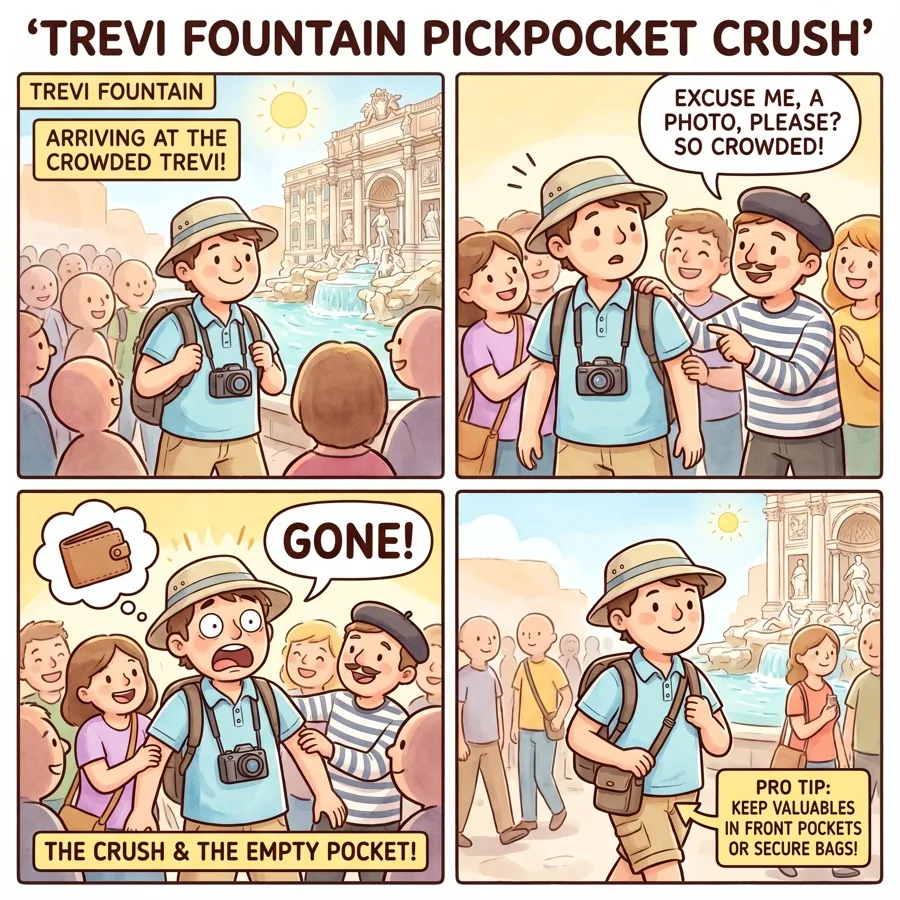
You walk through Trastevere on Vicolo del Cinque at 9pm on a Saturday. A trattoria on the corner has tables on the cobblestones and a chalkboard listing dishes without prices. The waiter waves you in. You order spaghetti carbonara, cacio e pepe, a half-liter of house red, a bottle of mineral water. The pasta is acceptable. The bill arrives: 22 EUR for carbonara, 19 EUR for cacio e pepe, 22 EUR for the wine, 8 EUR for water, 5 EUR coperto each, 12% servizio. Total 90 EUR for two pasta plates. The same dishes at a posted-price restaurant 200 meters east of Piazza Santa Maria in Trastevere cost 32 EUR for two with a 1-euro coperto each. The Polizia di Stato 113 line takes English-language reports of menu-without-prices complaints, but Italian consumer law requires prices to be posted only "before commencement of service," a threshold that judges have interpreted broadly in favor of restaurants. Defense: walk away from any restaurant without posted prices. The Trastevere alleys 50 meters off Vicolo del Cinque (Vicolo del Bologna, Vicolo del Mattonato) have priced menus and serve the same dishes for 30-50% less.
Read the full Rome scam guide →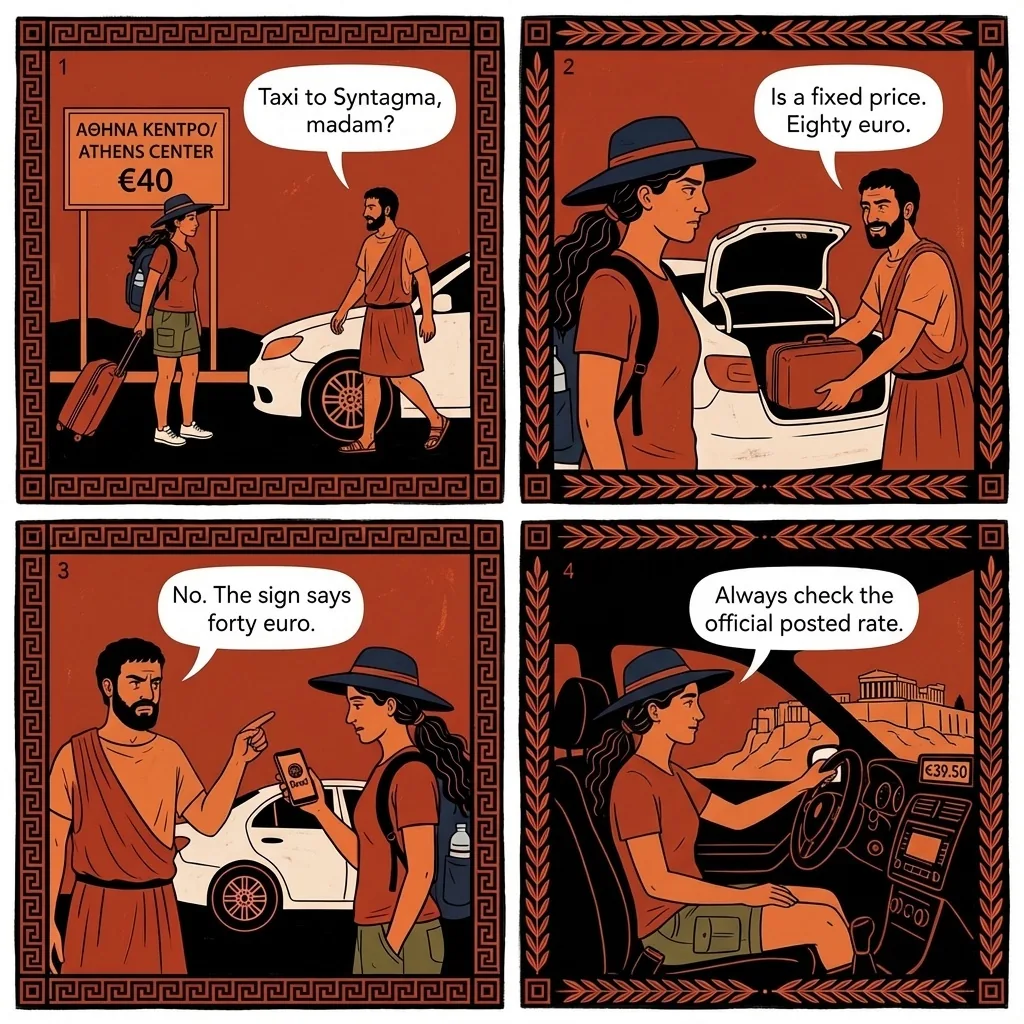
You join a half-day Athens walking tour at the Acropolis at noon. The guide ends the tour at 2pm and "highly recommends" a taverna in Plaka two streets up from Adrianou: "the lamb is the best in the neighborhood, my friend's place, you tell them I sent you, you get good price." You walk over with three other tour members. The taverna is full of tour-group tables. Lamb at 32 EUR, mixed meze at 28 EUR, half-liter of house wine at 18 EUR. The same dishes at the posted-price tavernas on Lyssikratous Street 200 meters east cost 18 EUR, 12 EUR, 9 EUR. Your guide collected 12-15% commission on the four bills. The Tourist Police 1571 line in Athens accepts English-language complaints about guide-kickback restaurants; the Hellenic Consumer Protection authority publishes annual lists of "tourist-trap" zones (Plaka tour-bus stops appear consistently). Defense: refuse guide recommendations categorically. Open Google Maps and find a taverna with reviews in Greek (not English). Walk to that one instead.
Read the full Athens scam guide →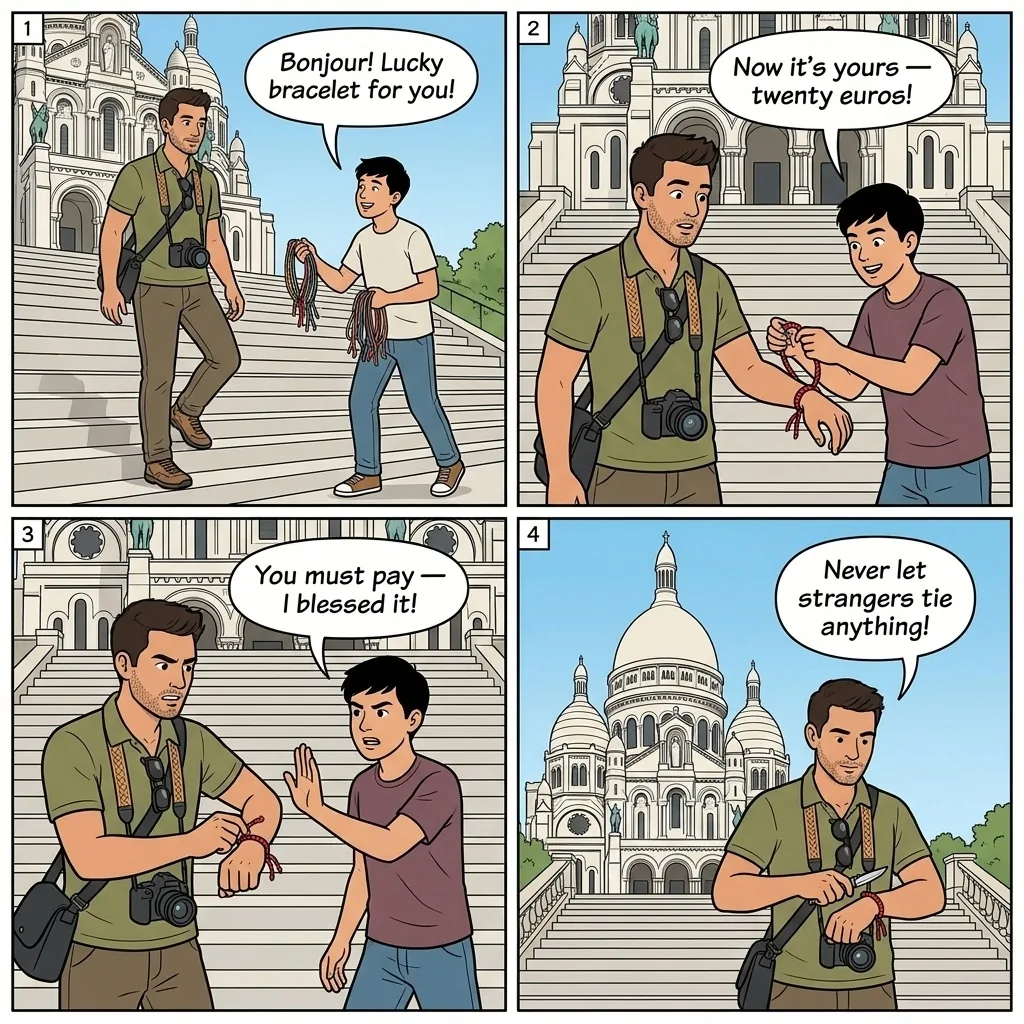
You walk to the Eiffel Tower from the Trocadero and sit at the cafe directly facing the south face on Avenue Gustave Eiffel. Two espresso, two San Pellegrino, a small assiette de fromage. The bill arrives: 9 EUR per espresso, 8 EUR per San Pellegrino, 28 EUR for the cheese plate, 4 EUR couvert. Total 66 EUR for what would be 18-20 EUR at a brasserie 300 meters away on Rue Saint-Dominique or Rue Cler. The DGCCRF (French consumer protection) requires prices to be posted, and the Eiffel-adjacent cafes do post them, but the markup is structural: the postcard view is the price. The Prefecture de Police 17 takes complaints about price-not-posted situations, but rarely about posted-but-extreme markups. Defense: walk 300 meters from any monument before sitting down. The Rue Saint-Dominique brasseries in the 7th arrondissement charge 4 EUR per espresso, 5 EUR per San Pellegrino, half what the Eiffel-adjacent terraces charge. Same view from the walk.
Read the full Paris scam guide →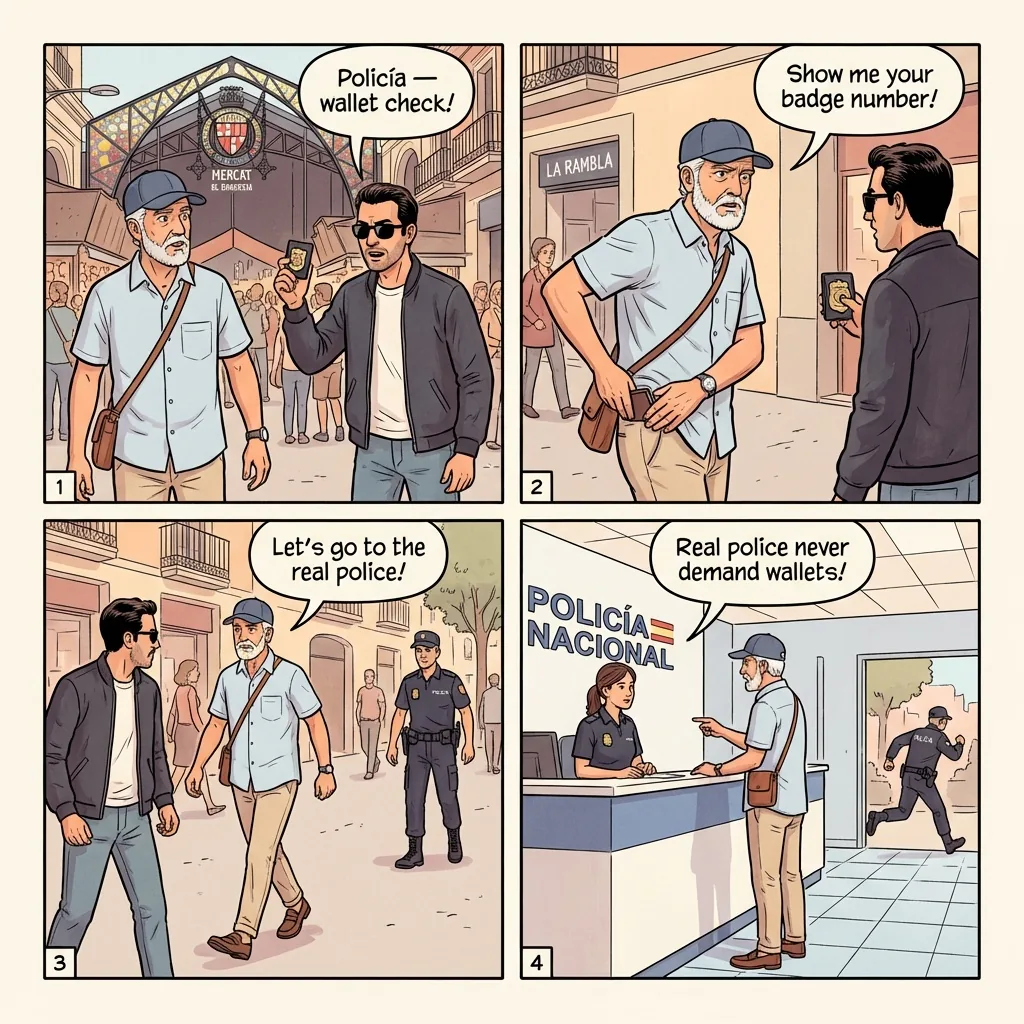
You walk down Las Ramblas at 1pm on a Tuesday. A restaurant with a large menu board outside displays photos of paella, sangria, and tapas without prices. A tout in a polo shirt waves you in: "menu del dia, paella for two, very good price." You sit at an outdoor table. You order the paella and a pitcher of sangria. The paella is acceptable but small, and the rice is from a microwaveable pre-prepared pack. The bill arrives: 38 EUR for paella per person (76 EUR for two), 22 EUR for the small pitcher of sangria, 4 EUR per person cubierto, 10% service. Total 110 EUR. The same paella at El Quim de la Boqueria (entrance at La Boqueria market 200 meters away) is 18 EUR per person with no cubierto, total 36 EUR for two. The Mossos d'Esquadra Tourist Help line at +34 932 903 000 accepts complaints about menu-without-prices, but the Catalan consumer law allows photo menus without prices if the prices are "displayed elsewhere," a standard the tourist-zone restaurants meet by posting prices on a small interior chalkboard most diners do not see. Defense: walk into La Boqueria market or 200 meters into the Gothic Quarter side streets where prices are posted. The same paella is half the price.
Read the full Barcelona scam guide →Red flags
If two or more of these signals fire when you are choosing a restaurant in a tourist zone, walk to the next street. The compounding rule: a single signal might be a coincidence; two signals are a tourist trap.
- The menu has no posted prices on chalkboard, paper, or price card
- The menu has photos but no prices printed under each photo
- A tout outside is actively waving people in or distributing flyers
- The restaurant displays only English-language signage in a non-English country
- "Menu del dia" or "tourist menu" is advertised but the price is not stated
- The fish display says "X euros" without "al etto" or "per kilo" qualifier visible
- The waiter resists telling you the price of an item when you ask
- The cubierto or coperto is hidden in small print or unposted
- Your tour guide, hotel concierge, or taxi driver insists on this restaurant
- The restaurant is directly facing a major monument
The phrases that shut it down
Refusing tourist-trap restaurants works when you signal you require posted prices and verbal confirmation before ordering. The phrase is the same idea in every language: prices first, food second.
If you got hit
The bill arrived at 143 EUR for what should have been 40. Tourist-trap restaurant losses are partially recoverable through three channels: the disputed-charge process at the table, the credit-card chargeback, and the consumer-protection complaint. The first hour matters because the table-level dispute is the only point of leverage before the food is paid for.
At the table: ask to see the printed menu and request a line-by-line audit of the bill against posted prices. If the menu has prices and the bill exceeds them, refuse to pay the difference. If the menu has no prices, ask for the cubierto / coperto / service charge to be removed (most consumer laws require prior posting). If the waiter refuses, ask for the manager. If the manager refuses, ask for the police; in Italy and Greece, the threat of calling the Carabinieri or Tourist Police is often enough to drop the disputed line items.
Within 48 hours of the bill: file a credit-card chargeback claim if you paid by card. The grounds: "service not as described" (no prices posted) or "fraudulent charge" (price misrepresentation). Visa and Mastercard chargeback windows are 60-120 days; submit the photo of the menu (no prices) and the bill (charges) as evidence.
Within 30 days: file a consumer-protection complaint with the local authority. Italian Polizia Annonaria, Greek INKA, French DGCCRF, Spanish Direccion General de Consumo all accept English-language tourist complaints.
- Italy: Polizia Annonaria via Comune di Venezia / Roma; Carabinieri 112; Polizia di Stato 113.
- Greece: INKA Athens (Greek Consumer Protection); Tourist Police 1571 (English-speaking dispatch).
- France: DGCCRF Paris (signalconso.gouv.fr online portal accepts English); Prefecture de Police 17.
- Spain: Direccion General de Consumo Cataluna and Madrid; Mossos d'Esquadra Tourist Help, +34 932 903 000.
- Portugal: ASAE (Autoridade de Seguranca Alimentar e Economica); PSP Tourist Help 21 342 1623.
- Croatia: Drzavni inspektorat (State Inspectorate); Tourist Police via 192.
- Turkey: Tuketici Hakem Heyetleri Istanbul; Tourist Police 0212 527 4503.
- Bali: Bali Tourist Police 0361 754 599 (English-speaking).
For chargeback claims, the strongest evidence is a photo of the menu (showing no posted prices or showing prices that do not match the bill) plus a photo of the bill itself, plus the date/time of the meal. Most chargebacks resolve in 30-60 days. The cash-paid loss is typically not recoverable; preventive habit is the only durable defense.
Related atlas entries
Sister entries in the Scam Atlas. Tourist-trap restaurants overlap with restaurant bill padding (the post-meal mechanic) and fake skip-the-line tickets (the monument-adjacent commerce family).
Sources
- Polizia Annonaria Venezia, San Marco perimeter pesce-al-etto and no-menu enforcement bulletins (Italy, ongoing).
- La Repubblica and Il Corriere della Sera, Trevi-area menu-without-prices coverage (Rome, 2018-2025).
- INKA (Greek General Consumer Federation), Plaka tour-bus restaurant tariff complaints (Greece, ongoing).
- Kathimerini and To Vima, Athens Plaka and Santorini Oia tourist-trap reporting (Greece, 2019-2025).
- DGCCRF Paris, Eiffel Tower-adjacent and Latin Quarter pricing inspections (France, ongoing).
- Direccion General de Consumo Cataluna, Las Ramblas paella-pricing investigations (Spain, ongoing).
- El Pais and La Vanguardia, Las Ramblas tourist-trap menu coverage (Barcelona, 2018-2025).
- Mossos d''Esquadra Tourist Help quarterly bulletins (Catalonia, ongoing).
- r/travel, r/italy, r/Greece, r/France, r/Spain continuing thread monitoring 2018-2026.
Get the full tourist-trap-restaurant playbook for your destination.
Each Travel Safety atlas covers every documented restaurant and food scam in one country, plus the country's full scam catalog: pickpocket, taxi, ATM, fake authority, monument-adjacent rip-offs. Buy once, lifetime updates as scams evolve. $4.99 on Kindle.