Fake 'Antique' & Souvenir Markup: the same scam, in 4 countries.
From Sydney The Rocks fake Aboriginal art to Marrakech medina fake Damascene to Cairo Khan el-Khalili counterfeit Dead Sea cosmetics, the same mechanic recurs: an item presented as antique, cultural-origin, or branded; a price 10-100x the actual cost; an absence of paperwork. The provenance rule defeats every variant.


Fake antique and souvenir markup scams run five mechanics across 4 countries: fake Aboriginal art (Sydney The Rocks, Cairns, Darwin, with 200-2,000 AUD per painting), fake Damascene metalwork (Istanbul Grand Bazaar, Cairo Khan el-Khalili, Marrakech medina, with 100-1,000 USD per piece), fake Dead Sea cosmetics (Jerusalem Old City, Amman, Cairo, with 50-300 USD per "treatment session"), antico branding bait (Rome Porta Portese, Florence, Venice San Marco, with 50-500 EUR per "antique"), and counterfeit luxury handbags (Bangkok MBK, Istanbul Grand Bazaar, Hong Kong Ladies Market, with 200-2,000 USD on items costing 5-50 to produce). The universal defense is one rule: demand written provenance for any item over 100 USD claimed as antique, cultural-origin, or branded. Indigenous Art Code certification for Aboriginal art; Soprintendenza license for Italian antiques; brand-store receipt for luxury; hallmark documentation for Damascene; brand-listed retailer for cosmetics. No paperwork, no purchase.
"Painted by a Pitjantjatjara elder, twelve hundred dollars, very lucky for your home."
The Rocks weekend market sits in the shadow of the Sydney Harbour Bridge. You and your travel partner stop at a stall hung with dot-painting canvases in oxblood, ochre, white. The dealer is in his fifties, white-haired, wearing a linen shirt. He sees you slow.
"Beautiful, beautiful, that one is from the Pitjantjatjara nation, painted by an elder, very limited, twelve hundred dollars, very lucky for your home." He gestures at the canvas: a swirl of dots in concentric circles, with smaller motifs around the edges. To your eye, it looks authentic. The dealer's manner is warm. He has a small printed card next to the canvas that says ABORIGINAL ART, AUTHENTIC, AUSTRALIA.
You ask the question that defines the variant: "Is this Indigenous Art Code certified?" The dealer's smile does not change but his eyes flick to the side. He says: "Oh, the Code, the Code, yes, of course, all our pieces, we work with all the artists, very ethical." He does not produce a sticker, a certificate, or a member number.
This is the fake Aboriginal art variant of the fake-antique-souvenir family, the most-documented Australian tourist-market scam. The defense is a single rule: demand written provenance, and verify it before purchase. The Indigenous Art Code (indigenousartcode.org) maintains an online member directory; a thirty-second phone search resolves the question. Real Indigenous Art Code members display the Code sticker prominently and provide certificates with each painting; absence of these is the variant by definition.
That is the fake Aboriginal art variant of the fake-antique family, executed at one of the most-documented locations in Australia. The rest of this page is the five-mechanic playbook, the four other places where it runs in different forms (Marrakech medina, Cairo Khan el-Khalili, Istanbul Grand Bazaar, Rome Porta Portese), and the provenance rule that defeats every variant.
Read the full Sydney scam guide →Key Takeaways
The provenance rule
Every variant of this family is defeated by the same single rule: demand written provenance for any item over 100 USD claimed as antique, cultural-origin, or branded. Each variant relies on tourist unfamiliarity with the certifying mechanisms in its category; surfacing the certification request collapses the trap at the moment of asking.
The first defense is category awareness. Aboriginal art has the Indigenous Art Code (indigenousartcode.org). Italian antiques have the Soprintendenza export license (required for items over 70 years old). Luxury brands have authorized-retailer databases on each brand website. Dead Sea cosmetics have brand-listed-retailer pages on AHAVA and Premier sites. Damascene metalwork has workshop hallmarks and verified-age documentation. Knowing the certifying body for each category is the first line of defense.
The second defense is verification at the counter. Photograph the item and any certificate the seller produces. Open the certifying body's website on your phone and search the seller's name or member number. Real members appear in the directory; fakes do not. A five-minute online check resolves 95%+ of the variants.
The third defense is the export-paperwork question. Italian antiques over 70 years old require Soprintendenza export licenses, which list the seller and item. Egyptian and Turkish antiquities have similar export controls. A seller unable to produce export paperwork is selling something that is either not antique or not legally exportable; both outcomes mean walk away.
The fourth defense is the chargeback corridor. If you decide to risk a high-value purchase despite missing paperwork, pay by credit card with chargeback rights and photograph the storefront, the seller, and the receipt. If the item turns out to be counterfeit or non-genuine, file a chargeback within 30 days under "item not as described"; Visa, Mastercard, and Amex all recognize this category and recover funds at high rates for tourist-market counterfeits.
The fifth defense, when in doubt: walk away and sleep on it. Real antique sellers operate from licensed shops with consistent paperwork and have no interest in pressuring you. Pressure is the variant's tell. If the seller cannot wait until tomorrow, the seller is not selling what they claim.
The five mechanics
Fake antique and souvenir markup scams run five distinct mechanics. Each has a signature region, a signature cultural good, and a signature certifying-body bypass.
1. Fake Aboriginal art (Sydney, Cairns, Darwin)
Mass-produced paintings styled to look like Aboriginal art, sold at 200-2,000 AUD with the claim that the artist is an Indigenous elder. The actual painters are often non-Indigenous workers in factory settings; some operations source from offshore. Documented heavily in Sydney The Rocks weekend market, Cairns waterfront galleries, Darwin tourist strip, Alice Springs souvenir shops. The Indigenous Art Code (indigenousartcode.org) is the official certifying body. Defense: only buy from Indigenous Art Code members or directly from artist co-ops; absence of the Code sticker is the variant.
2. Fake Damascene metalwork (Istanbul, Cairo, Marrakech)
Brass or copper bowls, trays, and jewelry inlaid with silver and gold wire, claimed to be antique Syrian Damascene work. Real Damascene work is rare since the Syrian war disrupted the workshops; most pieces sold in tourist markets in Istanbul Grand Bazaar, Cairo Khan el-Khalili, and Marrakech medina are mass-produced in Damascus diaspora workshops or in copy workshops in the same cities. Defense: real antique Damascene from before 2010 has visible age patina, hand-engraved inlay, and verifiable provenance documentation; claims of "pre-war" or "100-year-old" Damascene without paperwork are the variant.
3. Fake Dead Sea cosmetics (Jerusalem, Amman, Cairo)
Counterfeit AHAVA, Premier, or other Dead Sea-brand cosmetics sold in Jerusalem Old City Christian Quarter shops, Amman Rainbow Street, Eilat shoreline kiosks, and Cairo Khan el-Khalili. The variant uses aggressive in-shop pressure tactics: free "sample" applied to skin, refusal-to-leave dynamics, then 200-500 USD purchase. Real AHAVA and Premier are sold at brand stores and licensed pharmacies; the brand websites have authorized-retailer locators. Defense: never buy Dead Sea cosmetics from non-listed kiosks; check the brand authorized-retailer database before any purchase over 50 USD.
4. Antico branding bait (Rome, Florence, Venice)
In Italian flea markets and souvenir streets, items labeled "antico" (antique) when in fact they are 20-30 years old at most, sometimes brand-new with artificial aging. Documented heavily at Rome Porta Portese (Sunday flea market), Florence Mercato Centrale, Naples market streets, Venice San Marco antique shops. Real Italian antique export over 70 years old requires a Soprintendenza license; absence of the license proves the item is not legally antique. Defense: ask for the Soprintendenza export license before any purchase claimed as "antico" over 50 EUR.
5. Counterfeit luxury handbag (Bangkok, Istanbul, Hong Kong)
Louis Vuitton, Hermes, Gucci, Chanel, and Prada bags sold as authentic in tourist markets at 200-2,000 USD. Production cost on the counterfeits is typically 5-50 USD; the markup is 10-100x. Documented at Bangkok MBK, Patpong; Istanbul Grand Bazaar; Hong Kong Ladies Market (Tung Choi Street); Manila Greenhills; NYC Canal Street; Mexico City Tepito. Real luxury is sold only at brand boutiques and licensed retailers; tourist-market "authentic" is the variant 100% of the time. Defense: use the brand storefinder before any purchase; never buy luxury at tourist markets even when the seller claims authenticity.
Where it runs
The trap concentrates at major tourist markets, souvenir streets, and weekend art markets where high tourist volume sustains the markup. The geography below covers the most-documented locations per country and per variant.
- Australia (fake Aboriginal art): Sydney: The Rocks weekend market, Circular Quay galleries, Darling Harbour souvenir strip. Cairns: Esplanade galleries, reef-tour gift shops. Darwin: Mindil Beach Sunset Markets, tourist strip. Alice Springs: Todd Mall souvenir shops. Melbourne: Federation Square gift shops, Queen Victoria Market.
- Morocco (Damascene metalwork, antique rugs, "antique" jewelry): Marrakech: medina souks (Souk Semmarine, Souk des Bijoutiers), Jemaa el-Fnaa stalls. Fez: medina (Talaa Kebira, Bab Boujloud). Casablanca: Habous Quarter. Tangier: Petit Socco antique strip.
- Egypt (fake antiquities, fake Damascene, fake Dead Sea): Cairo: Khan el-Khalili, Souk al-Goma'a, Pyramid approach souvenirs. Luxor: souk near the temple, cruise-port stalls. Aswan: souk near the train station. Sharm el-Sheikh and Hurghada: tourist-strip souvenirs.
- Turkey (fake Damascene, fake antique rugs, counterfeit luxury): Istanbul: Grand Bazaar (Kapali Carsi), Spice Bazaar adjacent, Sultanahmet souvenir strip. Cappadocia: Goreme, Urgup tourist shops. Ephesus: Kusadasi cruise-port shops.
- Italy (antico branding): Rome: Porta Portese Sunday flea market, Via dei Coronari antique shops, Trastevere streets. Florence: Mercato Centrale, Ponte Vecchio jewelry. Venice: San Marco antique shops, Murano "antique glass." Naples: Spaccanapoli antique strip.
- Adjacent (also documented): Thailand: Bangkok MBK, Patpong (counterfeit luxury, fake gemstones). Hong Kong: Ladies Market, Temple Street (counterfeit). Mexico: Mexico City Tepito (counterfeit luxury), Cancun beach strip. United States: NYC Canal Street (counterfeit luxury), Miami Bayside.
Four more places, four more antique variants
Marrakech medina: the "pre-war Damascene" tray
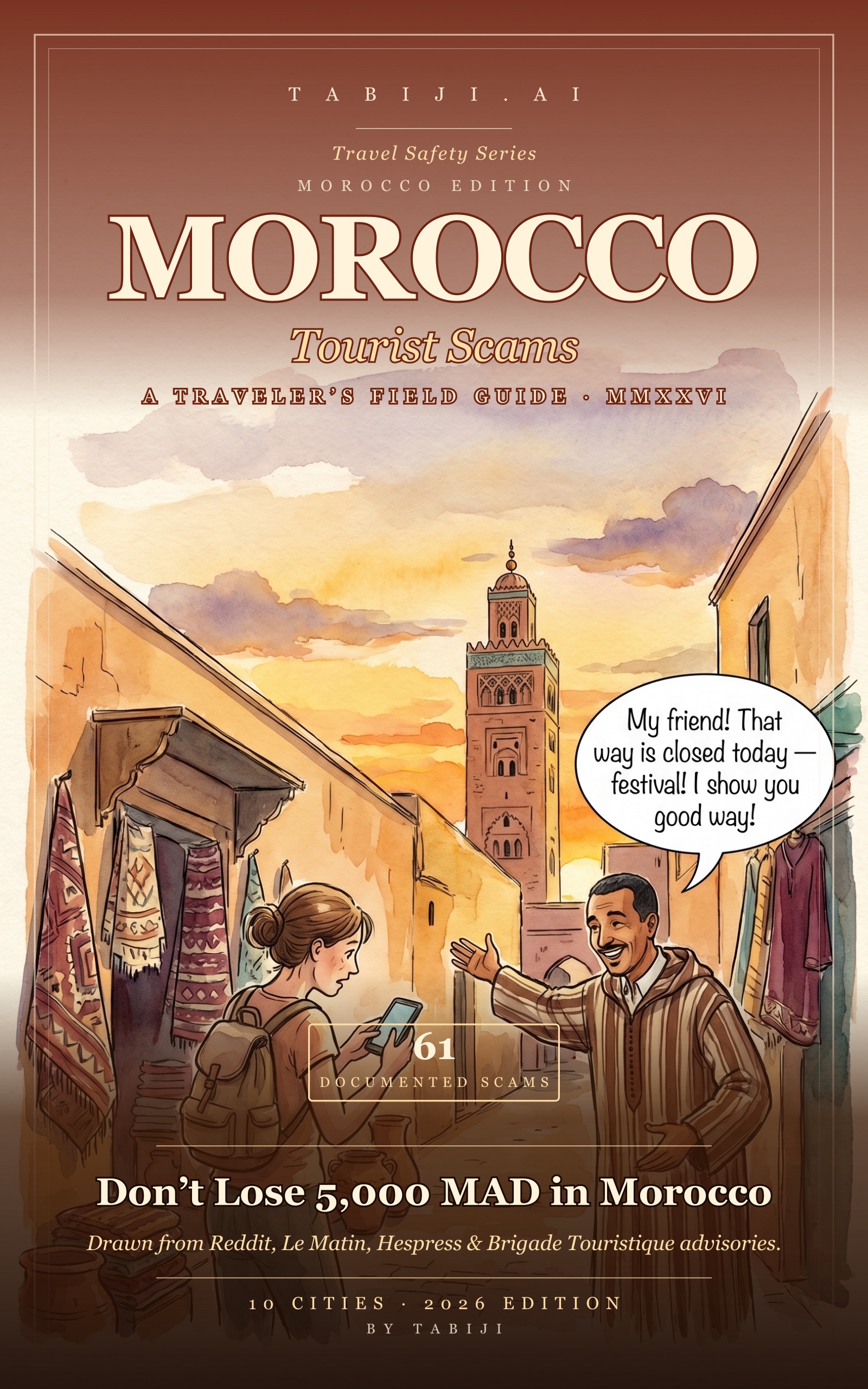
Souk Semmarine, late afternoon. The shop is small, walls covered in brass and copper, the dealer in his sixties. He brings out a hand-tray inlaid with silver and gold thread in geometric patterns. He says it is "pre-war Damascene, eighty years old, my grandfather brought it from Damascus, very rare." The price is 6,000 dirham (about 600 USD).
The variant: the silver-thread inlay is laser-etched, not hand-engraved (visible under a 10x loupe; real Damascene shows tooling marks). The "patina" is chemical, not aged. The dealer cannot produce hallmark documentation or import paperwork from Syria. Real pre-war Damascene from Damascus workshops is held in private collections and museums; tourist-market pieces are 95%+ mass-produced in copy workshops in Istanbul, Aleppo diaspora workshops in Cairo, or local Marrakech workshops.
Defense: ask for hallmark documentation and import paperwork. Use a phone-camera magnifier (or carry a pocket loupe) to inspect inlay tooling. The dealer's response (genuine paperwork vs. evasion) is the test of the variant.
Cairo Khan el-Khalili: the "Dead Sea spa session"
Khan el-Khalili side alley, 6:00pm. The shop window shows AHAVA-branded creams. A young woman with English fluency steps out and offers a "free spa session" inside, walks you to a back room where a chair waits. Without consent, she has applied a "mineral mask" to your hand and one cheek; she begins explaining the "anti-aging benefits."
Forty-five minutes later the bill is 1,200 USD for the session and a "starter kit" she has set out: a box of unbranded cream, a small jar with hand-printed label, a sample of mud. The AHAVA branding is on the shop window only; the products in the back room are unbranded counterfeits. The aggressive social pressure (the mask is on your face, you cannot easily leave, the woman is friendly) is the operator tactic.
Defense: do not enter shops where "free spa sessions" are offered to walk-by tourists. Real AHAVA and Premier sell from brand stores and licensed pharmacies (locator on each brand site); never from Khan el-Khalili side alleys. If you have entered: stand up, decline politely but firmly, walk out; do not pay even if the products are wrapped.
Istanbul Grand Bazaar: the "1820s Persian" rug
Grand Bazaar, Kapali Carsi, deep inside the carpet section. The dealer pulls out a small kilim. He says it is "1820s, from a village in Iran, my family carried it across the border in 1979, museum-quality." He shows you a "certificate" with Turkish text and a stamp. The price is 8,000 USD.
The variant: the certificate is stamped by the dealer's own shop, not by an independent verification body. The dye is synthetic (real pre-1900 rugs use natural dyes that age in characteristic ways). The wool shows machine-spinning under inspection. Real pre-1900 Persian rugs of this type sell at Sotheby's and Christie's with proper provenance documentation, not in Grand Bazaar shops.
Defense: any rug claimed as pre-1900 over 1,000 USD requires independent verification (Hali Magazine, certified independent appraisers, or auction-house certification) before purchase. Walk out at the documentation refusal. Note: legitimate Turkish-origin contemporary kilims at Grand Bazaar are real and reasonably priced; the variant is the false-antique claim, not contemporary rug sales.
Rome Porta Portese: the "antico Murano vase"
Porta Portese flea market, Sunday morning. A stall sells small glass vases in saturated colors. The dealer claims they are "antico Murano, fifty years old, beautiful for collection" and prices them at 250 EUR. They look beautiful. They are also new, made in factories in eastern Europe and labeled with stickers that say MADE IN MURANO that come off with a fingernail.
This is the antico branding bait, the canonical Italian flea-market variant. Real antique Murano (50+ years old) requires Soprintendenza export documentation if exported abroad. Real contemporary Murano carries a "Vetro Artistico Murano" trademark sticker (etched, not paper). The Porta Portese stalls have neither.
Defense: ask for the Soprintendenza export license for any antico claim over 50 EUR; or, for contemporary Murano, look for the etched trademark sticker. No license, no purchase. If you want real Murano, buy from a licensed Murano workshop on the island itself (Vetreria Artistica Colleoni and equivalents).
Red flags
- "My family / my grandfather / my elder" provenance story. The personal narrative substitutes for paperwork. Real antiques have written provenance, not stories.
- Certificate stamped by the seller's own shop. Self-certification is the variant. Real certifications come from independent bodies.
- "Free sample" or "free spa" walk-in offer. The pressure-sale tactic. Real cosmetics shops do not offer 45-minute "spa sessions" to walk-bys.
- Pressure to buy now. Real antique sellers can wait. "Special price today only" is the variant's tell.
- No Indigenous Art Code sticker on Aboriginal art. The Code is free for ethical sellers to display; absence is operational choice.
- "Antico" / "antique" without Soprintendenza paperwork. In Italy, the absence of the export license is by definition not legally antique.
- Luxury at tourist markets. Hermes, Louis Vuitton, Gucci, Chanel are sold only at brand boutiques. Tourist-market "authentic" claims are the variant 100% of the time.
- Laser-etched inlay on "antique" Damascene. Real pre-war Damascene shows hand-tooling marks; laser etching is the post-2010 mass-production tell.
The phrases that shut it down
Each language below shuts down the local variant at the point of provenance request. The seller's response (genuine paperwork vs. evasion) is the test.
If you got hit
If you bought a counterfeit luxury bag, fake Damascene, or fake Aboriginal art and paid by credit card: file a chargeback within 30 days under "item not as described." Visa, Mastercard, and Amex all recognize this category. Provide photographs of the item, the storefront, the receipt, and any false certifications. Recovery rates for tourist-market counterfeits are high if filed within the window.
If you bought a fake Aboriginal painting and want to verify before chargeback: contact the Indigenous Art Code (indigenousartcode.org) with photographs of the work and the seller; the Code can confirm whether the seller is a member and whether the work matches an Indigenous artist registered with them. Their response is admissible as evidence in a chargeback dispute.
If you bought a fake Italian antique: consult the Soprintendenza ai Beni Culturali in the region of purchase (Rome, Florence, Naples each have offices); they can confirm whether the item is registered as antique and whether the seller is licensed. The complaint can be filed with the Italian Carabinieri Tutela Patrimonio Culturale (cultural heritage police) for items represented as protected antiquities.
If the item is a fake Egyptian or Turkish antiquity that you cannot legally export: do not attempt the export. Egypt and Turkey both have strict antiquities laws; declared "antiques" without export permits are confiscated at airports and the carrier can face prosecution. Surrender the item to the local antiquities authority and request a receipt; this protects against accusations of attempted smuggling.
Related atlas entries
Sources & references
- Indigenous Art Code (Australia): indigenousartcode.org — member directory and ethical-purchase guide.
- Soprintendenza ai Beni Culturali (Italy): regional offices; Carabinieri Tutela Patrimonio Culturale (cultural heritage police) hotline.
- AHAVA authorized retailer locator: ahava.com/store-locator.
- Brand storefinders for luxury verification: hermes.com, louisvuitton.com, gucci.com, chanel.com, prada.com all maintain authorized-retailer pages.
- Royal Gendarmerie of Morocco: souk-fraud advisories for Marrakech, Fez, Casablanca.
- Egyptian Tourism and Antiquities Police: Khan el-Khalili and Pyramids approach advisories.
- Tabiji field reports: Sydney The Rocks, Marrakech medina, Cairo Khan el-Khalili, Istanbul Grand Bazaar, Rome Porta Portese (2024-2026).
Get the full antique & souvenir scam playbook for your destination.
Each Travel Safety atlas covers every documented antique, souvenir, and counterfeit scam in one country, plus the full scam catalog: pickpocket, taxi, ATM, restaurant, fake authority. Buy once, lifetime updates as scams evolve. $4.99 on Kindle.