Gem, Jewelry, Carpet & Custom-Goods Shop Pressure: the same scam, in 4 countries.
From the Bangkok tuk-tuk gem loop to the Marrakech medina tea pitch to the Jaipur bazaar bespoke push, the same mechanic recurs: a detour, a polished sales pitch, a "tax-free for tourists" framing, a 5-10x markup. The destination rule, the resell rule, and the 24-hour rule defeat every variant.


Gem, jewelry, and carpet shop pressure scams run six mechanics across 4 countries: Bangkok tuk-tuk gem loop (with 5,000-50,000 USD typical loss on glass or low-grade synthetics), Marrakech medina jewelry-tea pitch (with 500-5,000 EUR on Berber-claimed silver), fake export tax rebate (in-shop "tax-free" certificates worthless at the airport), investment-resell promise ("you can sell this at home for 5x" — you cannot), Thai bespoke tailor deposit-trap (Bangkok Sukhumvit and Phuket Patong, 50-100% upfront, poor delivery), and Moroccan spice detour overcharge (taxi or guide kickback to "Berber pharmacy" at 50-200 EUR vs. 5-20 EUR souk pricing). The universal defenses are three rules: the destination rule (no detours from a driver or guide), the resell rule (never buy with intent to resell at home; the wholesale arbitrage does not exist), and the 24-hour rule (walk out and sleep on any shop purchase over 200 USD). Royal Thai Police 1155, Marrakech tourist police 19, Cairo tourist police 126.
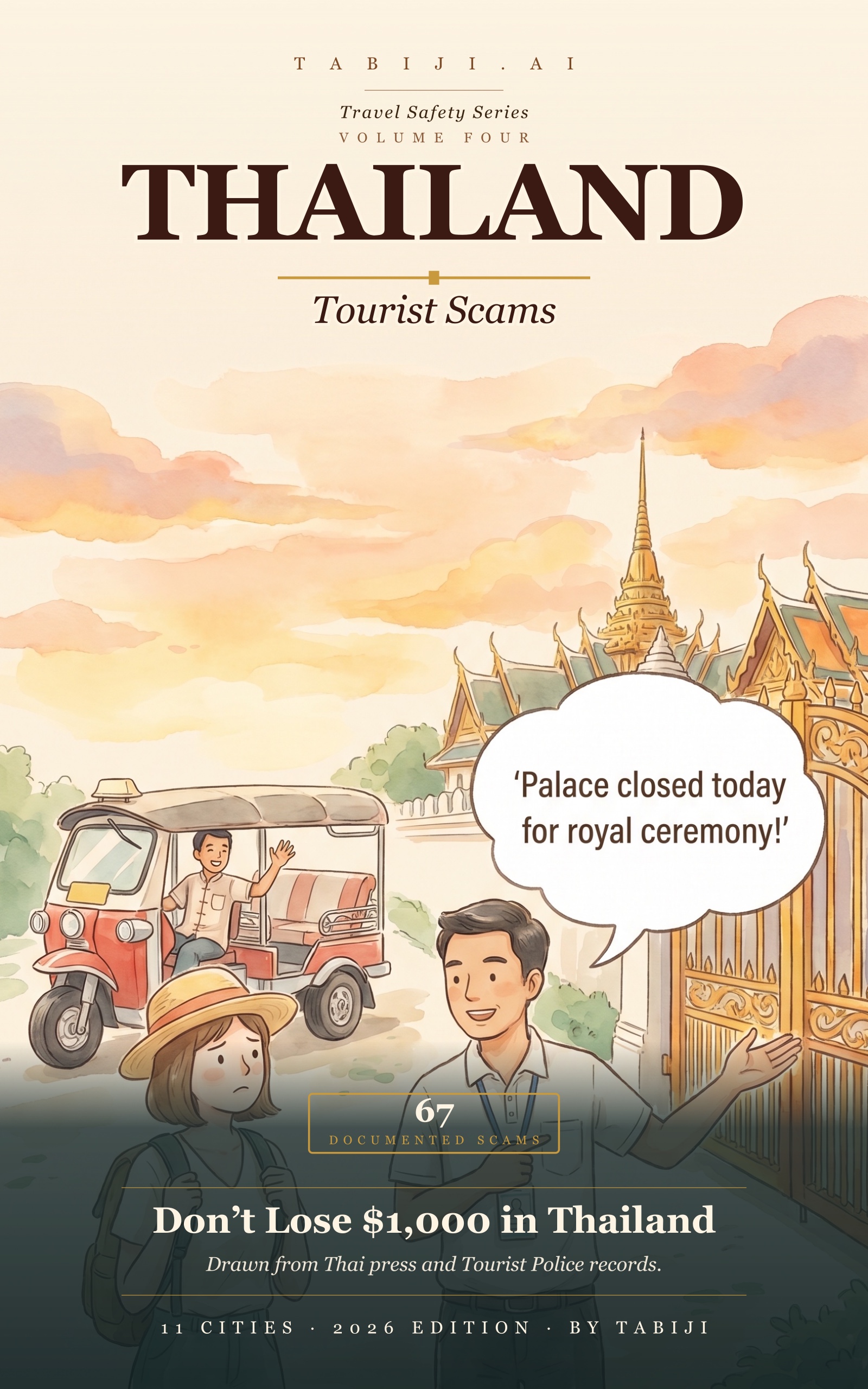
"Grand Palace closed today, sir, ceremony, but I take you better, special tax-free, just one stop."
You and your travel partner step out of the BTS Saphan Taksin station and walk north toward the river to catch the express boat to the Grand Palace. A tuk-tuk pulls up at the curb. The driver leans out: "Where you going? Grand Palace? Twenty baht, very cheap, special, but Grand Palace closed today, ceremony, you didn't hear?" He points at a small printed notice taped to his dashboard that reads CLOSED FOR ROYAL CEREMONY in English.
You hesitate. He says: "I take you better place, lucky stone shop, government approved, very nice, just look, then I take you to Wat Pho, no problem, twenty baht only." He gestures at his meter, which reads 20. You climb in.
Twenty-five minutes later the tuk-tuk stops at a building you do not recognize. A polished sign reads GOVERNMENT APPROVED GEMS, BANGKOK. A man in a suit greets you at the door, walks you through air-conditioned showrooms with glass cases of sapphires, rubies, emeralds. He says: "These are tax-free for tourists today, special export price, you can sell at home for three times, very lucky stones." He produces a printed certificate that says TAX-FREE EXPORT, BANGKOK GEMS, signed by him.
This is the Bangkok tuk-tuk gem loop, the most-documented variant of the gem-shop-pressure family. It has been documented continuously since the 1980s. Tourists have lost 5,000-50,000 USD per victim on glass, low-grade synthetics, or commercial-quality pieces priced at 10-50x retail. The Tourism Authority of Thailand and the Royal Thai Police Tourist Police (1155) publish ongoing warnings; the Grand Palace itself displays "Beware of Touts" signage at every entrance.
The defense is three rules. The destination rule: the Grand Palace is not closed; touts and drivers fabricate the closure to justify the detour. Walk to the Grand Palace ticket office yourself; ask the official guards. The resell rule: the "sell at home for 3x" pitch is the variant's tell; real wholesale gem markets are global. The 24-hour rule: any shop purchase over 200 USD requires walking out and sleeping on it; pressure to buy now is the variant.
That is the tuk-tuk gem loop, the leading edge of the gem-jewelry-shop-pressure family. The rest of this page is the six-mechanic playbook, the four other places where it runs in different forms (Marrakech medina, Cairo Khan el-Khalili, Istanbul Grand Bazaar, Jaipur Pink City), and the three rules that defeat every variant.
Read the full Bangkok scam guide →Key Takeaways
The destination rule, the resell rule, and the 24-hour rule
Every variant of this family is defeated by the same three rules. The destination rule: do not allow a driver, guide, or tout to detour to any shop you did not request; if they stop, get out and pay only the metered fare. The resell rule: never buy gems, jewelry, carpets, or custom goods in tourist countries with intent to resell at home; the wholesale arbitrage does not exist. The 24-hour rule: for any shop purchase over 200 USD, walk out without paying and sleep on it before returning the next day.
The first rule addresses the kickback economy. Tuk-tuk drivers, taxi drivers, and guides at Bangkok, Marrakech, Cairo, and Jaipur receive 30-50% commission on shop sales they generate. The "closed temple" or "this is the better place" pivot is the kickback at work. Refusing the detour denies the commission.
The second rule addresses the wholesale-arbitrage myth. Real wholesale gem markets exist in Antwerp, Bangkok, and Tel Aviv; real wholesale carpet markets in Iran, Turkey, and India. Jewelers in any country pay only wholesale rates and never the inflated retail prices charged at tourist shops. The "you can sell at home for 5x" pitch assumes the buyer at home is uninformed; in fact, every jeweler at home knows wholesale and will not pay the tourist-retail price.
The third rule addresses the urgency tactic. Real shop owners can wait until tomorrow. Pressure to buy now ("closing in 10 minutes", "last piece", "special price expires today") is the variant's structural tell because the variant relies on the tourist not consulting third parties before buying. The 24-hour wait breaks the variant's urgency without the buyer needing technical knowledge of gems or carpets.
The fourth defense is paperwork. Real gem and jewelry purchases over 1,000 USD come with GIA (Gemological Institute of America) certificates or equivalent national-laboratory documentation. Real carpet purchases come with hand-knot-density documentation and origin certification. Real custom-tailoring purchases come with measurement records and fitting receipts. No paperwork, no purchase.
The fifth defense is the chargeback. If you do buy and discover the variant after returning home, file a credit-card chargeback within 30 days under "item not as described." Visa, Mastercard, and Amex all recognize this category and recover funds at high rates for tourist-market overpriced or counterfeit goods.
The six mechanics
Gem, jewelry, and carpet shop pressure scams run six distinct mechanics. Each has a signature region, a signature lure, and a signature payout shape.
1. Bangkok tuk-tuk gem loop (Thailand)
Tuk-tuk driver fabricates a "temple closed" claim, detours to a "government approved" gem shop. Sales staff offers "tax-free export rate" with a fake certificate; pressure to buy at 5,000-50,000 USD on glass or commercial-grade synthetics. Documented heavily near Bangkok Grand Palace, Wat Pho, Wat Arun, Khao San Road, Siam Square. Variant has run continuously since the 1980s. Defense: destination rule (refuse detours); resell rule (no wholesale arbitrage exists); 24-hour rule (walk out, sleep on it).
2. Marrakech jewelry tea pitch (Morocco)
Shop owner in the medina (Souk Semmarine, Souk des Bijoutiers, Mellah) invites tourists for "free mint tea" inside the shop. The 30-45 minute tea session displays "Berber heritage" jewelry priced at 500-5,000 EUR. Same mechanic operates with carpets in Souk Smarine and with leather in the tannery district. Defense: politely decline tea offers from shops you did not enter to buy from; if you accept tea, you are not obligated to purchase.
3. Fake export tax rebate (Thailand, Morocco, Egypt, Turkey)
Sales staff issue "tax-free certificate" for in-shop rebate or claim "VAT refund at airport" to justify a 5-10x markup. Real VAT refunds (where they exist) are processed at airport government desks using uniform forms, not glossy custom certificates. Documented across Bangkok, Phuket, Marrakech, Cairo, Istanbul, and Jaipur. Defense: ignore in-shop rebate claims; if VAT applies, only the standard government form is valid.
4. Investment resell promise (universal)
Sales pitch: "in your country these stones sell at 3-5x; you can resell to a jeweler at home for instant profit." The arbitrage does not exist; jewelers globally pay only wholesale, set in Antwerp, Bangkok, and Tel Aviv. Documented at every gem-shop-pressure location worldwide. Typical loss: 1,000-50,000 USD on stones worth 100-500 USD. Defense: never buy gems, jewelry, or carpets with intent to resell. Buy only what you want to keep.
5. Thai bespoke tailor overcharge (Thailand)
Bangkok Sukhumvit and Phuket Patong tailors offer "custom suit, three-day turnaround, 100 USD per piece" with 50-100% deposit upfront. Final delivery shows poor stitching, wrong measurements, refusal to refund. Some operations upsell to "premium fabrics" at 200-400 USD per piece using the deposit as sunk-cost lever. Documented heavily in Sukhumvit Soi 11, Patong Beach Road, Khao San Road. Defense: only buy bespoke from tailors with verifiable Google or hotel-recommended reviews; require fittings; pay only on satisfactory final delivery.
6. Moroccan spice detour overcharge (Morocco)
Taxi or guide takes the tourist on a "tour" that detours through a "Berber pharmacy" or spice shop. 30-minute presentation about argan oil, saffron, "Berber whitening cream"; items priced at 50-200 EUR vs. 5-20 EUR at a normal souk stall. Driver receives a kickback. Documented in Marrakech, Fez, Casablanca, Tangier. Defense: destination rule (no detours); report driver license plate to Marrakech tourist police 19.
Where it runs
The trap concentrates at major tourist transit points (palaces, temples, bazaars) where high tourist volume sustains the kickback economy. The geography below covers the most-documented locations per country and per variant.
- Thailand (gem loop, tailor, fake rebate): Bangkok: Grand Palace approach (Sanam Luang area), Wat Pho, Wat Arun, Khao San Road, Sukhumvit Soi 11 (tailors), Siam Square. Phuket: Patong Beach Road (tailors and gems). Pattaya: Walking Street area. Chiang Mai: night bazaar.
- Morocco (jewelry tea, carpet pitch, spice detour): Marrakech: medina (Souk Semmarine, Souk des Bijoutiers, Mellah), Bahia Palace approach, Saadian Tombs route. Fez: medina (Bab Boujloud, Talaa Kebira), tannery district. Casablanca: Habous Quarter. Tangier: Petit Socco.
- Egypt (carpet, alabaster, papyrus): Cairo: Khan el-Khalili (jewelry, carpets, alabaster), Old Cairo (carpets), Pyramid approach (alabaster, papyrus). Luxor: West Bank alabaster workshops, souk near Karnak. Aswan: Nubian carpet shops.
- Turkey (carpet pitch, jewelry, leather): Istanbul: Grand Bazaar (Kapali Carsi), Spice Bazaar adjacent. Cappadocia: Goreme, Urgup carpet shops. Pamukkale: Turkish bath plus carpet pitch. Ephesus: Kusadasi cruise-port shops.
- India (gem, bespoke jewelry, custom textile): Jaipur: Pink City bazaar, Johari Bazaar. Agra: Taj Mahal approach jewelry shops. Delhi: Chandni Chowk, Karol Bagh. Mumbai: Colaba Causeway. Goa: beach-town tailors.
- Adjacent (also documented): Sri Lanka: Colombo (gem capital, "tax-free" pitch). Cambodia: Siem Reap silk and silver shops. Vietnam: Hanoi Old Quarter tailors and jewelry. Mexico: Mexico City silver-jewelry tour. Peru: Cuzco textile pitch.
Four more places, four more shop variants
Marrakech medina: the tea-pitch jewelry sale
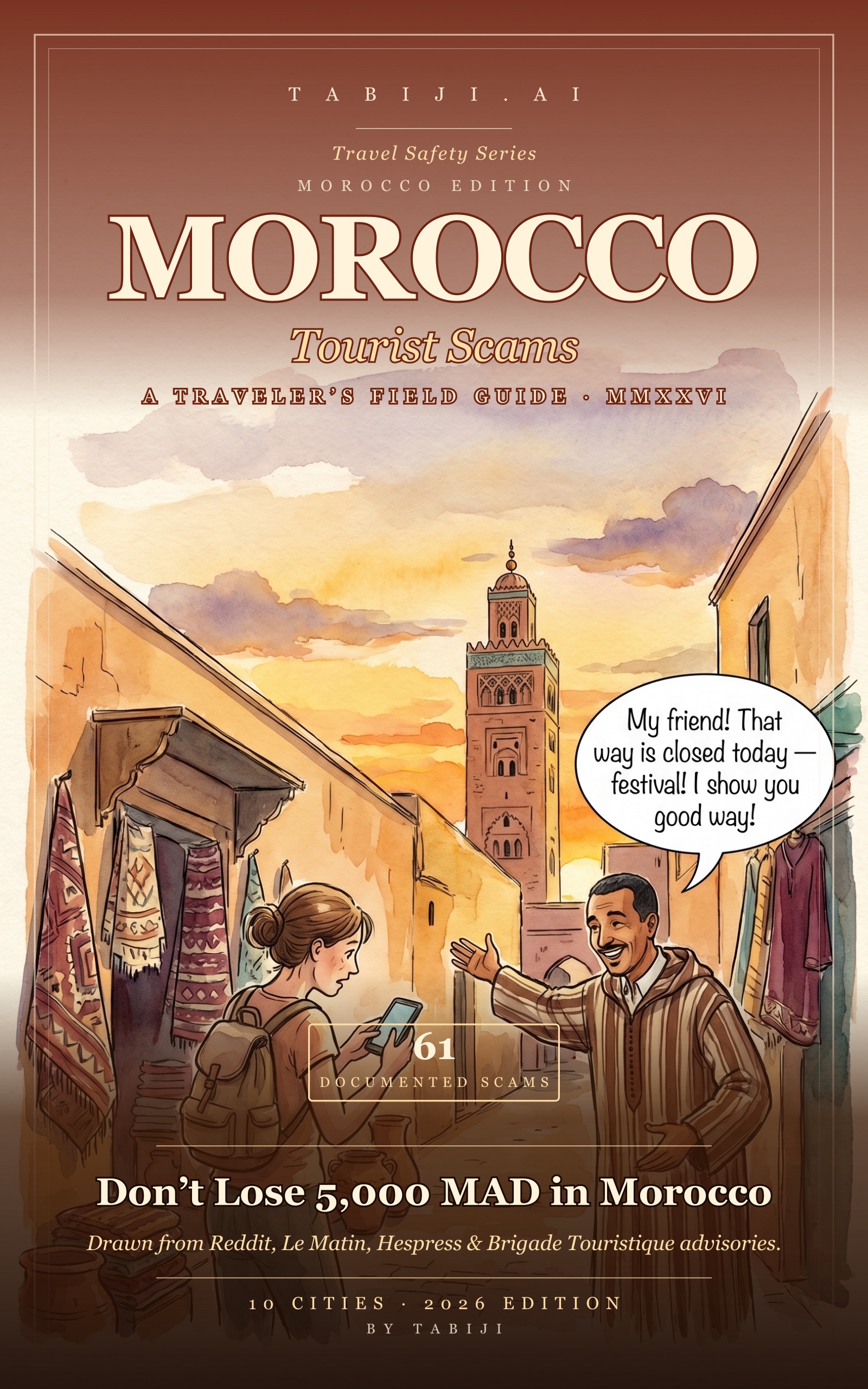
Souk Semmarine, mid-afternoon. The shop owner (a man in his fifties, multilingual) steps out as you walk past, smiles, says "welcome, just tea, no buying, please, you are my guest." You sit on a low cushion. The tea arrives in a silver pot. He pours from a height. He shows you Berber silver pieces: a hand-of-Fatima pendant, a heavy necklace, earrings.
Forty-five minutes pass. You have drunk three glasses of tea. He prices the pendant at 1,800 EUR ("antique, my grandmother's region, very rare"); he says he can do 1,200 if you decide today. The pendant is in fact mass-produced contemporary silver from Marrakech workshops, worth roughly 60-100 EUR at fair-trade Berber silver shops outside the medina.
Defense: the tea is a tactic, not a contract. Declining a purchase after tea is socially acceptable; the owner expects most tea-recipients to leave without buying. If you want Berber silver, buy from Ensemble Artisanal (the government-run fair-trade shop on Avenue Mohammed V) where prices are fixed and authentic. The 24-hour rule applies: walk out, sleep on it, return tomorrow if you still want the piece.
Cairo Khan el-Khalili: the "papyrus institute"
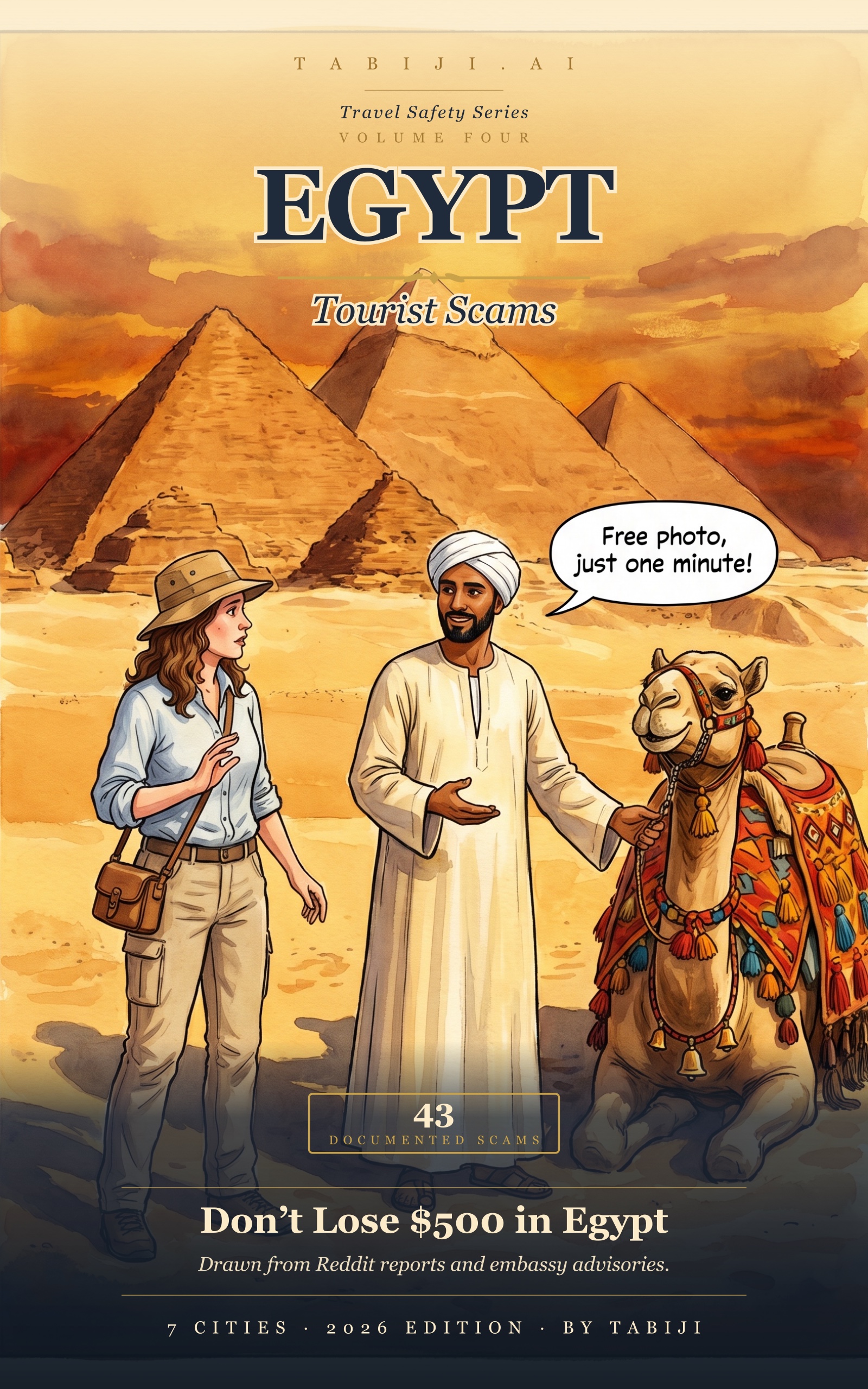
Khan el-Khalili side alley. A man approaches: "Sir, sir, papyrus institute, government, ten minutes, free demonstration, you will see how it is made, beautiful art." He walks you to a small workshop with a printed sign: GOVERNMENT PAPYRUS INSTITUTE, CAIRO. A young man performs a five-minute demonstration of papyrus-making (cutting reeds, soaking, pressing). At the end, you are walked into a back room with framed papyrus paintings. The cheapest is 200 USD; the most expensive is 1,200.
The variant: real papyrus is made in workshops, not "institutes"; "Government Papyrus Institute" is signage, not certification. The framed paintings are mass-produced (often printed, not painted by hand) at 5-15 USD wholesale. The Cairo Tourism and Antiquities Police (126) issue advisories about Khan el-Khalili "institute" branded shops.
Defense: ignore "institute" or "government approved" signage; the only legitimate papyrus authentication comes from the Egyptian Tourist Authority's licensed papyrus workshops (registered list at the airport tourist desk). Walk away from any "ten-minute demonstration" leading to a back room.
Istanbul Grand Bazaar: the carpet sleep-on-it
Grand Bazaar, deep in the carpet section. The shop is large, walls covered in stacked rugs. The dealer is in his sixties, drinks tea with you for forty minutes, pulls out kilim after kilim, lets you walk on them, talks about provenance ("this from Konya, this from Hereke, this from a village in eastern Turkey"). The price on a 4x6 rug is 12,000 USD; he can do 8,000 today.
The variant: the price is reflective of the bazaar's tourist-multiplier, not the wholesale price. Real Konya kilims at wholesale are 800-1,500 USD; Hereke double-knotted silks at wholesale are 3,000-5,000 USD. The dealer's "today special" mechanic is the urgency tactic.
Defense: apply the 24-hour rule. Tell the dealer you will return tomorrow with your partner; photograph the rug and the price tag. Cross-check the wholesale price using Hali Magazine or independent appraisers (Istanbul has several listed in Lonely Planet and TripAdvisor for second-opinion). If the dealer refuses to hold the rug at the quoted price for 24 hours, the variant is confirmed; walk away.
Jaipur Pink City: the bespoke jewelry deposit
Johari Bazaar. The jeweler shows you uncut gemstones (Jaipur is a global cutting capital), offers to "design custom for you, ready in three days, special price 4,000 USD with stones of your choice." He requires 50% deposit upfront. The deposit is non-refundable. On day three, the piece is delivered with substituted lower-grade stones; the bezel is poorly set; the certificate is from the shop's own "lab."
Defense: do not pay upfront deposits at unknown jewelers. Real Jaipur jewelers operate on consignment or final-payment basis with reputable hotel concierges. Require GIA (Gemological Institute of America) certification on any stone over 500 USD; GIA has labs in Mumbai and Bangkok and is the universal gem-grading standard. Pay only on receipt of the GIA certificate and physical inspection of the piece.
Red flags
- Driver claims your destination is closed. The "temple closed for ceremony" pivot is the gem-loop's structural tell. Walk to the destination yourself; ask official guards.
- "Government approved" signage on a non-government shop. Real government certifications come from authorities, not from shop signage. The Egyptian "Government Papyrus Institute" and Thai "Government Approved Gems" are operator branding, not licensing.
- "Tax-free for tourists" or in-shop rebate certificate. Real VAT refunds use uniform government forms at airport desks. In-shop certificates are worthless.
- "You can sell at home for 3-5x." The investment-resell pitch is the variant's defining tell. Wholesale arbitrage does not exist; jewelers at home pay only wholesale.
- Free tea, free demonstration, free spa. The hospitality lure precedes the high-pressure sale. Decline if you have not entered with intent to buy.
- Pressure to buy today. "Closing in 10 minutes", "last piece", "special price expires" are urgency tactics. Real shops can wait until tomorrow.
- Deposit required upfront on bespoke goods. Real bespoke tailors and jewelers operate on final-payment basis or consignment. Upfront deposits are sunk-cost levers.
- No third-party certification offered. Real gems over 500 USD come with GIA or equivalent lab certification. Real carpets come with hand-knot-density and origin documentation. No paperwork, no purchase.
The phrases that shut it down
Each language below shuts down the local variant at the point of detour, tea offer, or pressure sale. The seller's response is the test of the variant.
If you got hit
If you bought gems, jewelry, or a carpet and paid by credit card: file a chargeback within 30 days under "item not as described." Visa, Mastercard, and Amex all recognize this category. Provide photographs of the item, the storefront, the receipt, the "tax-free certificate" if any, and any third-party gem appraisal showing the item's actual value. Recovery rates for tourist-market gem-loop and tea-pitch purchases are high if filed within the window.
If you bought gems and want them appraised independently: GIA (Gemological Institute of America) operates labs in Mumbai (India), Bangkok (Thailand), Carlsbad (USA), New York, Hong Kong, and Tel Aviv. A GIA appraisal costs 100-500 USD per stone and produces a court-admissible certificate. Independent appraisers in your home country (American Society of Appraisers, member directory at appraisers.org) are also valid for chargeback purposes.
If a tuk-tuk or taxi driver detoured against your stated destination: report the license plate, photo of the driver if safely possible, and the shop name to the local tourist police (Thailand 1155, Morocco 19, Egypt 126, India 1363). Most operations rely on driver-shop kickback agreements that police can investigate; reports do contribute to crackdowns.
If a bespoke tailor delivered substandard goods after collecting a deposit: file a complaint with the local tourism authority (Tourism Authority of Thailand for Bangkok and Phuket, Ministry of Tourism in Morocco) along with photographs of the delivered piece and the original quote. The chargeback corridor still applies for credit-card payments.
Related atlas entries
Sources & references
- Royal Thai Police, Tourist Police Bureau: 1155 hotline, ongoing gem-loop advisories since the 1980s.
- Tourism Authority of Thailand: tourismthailand.org — Beware of Touts campaigns at Grand Palace, Wat Pho, Wat Arun.
- Royal Gendarmerie of Morocco: tourist police 19, ongoing souk-fraud advisories for Marrakech, Fez, Casablanca.
- Egyptian Tourism and Antiquities Police: 126, advisories for Khan el-Khalili and Pyramid approach shops.
- GIA (Gemological Institute of America): gia.edu — gem grading standard; labs in Mumbai, Bangkok, Carlsbad, NYC, HK, Tel Aviv.
- UK FCO Thailand travel advice: gem-scam warnings.
- US State Department Thailand and Morocco country information: tourist-shop pressure warnings.
- Tabiji field reports: Bangkok Grand Palace, Marrakech medina, Cairo Khan el-Khalili, Istanbul Grand Bazaar, Jaipur Pink City (2024-2026).
Get the full gem & shop-pressure playbook for your destination.
Each Travel Safety atlas covers every documented gem-shop, jewelry, carpet, and tailor-pressure scam in one country, plus the full scam catalog: pickpocket, taxi, ATM, restaurant, fake authority. Buy once, lifetime updates as scams evolve. $4.99 on Kindle.