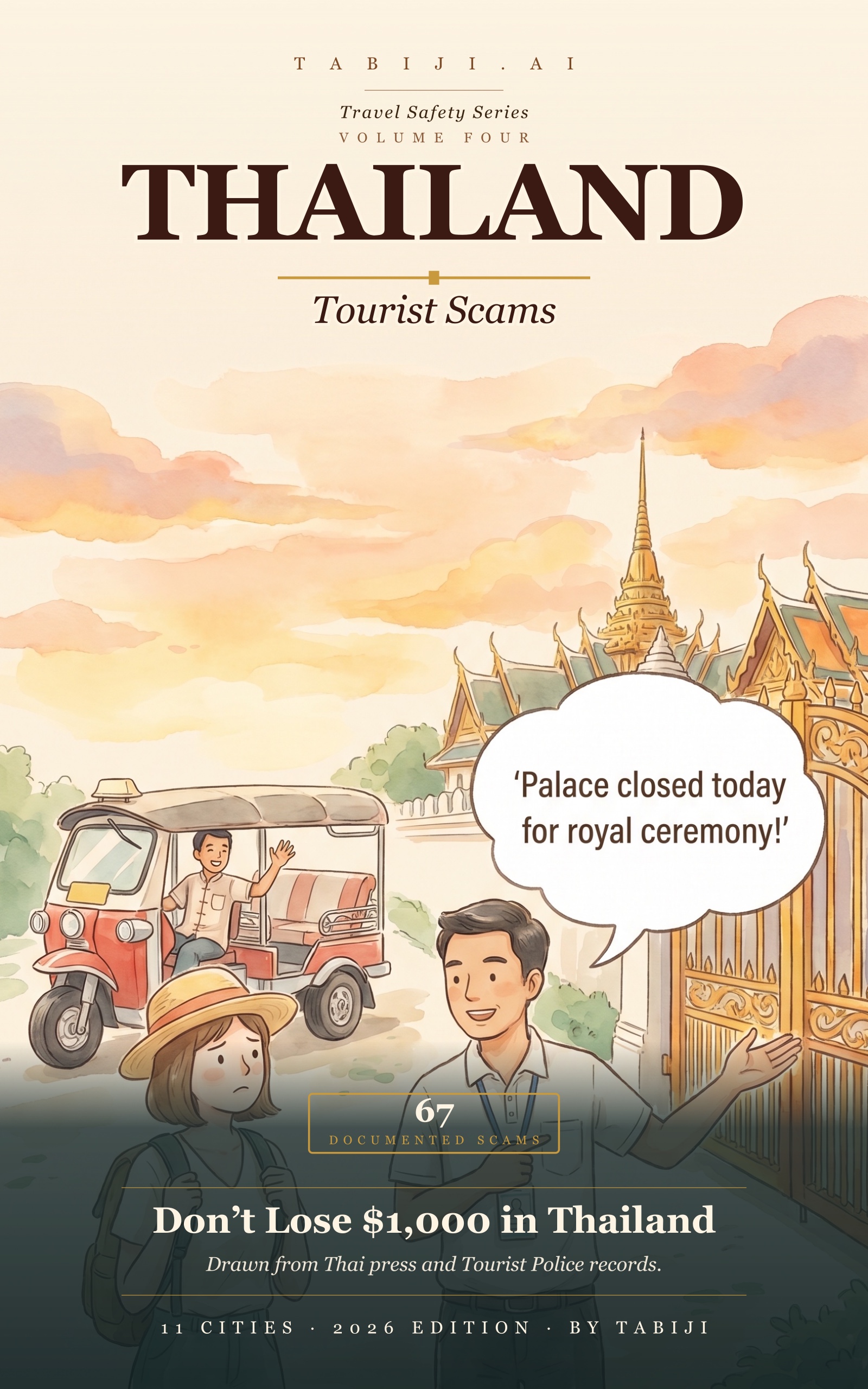
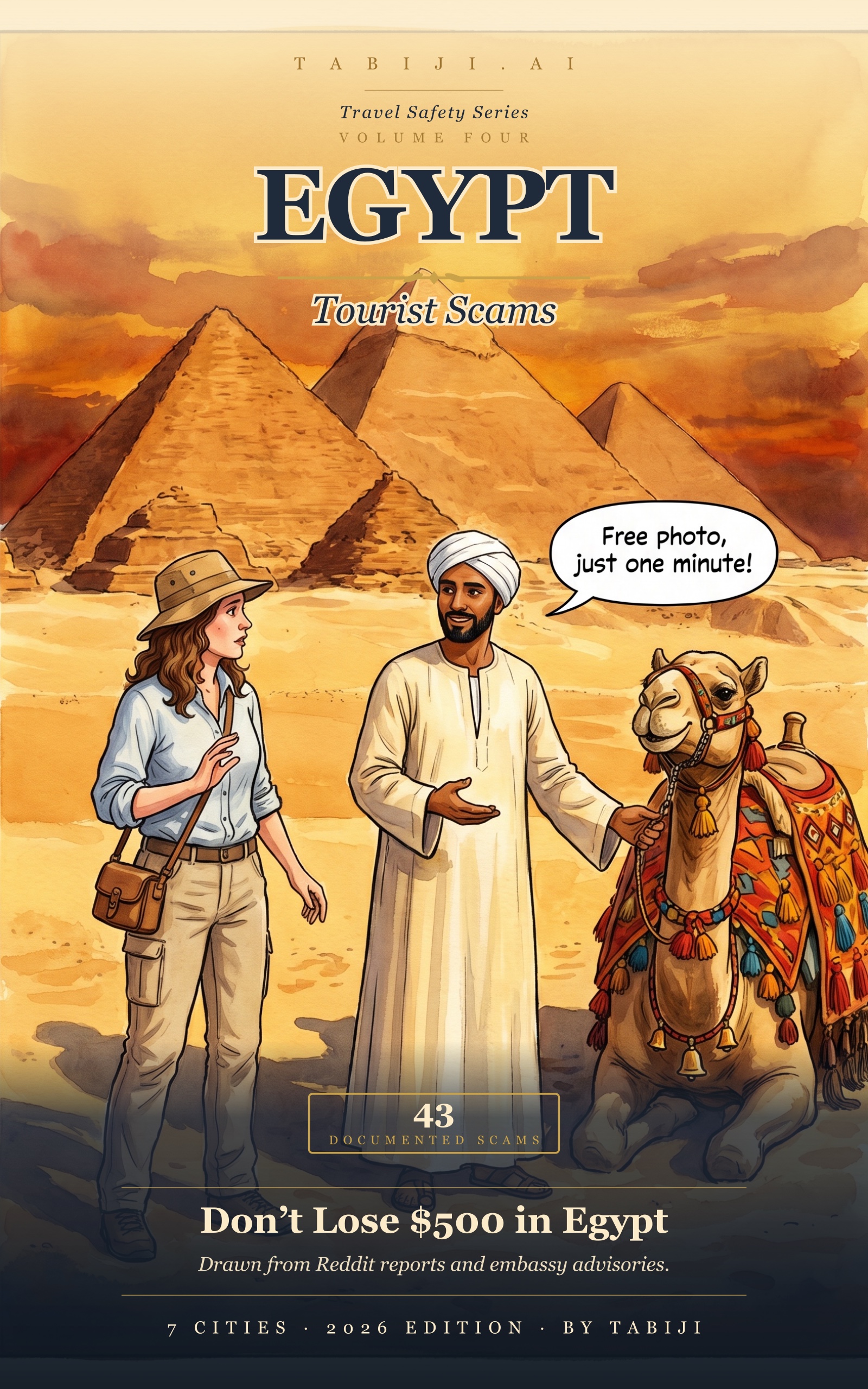
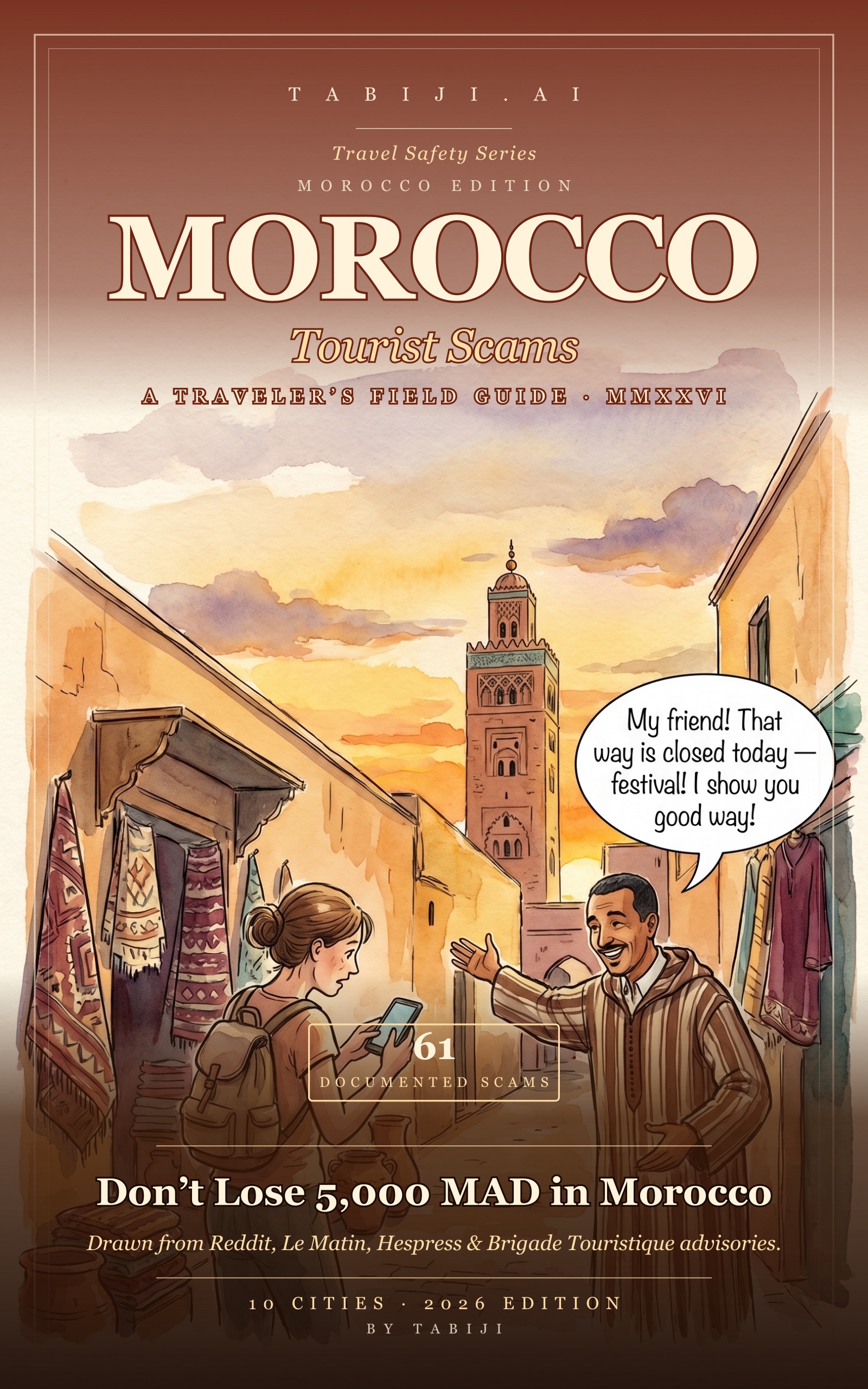
Fake government tourist offices, four mechanics behind the official-looking logo.
A "Tourist Information" booth at Bangkok Suvarnabhumi airport arrivals steering you to a kickback hotel at 50% over market rate. A Marrakech taxi driver insisting on a five-minute stop at "a special tourist office" that turns out to be a leather souk. A Hanoi Old Quarter streetside shop with a TAT-style logo selling overpriced day tours. An Istanbul stranger near Hagia Sophia saying it's closed today, "but the tourist office can help find alternatives." Four mechanics across 7 countries, defeated by the same five-second rule: verify the office's address on the official tourism authority website.


Fake government tourist office scams run four mechanics across 7 countries: airport arrivals booth (most-documented in Bangkok, Cairo, Hanoi, Istanbul), taxi-driver / tuk-tuk redirect, closed-attraction redirect, and brochure-display fake office. The universal defense is one five-second rule: verify any "tourist office" address against the official tourism authority website (tourismthailand.org for Thailand, egypt.travel for Egypt, visitmorocco.com for Morocco, vietnam.travel for Vietnam). The defense in depth is refusing curb-side booths, refusing driver-initiated office redirects, verifying closed-attraction claims on Google Maps in real time, and booking tours through Get Your Guide / Klook / Viator.
"Sir, Tourist Information, please come, hotel booking, taxi to city, all here."
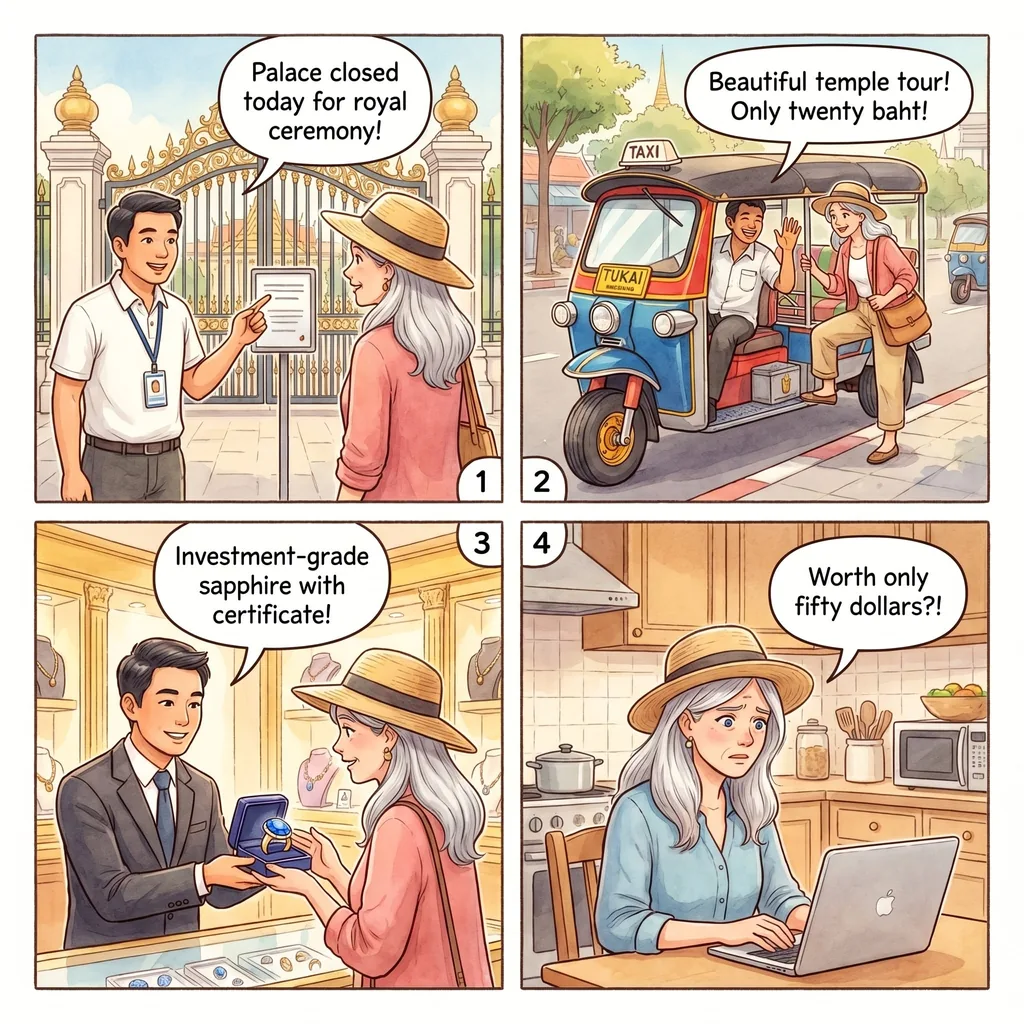
You exit Bangkok Suvarnabhumi (BKK) immigration and customs at 11pm on a Saturday. The arrivals concourse is crowded; signs are in Thai and English. Twenty meters past customs, just inside the public area, a brightly lit booth reads "TOURIST INFORMATION CENTER" in red letters with a faded gold logo that vaguely resembles the Tourism Authority of Thailand (TAT) seal. Two women in matching polo shirts sit behind the counter; a third stands with a clipboard. The third woman waves at you: "Sir, Tourist Information, hotel booking, taxi to city, all here, very fast."
You stop. You ask: "How much is the taxi to my hotel in Sukhumvit?" The clipboard woman quotes 800 THB. The official airport public-taxi metered rate from BKK to Sukhumvit is approximately 350-450 THB plus tolls (50-70 THB). The booth's quote is roughly double the official rate. The clipboard woman hands you a printed brochure with hotel options; the cheapest is 1,800 THB per night for a property listed on Booking.com at 1,100 THB. The booth charges roughly 60% above market on hotel bookings.
You verify the booth on your phone. The TAT website (tourismthailand.org) lists official TAT counters at Bangkok Suvarnabhumi: one in the public area near Gate 4, one at the AOT Limousine counter inside arrivals. The booth in front of you is labeled "Tourist Information Center" but does not appear on the TAT official directory. The faded gold logo is a private brand designed to mimic the TAT seal.
You take ninety seconds. You walk past the booth to the official Public Taxi queue (clearly signed, supervised by AOT Airport staff in uniforms), take a metered taxi to your Sukhumvit hotel for 380 THB plus 50 THB toll = 430 THB total. The booth would have charged you 800 THB. Your hotel booked directly via Booking.com costs 1,100 THB; the booth would have charged 1,800 THB. Total avoided over-charge: 1,070 THB (about 30 USD).
The Tourist Authority of Thailand publishes annual advisories about unofficial "Tourist Information" booths at Bangkok airport, particularly during high-tourist seasons (November-April). The Tourist Police 1155 (English-speaking dispatch) accepts complaints about fake booths but pursuit is limited because the booths are technically legal private businesses (they do not impersonate state enforcement, just official-looking branding).
That is the canonical airport arrivals booth variant of the fake-government-tourist-office family. The rest of this page is the four-mechanic playbook, the four other places where it runs in different forms (Cairo, Marrakech, Hanoi, Istanbul), and the verify-the-domain rule that defeats every variant.
Read the full Bangkok scam guide →Key Takeaways
The verify-the-domain rule
Fake government tourist offices depend on you accepting their official-looking signage at face value. Real national tourism authorities publish their offices on official .gov or established commercial domains; the fake-office addresses never appear on those lists. The defensive routine is one five-second check: verify the office's address on the official tourism authority website before engaging. The play falls apart instantly because the fake office's address is never listed.
- Identify real tourist offices by official domain and signage. TAT (tourismthailand.org), Egyptian Tourist Authority (egypt.travel), ONMT Morocco (visitmorocco.com), Vietnam Tourism (vietnam.travel), Hellenic GNTO (visitgreece.gr) all publish their official office addresses online. Verify any "tourist information" booth's address matches the official site before engaging.
- Refuse "tourist information" booths in the airport arrivals zone. Real official booths are inside the public-area concourse, not at the curb. Walk past curb-side booths; verify any inside-terminal booth via the airport's official directory.
- Refuse taxi-driver and tuk-tuk-driver office redirects. If a driver insists on stopping at a "special tourist office" on the way, decline. The redirect is a kickback play; real tourist offices are walk-in accessible at known addresses.
- Verify any "closed attraction" claim on Google Maps before redirecting. Major attractions have continuously updated hours. The closed-attraction-plus-redirect pattern is a kickback variant that ends at a craft shop or fake museum.
- Use Get Your Guide / Klook / Viator for tour bookings. Real tour bookings should go through licensed platforms or directly with the country's tourism authority. The fake-tourist-office variant runs by selling tours on the spot at 30-50% above market rate.
The four mechanics
Different geographies and operator types lean on different mechanics within the same family. Here are the four sub-variants documented globally. Each has a recognition tell, a primary geography, and the routine step that defeats it.
1. Airport Arrivals Booth
The most-documented variant. Tourists arriving at Bangkok Suvarnabhumi, Cairo, Hanoi, Istanbul, or Bali Ngurah Rai airports see prominent "Tourist Information" booths in the arrivals concourse or at the curb. The booths run hotel and tour kickbacks: when a tourist asks for hotel or taxi recommendations, the booth steers them to a kickback partner at 30-60% above market rate.
Defense: verify any inside-terminal booth via the airport's official directory; walk past curb-side booths. Most reported in: Bangkok BKK arrivals; Cairo CAI Terminal 1; Hanoi Noi Bai (HAN) Terminal 2; Istanbul IST arrivals; Bali Ngurah Rai (DPS) curb; Marrakech RAK arrivals.
2. Taxi-Driver / Tuk-Tuk Redirect
Documented in Marrakech, Cairo, Bangkok, Hanoi. A taxi or tuk-tuk driver, en route to your stated destination, insists on a brief stop at "a special tourist information office I always recommend, just five minutes, very helpful." The "office" is a kickback shop (craft shop, leather souk, unlicensed tour operator). The driver takes commission on any purchase or booking.
Defense: refuse all driver-initiated office redirects. Most reported in: Marrakech medina taxi rides to riads; Cairo airport taxis to downtown; Bangkok tuk-tuk circuits in old town; Hanoi Old Quarter cyclo and taxi rides.
3. Closed-Attraction Redirect
Most documented in Bangkok, Istanbul, and Cairo. A stranger near a major attraction tells you the attraction is closed today and offers to redirect you to a "tourist information office" or alternative attraction. The "tourist office" is a kickback craft shop or fake museum. Overlaps with the Fake Tour Guide variant (Vol 22) but specifically uses the "tourist office" framing.
Defense: verify any closed-attraction claim on Google Maps in real time. Most reported in: Bangkok Grand Palace and Wat Phra Kaew approaches; Istanbul Sultanahmet near Hagia Sophia and Blue Mosque; Cairo Egyptian Museum and Khan el-Khalili.
4. Brochure-Display Fake Office
A small shop or streetside stall displays prominent "Tourist Information Center" or "Government Tourist Office" signage, with a brochure rack and English-speaking "staff." The shop sells overpriced tours, hotel bookings, or directs tourists to kickback taxi services. The signage and branding mimic real government tourism authority logos.
Defense: cross-reference any "TIC" or "Tourist Office" against the official tourism authority website. Most reported in: Marrakech medina near Bab Doukkala and Place Jemaa el-Fna; Hanoi Old Quarter near Hoan Kiem Lake; Cairo Khan el-Khalili and Tahrir Square street-fronts; Istanbul Sultanahmet and Taksim Square.
Where it runs
Fake government tourist offices concentrate at major airport arrivals halls and at the entry points to high-traffic medina/old-town zones in Southeast Asia, North Africa, and Turkey. The seven countries below cover the bulk of global tourist exposure.
| Country | Documented variants | Iconic location pattern |
|---|---|---|
| 🇹🇭 Thailand | 4 | Bangkok Suvarnabhumi airport arrivals; Khaosan Road street-front fake offices; Sukhumvit BTS station booths; Chiang Mai old city |
| 🇪🇬 Egypt | 3 | Cairo airport tourist information booth; Tahrir Square street-front; Giza Pyramid approach; Khan el-Khalili |
| 🇲🇦 Morocco | 3 | Marrakech airport curb 'information'; medina gate fake offices; Fez Bab Boujloud; Casablanca downtown |
| 🇻🇳 Vietnam | 2 | Hanoi Old Quarter street-front fake TIC; Hoi An old town; Ho Chi Minh City Pham Ngu Lao |
| 🇹🇷 Turkey | 2 | Istanbul Sultanahmet near Hagia Sophia; Taksim Square; Cappadocia airport |
| 🇮🇩 Indonesia | 1 | Bali Ngurah Rai airport curb; Ubud street-front fake offices; Lombok Bangsal port |
| 🇮🇳 India | 1 | Delhi Connaught Place fake offices; Goa airport; Mumbai CST station booths |
Bar width is data-bound at 35 pixels per documented variant. Thailand alone accounts for 25% of global exposure, driven by Bangkok Suvarnabhumi airport arrivals booth concentration.
Four more places, four more office mechanics
The Bangkok Suvarnabhumi arrivals booth scene above showed the airport variant. Here are four more places where different sub-variants dominate. Each links to the full city scam guide.
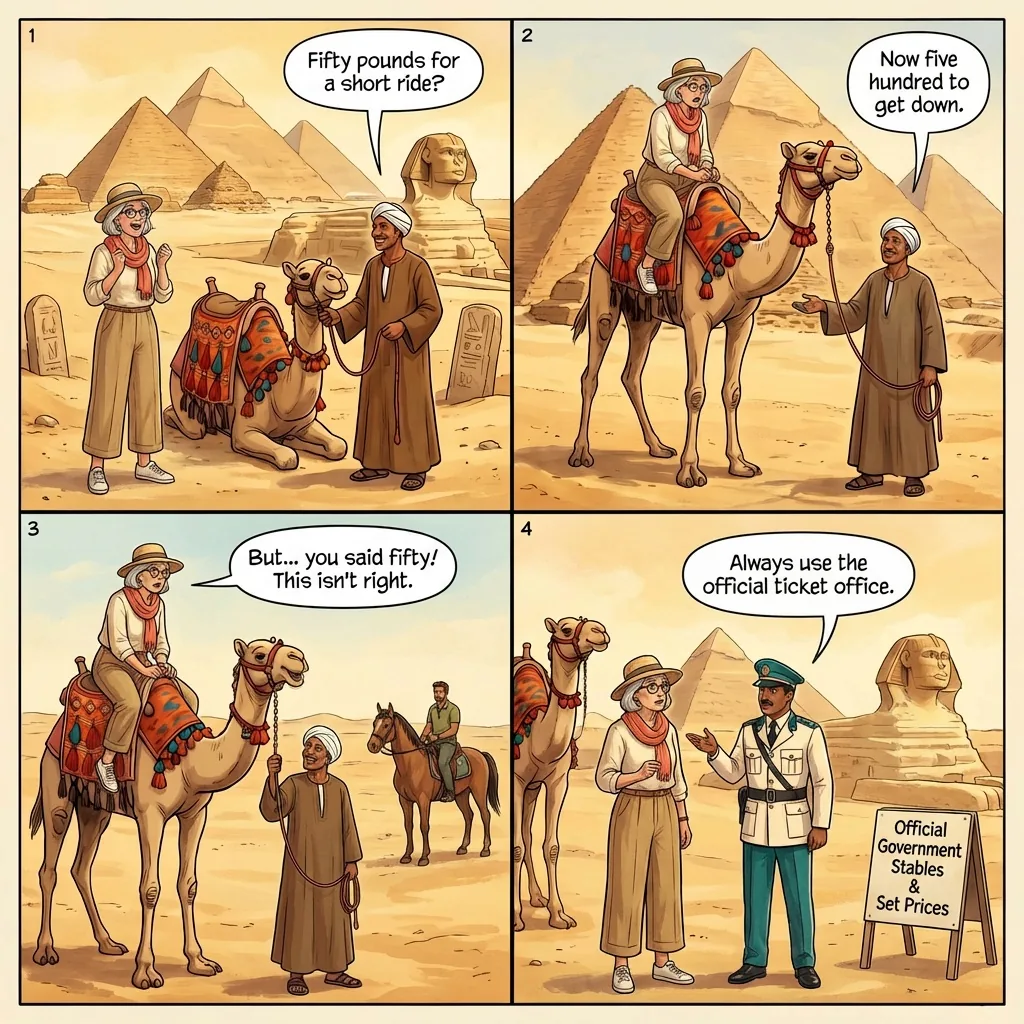
You arrive at Cairo International Airport (CAI) Terminal 1 at 1am after a connecting flight from London. The arrivals hall is dim; English-language signage is limited. Five meters past customs, a booth labeled "TOURIST INFORMATION" with a faded gold logo offers hotel bookings, taxi services, and Pyramid tour packages. The clipboard agent quotes 60 USD for a taxi to Zamalek (real metered rate: 200-300 EGP, about 7-10 USD), and 250 USD per night for a hotel listed on Booking.com at 90 USD. The Egyptian Tourist Authority (egypt.travel) maintains official information desks elsewhere in the airport, clearly marked with the official Egypt Travel logo and uniformed staff. The variant has been documented continuously since the 1990s; the Egyptian Tourist Police 126 publishes quarterly advisories. Defense: at Cairo airport, walk past all "Tourist Information" booths in the arrivals hall. Use the official Uber or Careem rideshare for transport (both operate from BKK / CAI airport). Book hotels online before arriving via Booking.com or Hotels.com.
Read the full Cairo scam guide →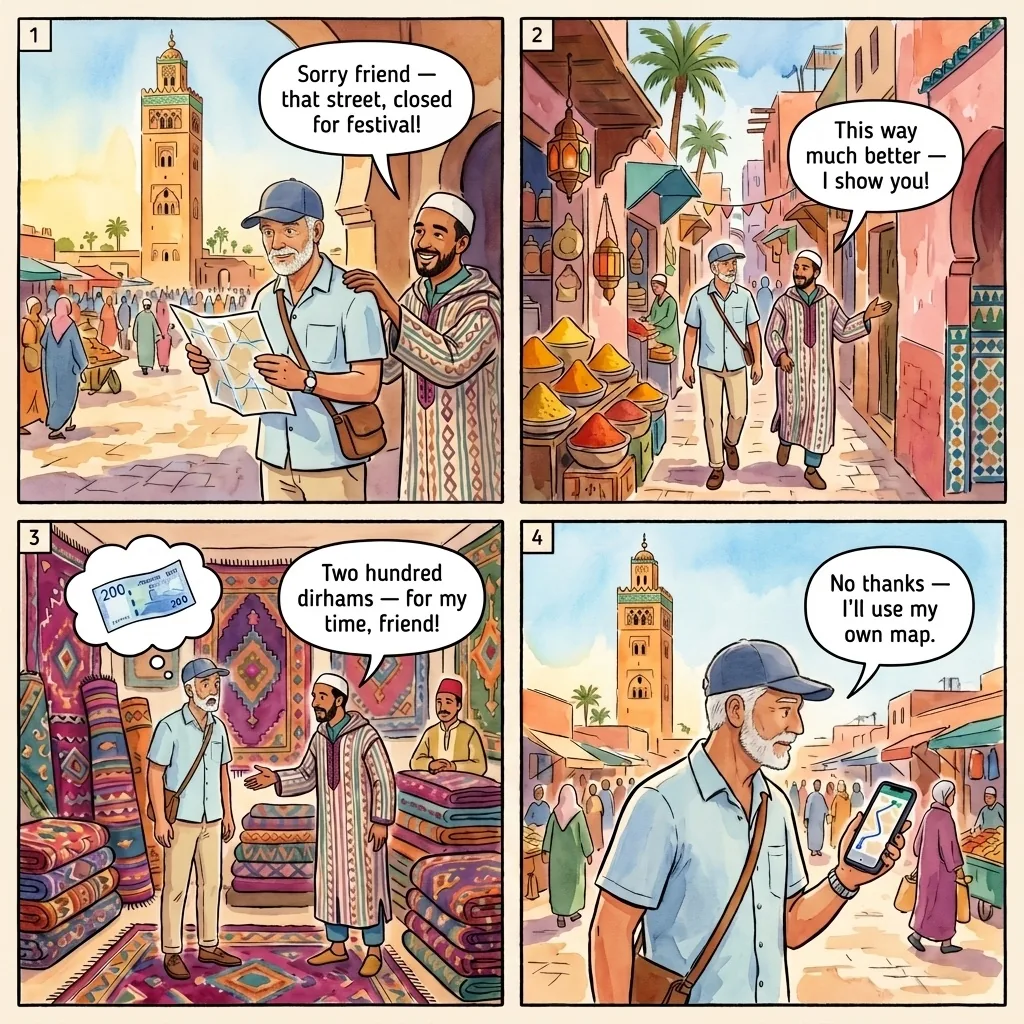
You arrive at Marrakech Menara airport (RAK) at 4pm and take a petit taxi to your riad in the medina. Halfway through the 20-minute drive, the driver says "Sir, before riad, one minute, special tourist office, very famous, my friend's place, you get good information about Morocco." The "office" is a leather souk in the medina; the driver receives 10-30% commission on any purchase. You decline; the driver continues to the riad without further pressure. Separately, near the Bab Doukkala medina gate, a small streetside shop with a "Tourist Information Center" sign and ONMT-style brand colors sells overpriced Atlas Mountain day tours (1,200 MAD vs 600 MAD via Get Your Guide). The Brigade Touristique Marrakech at Place Bab Doukkala accepts complaints; the variant is documented continuously. Defense: refuse all driver-initiated office redirects ("not interested, please continue to my riad"). Verify any medina-gate "TIC" against the ONMT visitmorocco.com official offices list (the real Marrakech tourism office is at Place du 16 Novembre, not at the medina gates).
Read the full Marrakech scam guide →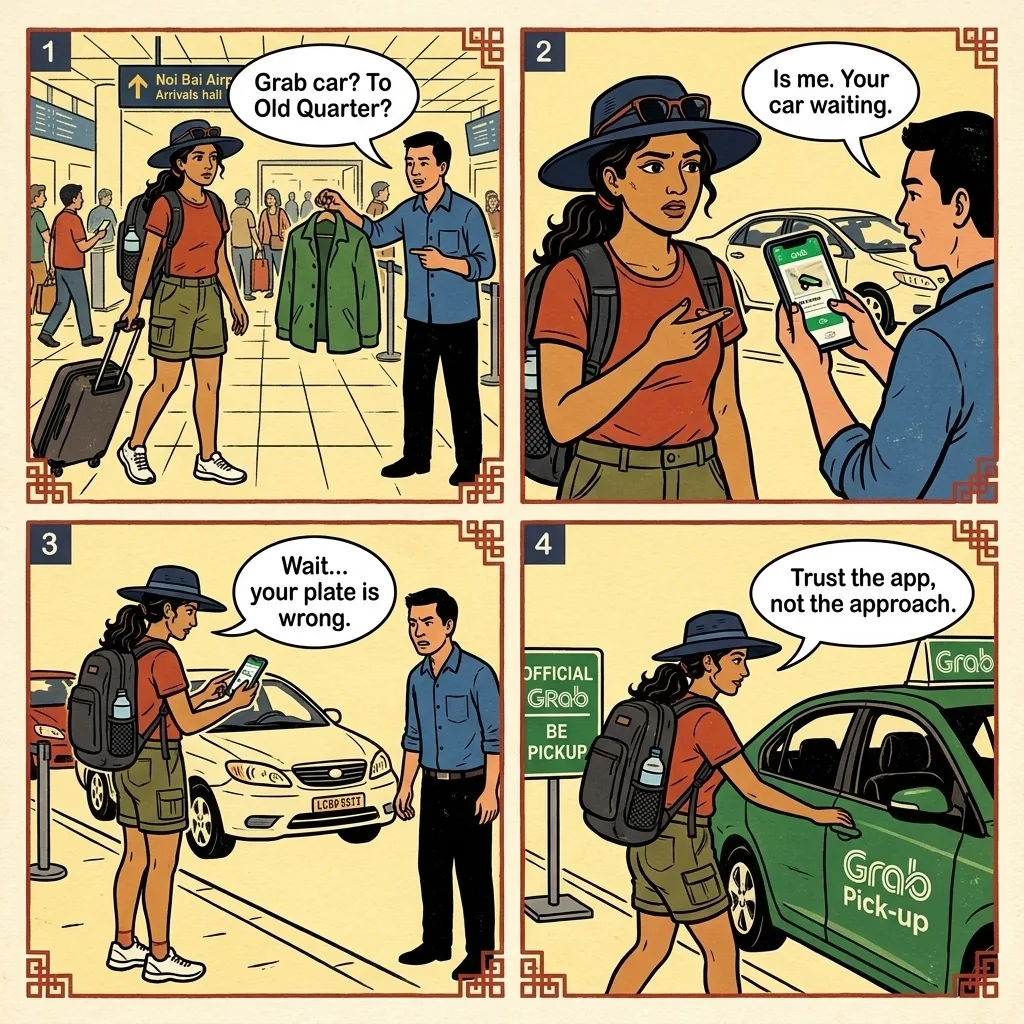
You walk through Hanoi Old Quarter near Hoan Kiem Lake at 10am on a Tuesday. On Hang Bac street you see a small shop with prominent "TOURIST INFORMATION CENTER" signage in red and gold, brochure rack outside, English-speaking staff. The shop sells Halong Bay 2-day cruises at 4,500,000 VND per person (about 180 USD); the equivalent cruise via Get Your Guide or directly with operators like Indochina Junk costs 2,800,000 VND (about 110 USD). The shop's logo is designed to mimic the Vietnam Tourism (vietnam.travel) seal but does not match the official site's logo. The real Vietnam Tourism office in Hanoi is at 79 Ba Trieu street, not in the Old Quarter. The Hanoi Tourism Department accepts complaints about Old Quarter fake offices; the variant has been documented continuously since the 2010s. Defense: verify the address against vietnam.travel's official offices list before booking any tour. The shop's address (Hang Bac) is not on the official list.
Read the full Hanoi scam guide →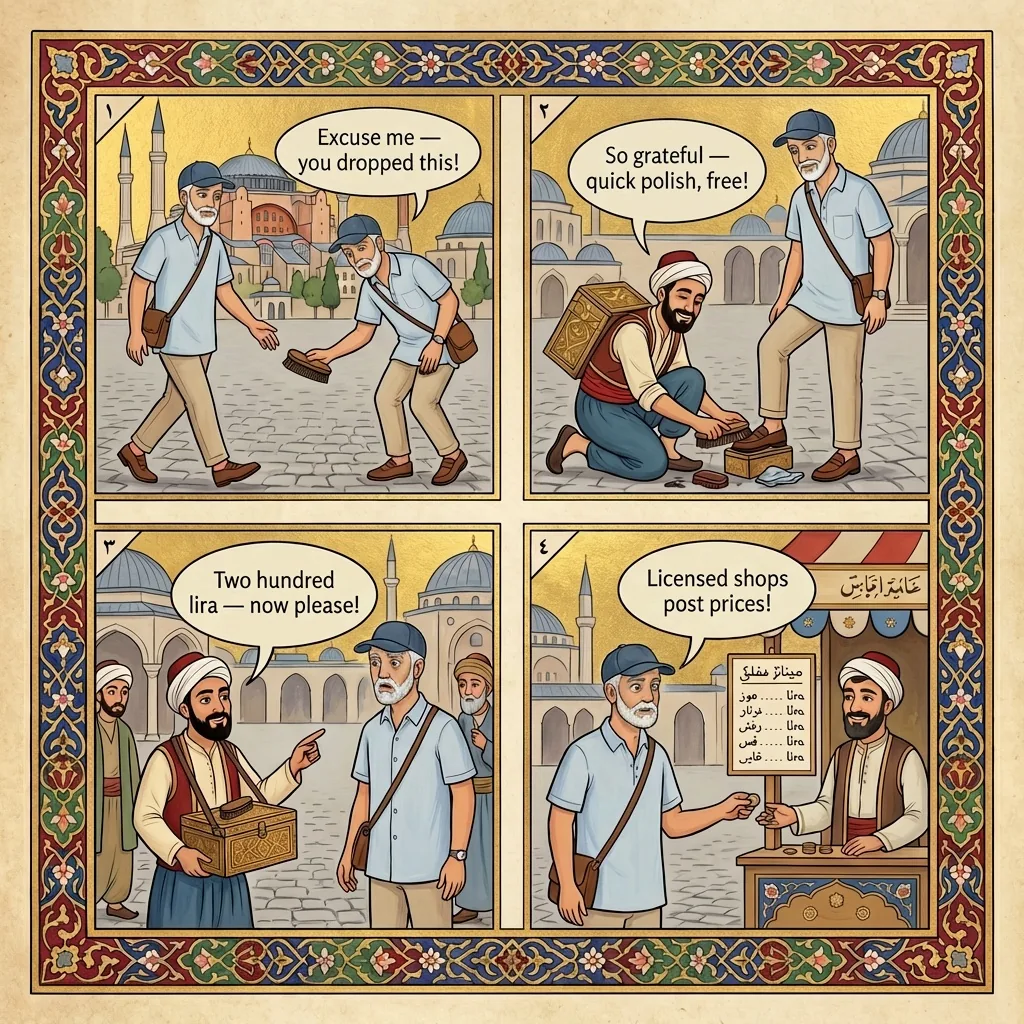
You walk into Sultanahmet from your hotel near Hagia Sophia at 11am on a Wednesday. A man in business casual approaches near the Sultanahmet tram stop: "Sir, the Hagia Sophia is closed today, prayer day, but the tourist office around the corner can help you find alternatives, just one minute." The "tourist office" is a streetside shop with "Istanbul Tourist Information" signage selling overpriced Topkapi Palace + Bosphorus tour packages and Turkish carpet "tours" (i.e. carpet shop visits with kickback). Hagia Sophia is open 7am-7pm daily except during 30-minute prayer-time closures (which are announced on the official site, kulturportali.gov.tr). The Istanbul Tourism office is at Sirkeci, not at Sultanahmet entrance. The variant has been documented in Sultanahmet continuously since the early 2000s. Defense: verify any closed-attraction claim on Google Maps in real time. The Istanbul Tourist Police office is at Yerebatan Street; legitimate tourism information is at Sirkeci, not at street-front shops near major attractions.
Read the full Istanbul scam guide →Red flags
If two or more of these signals fire when you encounter a "tourist information" office, walk away. The compounding rule: a single signal might be a coincidence; two signals are a script.
- The booth is at the airport curb or arrivals concourse edge, not in official directory
- The signage uses faded or mimicked national tourism authority logos
- The address is not listed on the official tourism authority website
- The booth offers hotel bookings, taxi service, AND tour bookings together
- The quoted hotel / taxi / tour rates are 30-60% above market
- A taxi or tuk-tuk driver insists on a "five-minute stop" at a special office
- A stranger near a major attraction says it's closed and redirects to an "office"
- The shop displays multiple national tourism authority logos (none match the country)
- Aggressive English-speaking staff push tour bookings on the spot
- The "office" sells handicrafts or carpets alongside tourism information
The phrases that shut it down
Refusing the fake tourist office works when you signal you have your own information source. The phrase pattern is the same in every language: I have my own information.
If you got hit
You booked a tour through a "Tourist Information Center" that turned out to be a kickback shop, or paid 60 USD for a 10 USD taxi at the airport booth. Fake-tourist-office losses are partially recoverable through credit-card chargeback when paid by card, rarely recoverable for cash. The actionable response is preventive for the next encounter.
Within 24 hours: file a credit-card chargeback claim if any portion was paid by card. The grounds: "service not as described" or "merchant misrepresentation." Visa and Mastercard chargeback windows are 60-120 days; submit the original brochure / receipt / photo evidence of the booth's official-looking signage and the description of what was delivered.
Within 7 days: file a complaint with the country's tourism authority. TAT (Tourism Authority of Thailand), Egyptian Tourist Authority, ONMT Morocco, Vietnam Tourism Department, Turkish Ministry of Culture and Tourism, Indian Ministry of Tourism all accept English-language complaints about fake-office variants. The complaint helps the authority track booth concentrations and update advisories.
If the variant included a closed-attraction redirect that ended at a tourist-trap shop: the cash for the shop purchase is rarely recoverable; the time and inconvenience are unrecoverable. The actionable response is preventive: book attractions and tours through Get Your Guide / Klook / Viator with verified itineraries.
- Bangkok: Tourist Police 1155 (24/7, English); TAT (Tourism Authority of Thailand) for booth complaints.
- Cairo: Tourist Police 126 (24/7); Egyptian Tourist Authority (egypt.travel) complaint form.
- Marrakech: Brigade Touristique, Place Bab Doukkala (24/7); ONMT for fake-office complaints.
- Hanoi: Vietnam Tourist Police 080-71-080; Hanoi Tourism Department.
- Istanbul: Istanbul Tourist Police 0212 527 4503; Turkish Ministry of Culture and Tourism.
- Bali: Bali Tourist Police 0361 754 599 (English-speaking); Indonesian Tourism Ministry.
- Delhi: Tourist Police 1363 (24/7); Indian Ministry of Tourism.
- Travel insurance: Allianz Travel, World Nomads, AIG Travel Guard cover misrepresentation claims with police report.
Recovery rates: credit-card chargeback 40-60% with documentation; tourism authority complaints 10-30% (mostly informational rather than refundable). The actionable response is preventive: verify the office address against the official tourism authority website; refuse curb-side booths; refuse driver-initiated office redirects; book tours via Get Your Guide / Klook / Viator.
Related atlas entries
Sister entries in the Scam Atlas. Fake government tourist office sits in the Fake Authority section alongside fake police and fake tour guide; closed-attraction redirect overlaps with the Fake Tour Guide variant.
Sources
- Tourism Authority of Thailand (TAT), Bangkok Suvarnabhumi airport advisory bulletins (Thailand, ongoing).
- Egyptian Tourist Authority (egypt.travel), Cairo airport tourist information complaints (Egypt, ongoing).
- Office National Marocain du Tourisme (ONMT), Marrakech and Fez fake-office advisories (Morocco, ongoing).
- Vietnam Tourism Department, Hanoi Old Quarter fake TIC enforcement (Vietnam, ongoing).
- Turkish Ministry of Culture and Tourism, Istanbul Sultanahmet tourist-office advisories (Turkey, ongoing).
- Bangkok Post, fake tourist information booth investigative coverage (Thailand, 2018-2025).
- Egypt Today and The National, Cairo airport fake-office complaints (Egypt, 2019-2025).
- Le Matin Morocco, Marrakech medina fake-office reporting (Morocco, ongoing).
- r/travel, r/Thailand, r/Egypt, r/Morocco, r/Vietnam, r/turkey continuing thread monitoring 2018-2026.
Get the full fake-government-tourist-office playbook for your destination.
Each Travel Safety atlas covers every documented authority and tourist-office scam in one country, plus the country's full scam catalog: pickpocket, taxi, ATM, restaurant, distraction. Buy once, lifetime updates as scams evolve. $4.99 on Kindle.