Tea House Invitation Scam: Beijing & Shanghai signature.
Friendly art students approach you on Wangfujing or the Bund, propose tea ceremony at a small house in a side street, and the bill arrives at 4,800 USD per person. The no-tea-with-strangers rule and the price-upfront rule defeat every variant of one of China most-documented tourist scams.


The China tea house invitation scam runs four city variants targeting foreign tourists with the same mechanic: friendly art students or fellow tourists approach near major monuments, propose a traditional tea ceremony, walk the tourist to a side-street tea house, and the bill arrives at 1,000-5,000 USD per person. Beijing Wangfujing and Tiananmen approach is the canonical hotspot; Shanghai Nanjing Road East and the Bund are the second most-active; Xi an Muslim Quarter near the Bell Tower frames the variant with claimed Tang dynasty cultural significance; Hangzhou West Lake promenade frames it with Longjing tea cultural ceremony. Documented continuously since the late 1990s; volume rebounded after China reopened to international tourists in 2023. The universal defenses are two rules: the no-tea-with-strangers rule (real Chinese hospitality is offered through hotel concierge, museum gift shops, or licensed teahouses with displayed prices like Lao She and Huxinting; strangers offering free or cheap tea ceremony are operating the variant 100 percent of the time), and the price-upfront rule (any teahouse must show a printed menu in Chinese and English with set prices before sitting; absence of menu is the variant by definition; real Chinese tea ceremony is 50-200 RMB per person, not 1,000-5,000 USD).
"My friend and I are art students; we want to practice English; would you like to see a traditional tea ceremony?"
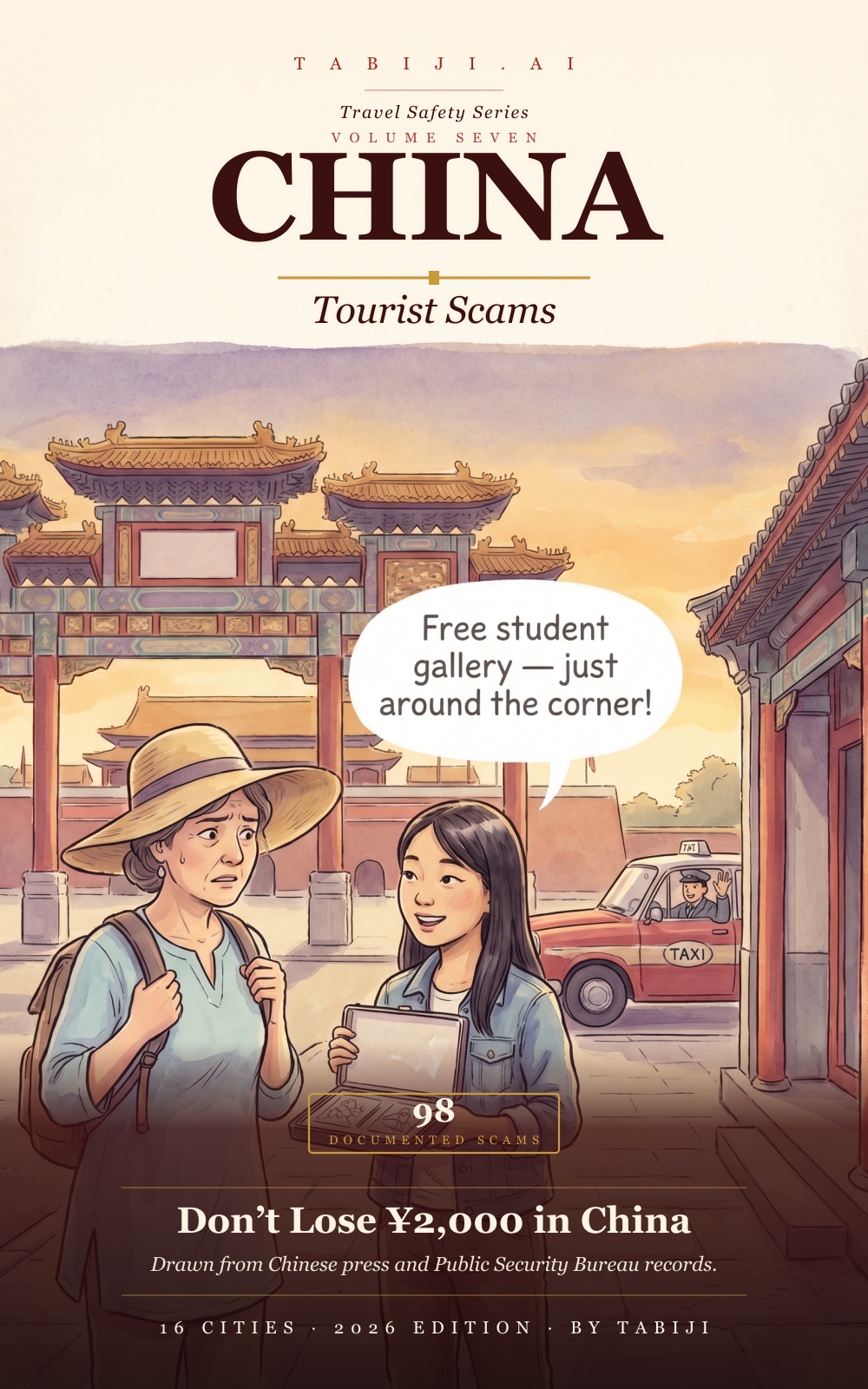
You and your travel partner walk south on Wangfujing, the main pedestrian shopping street in central Beijing. The afternoon is mild; you have just visited the Forbidden City. Two young women in their twenties approach you, smiling. They speak fluent English with slight accents. They say they are art students from the Central Academy of Fine Arts; they are working on an English-practice project; they would like to chat for ten minutes.
You hesitate, then agree. The conversation is friendly: where you are from (you tell them: Australia), what you have seen in Beijing, what foods you have tried. Twelve minutes in, one of them says: "we have a small tea house nearby, just five minutes walk; we are going for a traditional tea ceremony with our friends; would you like to come, you can experience real Chinese tea, very interesting." Her friend nods enthusiastically.
You agree. You walk five minutes east, into a side street off Dongdan, up a narrow staircase to a second-floor tea house. The room is small, ornate: lacquered wood walls, a calligraphy scroll, a low tea table with a single setting. Two more young women in qipao greet you. The art students sit with you. The qipao-dressed pourers begin a tea ceremony — multiple infusions, small accompaniments, brief explanations of each tea variety. The ceremony lasts about forty minutes.
At the end, the manager appears. He hands you a folded printed bill on a small tray. The bill is in Chinese; one of the art students translates: total 32,000 RMB (about 4,500 USD) for the ceremony, two tourists, eight tea varieties, three accompaniments, service charge. The art students have stood up and walked toward the door. The manager closes the door behind them.
This is the canonical Beijing tea house invitation scam, the most-documented Chinese tourist scam since the late 1990s. The Beijing Public Security Bureau receives dozens of complaints per week during peak tourist season; the China Tourism Administration issues advisories; tourist police 110 and the Tourism Complaint Hotline 12301 both handle the variant regularly. Real Chinese tea ceremony at licensed houses (Lao She Teahouse near Tiananmen, Huxinting Teahouse in Shanghai Yu Garden) charges 50-200 RMB per person; the 32,000 RMB bill is 200x the legitimate rate.
The defense is two rules. The no-tea-with-strangers rule: real Chinese hospitality is offered through hotel concierge, museum gift shops, or licensed teahouses with displayed prices. Strangers approaching tourists at major monuments offering free or cheap tea ceremony are operating the variant 100 percent of the time. Polite firm refusal in Mandarin ("Bu yong, xie xie") and continued walking ends the engagement before the invitation. The price-upfront rule: any teahouse must show a printed menu in Chinese and English with set prices before sitting; absence of menu is the variant by definition.
That is the canonical Beijing variant of the China tea-house-invitation family, executed at the most-documented Chinese tourist street. The rest of this page is the four-mechanic playbook, the three other places where it runs in different forms (Shanghai Bund, Xi an Muslim Quarter, Hangzhou West Lake), and the two rules that defeat every variant.
Read the full Beijing scam guide →Key Takeaways
The no-tea-with-strangers rule and the price-upfront rule
Every variant of the China tea house invitation scam is defeated by the same two rules. The no-tea-with-strangers rule: never accept tea-ceremony invitations from strangers in China. Real Chinese hospitality is offered through hotel concierge, museum gift shops with set prices, licensed teahouses with displayed prices, or hotel-arranged cultural tours. Strangers approaching tourists at major monuments offering free or cheap tea ceremony are operating the variant 100 percent of the time. The price-upfront rule: any teahouse experience must show a printed menu in Chinese and English with set prices before sitting. Reputable tea houses display prices prominently; operator-aligned ones do not. If a tea house has no displayed menu, walk out before sitting.
The first rule addresses the social-warmth asymmetry. Operators frame the invitation as cultural hospitality, language-practice opportunity, or fellow-traveler kindness. Foreign visitors raised in cultures where polite acceptance is socially expected feel pressure to accept; declining feels rude. The structural reality is that real Chinese students, locals, and travelers do not invite foreign tourists to commercial tea houses minutes after meeting them; the invitation pattern is the variant by definition. Polite firm refusal in Mandarin (Bu yong, xie xie) and continued walking is socially acceptable in China; cultural norms recognize the right to decline street solicitation.
The second rule addresses the price-disclosure asymmetry. Real Chinese tea ceremony at licensed houses (Lao She Teahouse, Huxinting Teahouse, Tianyun Tea House) charges 50-200 RMB per person and displays the price publicly. Operator-aligned tea houses operate from side streets or upper floors of unmarked buildings, set up a single tea-ceremony table per session, and announce prices only at end-of-ceremony when leaving requires payment. Demanding the printed menu before sitting collapses the price-disclosure asymmetry; operator-aligned houses cannot produce a real menu and the variant ends.
The third defense is the art-student refusal. The standard pitch in Beijing Wangfujing, Shanghai Nanjing Road, Xi an Muslim Quarter, Hangzhou West Lake is identical: hello, where are you from, can you help my English, would you like to see traditional tea ceremony with my friends. Recognizing the pattern (multiple young women approaching, fluent English with slight accent, geographic-origin question, tea-ceremony invitation within five minutes) and refusing politely defeats the engagement before the walk to the tea house.
The fourth defense is the exit-on-arrival rule. If you have already accepted the invitation and arrived at the tea house, leave immediately upon entering and noticing red flags: no menu visible, ornate-but-empty room, single small table set up, Chinese opera music playing, the door closed behind you. Pay nothing if no service has been rendered; reputable tea houses welcome customers entering and leaving freely.
The fifth defense, when the inflated bill arrives: refuse to pay the inflated amount. Offer 100-200 RMB cash for the tea actually consumed (the equivalent of a real teahouse charge). If the staff insist or block the exit, phone tourist police on 110 or call the China Tourism Complaint Hotline 12301. Most tea houses accept the offered amount when police are confirmed inbound; a few escalate, in which case stay calm and verbal until police arrive. The Beijing Public Security Bureau and Shanghai Tourism Administration both handle these reports daily.
The four city variants
The China tea house invitation scam runs in four regional variants across the major Chinese tourist destinations. The mechanic is identical; the cultural framing and operator network differ by city.
1. Beijing Wangfujing / Tiananmen approach
The canonical variant. Operators concentrate at Wangfujing pedestrian street, Tiananmen Square approach, Forbidden City exits, Houhai lakes, the Temple of Heaven entrance. The pitch is art-student English-practice; the tea house is in a side street or upper floor near the monument. Bills run 1,500-4,800 USD per person. Documented continuously since the late 1990s. Beijing Public Security Bureau handles complaints; tourist police 110 and Tourism Complaint Hotline 12301.
2. Shanghai Nanjing Road / The Bund
The Shanghai variant. Operators concentrate on Nanjing Road East (between People Square and the Bund waterfront), the Bund promenade, Yu Garden surroundings. Same art-student pitch with Shanghai-cultural framing; the tea house is typically in a Bund-adjacent side street or upper floor of a colonial-era building. Bills run 1,000-3,000 USD per person. Documented heavily; Shanghai Tourist Police 110 and the Shanghai Tourism Administration accept complaints.
3. Xi an Muslim Quarter / Bell Tower
Xi an variant adds Tang dynasty cultural framing. Operators concentrate at the Muslim Quarter near the Bell Tower and Drum Tower, the Big Wild Goose Pagoda approach, the Terracotta Warriors site approach (less common, more bus-tour controlled). Pitch is similar to Beijing but with claimed cultural significance for Tang dynasty tea traditions. Bills run 1,000-2,500 USD per person. Documented at lower volume than Beijing or Shanghai but the per-victim loss is similar.
4. Hangzhou West Lake / Longjing Plantation
Hangzhou variant frames the invitation around Longjing (Dragon Well) tea, a famous green-tea variety from the Hangzhou region. Operators concentrate on the West Lake promenade (especially near Su Causeway and Bai Causeway), the Lingyin Temple approach, and the Longjing tea plantation village (where some tourist-shop operations layer onto real plantation visits). The variant runs at lower volume but with a stronger cultural-authenticity claim. Bills 800-2,000 USD per person. Adjacent: similar variants in Hong Kong Tsim Sha Tsui targeting mainland-Chinese tourists; Macau lower volume.
Where it runs
The China tea house invitation scam concentrates at major tourist monuments in Beijing, Shanghai, Xi an, and Hangzhou. The geography below covers the most-documented operator hotspots.
- Beijing (canonical hotspot): Wangfujing pedestrian street (especially the Wangfujing Snack Street and Wangfujing Bookstore area); Tiananmen Square approach (especially Qianmen Street and the south-east corner); Forbidden City east and west exits; Houhai lakes and Yandai Xie Jie alley; Temple of Heaven east gate; Beihai Park exits; Olympic Park approach. Beijing Public Security Bureau handles complaints; Wangfujing police substation responds in 5-10 minutes.
- Shanghai: Nanjing Road East between People Square and the Bund; the Bund waterfront promenade (especially north end near Suzhou Creek); Yu Garden surroundings (Old City); Tianzifang artistic quarter; French Concession (lower volume). Shanghai Tourist Police 110 and Shanghai Tourism Administration handle complaints.
- Xi an: Muslim Quarter near Bell Tower and Drum Tower; Big Wild Goose Pagoda approach; Bell Tower Square; Han Yang Mausoleum approach (less common). Xi an Public Security Bureau handles complaints.
- Hangzhou: West Lake promenade (especially Su Causeway and Bai Causeway entrances); Lingyin Temple approach; Longjing tea plantation village (some operator overlap with real plantation visits); Hefang Street. Hangzhou Tourist Office handles complaints.
- Adjacent (also documented): Hong Kong: Tsim Sha Tsui Star Ferry approach, Mong Kok Ladies Market (lower volume, often targeting mainland-Chinese tourists). Macau: Senado Square (lower volume). Chengdu: Wide and Narrow Alleys (Kuanzhai Xiangzi). Guilin: Yangshuo West Street.
Three more places, three more tea-house variants
Shanghai Nanjing Road: the Bund tea ceremony
Shanghai, Nanjing Road East, near the Bund. You and your travel partner walk east toward the Huangpu river waterfront. Two young women approach: they say they are MFA students at Shanghai Theater Academy, working on an English-language theater project. They ask if you would like to see a tea ceremony at a friend tea house in the Bund area. You agree.
They walk you four blocks south, into a side street off the Bund, up to the third floor of a 1920s colonial-era building. The tea house is small, decorated with Republic-era Shanghai memorabilia. The ceremony is professional. At the end, the bill arrives at 28,000 RMB (about 3,900 USD) for two people, four tea varieties, accompaniments, service.
You phone tourist police 110. The two students have left. The manager hears you on the phone and reduces the bill to 800 RMB (about 110 USD), which you pay in cash. You file a Shanghai Tourism Administration complaint via 12301; the agency confirms the tea house was on a watch-list and the case opens an investigation.
Xi an Muslim Quarter: the Tang dynasty ceremony
Xi an, Muslim Quarter, evening. The night market is dense; lamb skewers cook on grills; pomegranate juice vendors call out. A man in his thirties approaches you and your travel partner; he says he is a Tang-dynasty culture researcher and would like to invite you to a small tea house showing Tang ceremony.
The walk is six minutes through narrow alleys; the tea house is in the upper floor of an old hutong. The ceremony is theatrical: hosts in Tang costume, calligraphy demonstrations, multiple tea varieties from "Tang dynasty mountain regions." Bill arrives at 18,000 RMB (about 2,500 USD) per couple.
Defense: refuse the invitation at the night market. Real Tang dynasty cultural performances are at the Tang Paradise (Tang Paradise theme park), Shaanxi History Museum, or Datang Furong Garden — all government-licensed venues with displayed prices. Side-street upper-floor tea houses with Tang ceremony are the variant by definition.
Hangzhou West Lake: the Longjing plantation visit
Hangzhou West Lake, Su Causeway. A young woman approaches your couple; she says she is a tea master in training and would like to invite you for a Longjing (Dragon Well) ceremony at her family tea house in the West Lake hills. The framing is cultural: Longjing is a famous Chinese green tea, and the variant frames an authentic plantation experience.
Twenty-minute taxi ride to a tea house in the Longjing village. The house is real (Longjing is a real tea-producing region), but the operator is not. The ceremony is professional; the bill at end is 9,500 RMB (1,300 USD) per couple. The tea master takes the cash and disappears; the next ceremony is set up for another tourist couple.
Defense: real Longjing plantation visits are arranged through licensed tour operators (Hangzhou Tourist Office, Lonely Planet recommendations, hotel concierge). Real plantation tours include a tea-tasting at 50-150 RMB per person. The street-invitation variant is the operator setup; the cultural-authenticity claim does not change the price-disclosure asymmetry.
Hong Kong Tsim Sha Tsui: the mainland-cousin variant
Hong Kong, Tsim Sha Tsui Star Ferry pier, evening. A young woman approaches you (a mainland-Chinese tourist couple). She speaks Mandarin; she says she is a Hong Kong art student and would like to show you a traditional Cantonese tea ceremony at a small tea house in Mong Kok. The pitch is identical to Beijing but framed as Cantonese-cultural rather than Mandarin.
You walk to a tea house in the upper floor of a Mong Kok building. The ceremony is brief; the bill is HK$ 18,000 (about 2,300 USD) per couple. The variant runs at lower volume in Hong Kong than in mainland China; Hong Kong Police 999 dispatch responds quickly to Tsim Sha Tsui calls.
Defense: same as mainland China. Real Hong Kong tea houses (Lin Heung Tea House, Lock Cha Tea Shop) display prices prominently and welcome walk-in customers without solicitation. Street-invitation variants in Tsim Sha Tsui or Mong Kok are the operator setup.
Red flags
- Strangers approach you within seconds of arriving at a major Chinese monument. Wangfujing, Bund, Muslim Quarter, West Lake — operator preferred environments.
- Multiple young people approach as a group. Real students approach singly; operator pairs are the structural setup.
- Fluent English with slight Chinese accent. Real students vary widely in English; operators are trained for the script.
- Geographic-origin question early in conversation. "Where are you from" within first three minutes is the operator setup.
- Tea-ceremony invitation within five minutes of meeting. The signature trigger; refuse politely and walk away.
- Tea house in side street or upper floor without displayed prices. Real teahouses are at street level with prominent menus.
- Door closes behind you upon entering tea house. Reputable houses leave doors open during business hours.
- Bill arrives only at end of ceremony, in Chinese, on folded paper. Real teahouses present price upfront with menu.
The phrases that shut it down
Each phrase below refuses the tea-house invitation firmly without breaking stride. Said in Mandarin, walking past at normal pace, no eye contact.
If you got hit
If you are inside a tea house and the bill arrives at 1,000-5,000 USD: stay calm. Refuse to pay the inflated amount; offer 100-200 RMB cash for the tea actually consumed (the equivalent of a real teahouse charge). Phone tourist police on 110 (police emergency) or call the China Tourism Complaint Hotline 12301. Most tea houses accept the offered amount when police are confirmed inbound; a few escalate, in which case stay calm and verbal until police arrive. The Beijing Public Security Bureau, Shanghai Tourist Police, Xi an Public Security Bureau, and Hangzhou Tourist Office all handle these reports daily during peak tourist season.
If you have already paid by credit card under duress: file a chargeback within 30 days under "billed amount differs from agreed amount" or "service not as described." Visa, Mastercard, Amex accept tea-house-fraud disputes; recovery rate is high with documentation (photo of the tea house exterior if safely possible, photo of the bill, receipt of any prior real-rate payment). UnionPay (China-domestic) chargeback corridor is more limited; the foreign card is the better path.
If you have already paid by cash and left: file a complaint with the China Tourism Complaint Hotline 12301 within 7 days. Provide the tea house location, names if known, the bill amount, and any photos. The China Tourism Administration maintains a watch-list of operator-aligned tea houses and runs periodic enforcement waves; reports do contribute to license suspensions. Cash recovery is uncommon but the report protects later tourists.
If you were physically blocked from leaving and felt threatened: phone the embassy emergency duty officer in addition to local police. The US, UK, Canadian, Australian embassies in Beijing all have 24-hour duty officers; consulates in Shanghai, Guangzhou, Chengdu, Wuhan also handle tourist-distress cases. US +1 202 501 4444; UK +44 20 7008 5000.
Related atlas entries
Sources & references
- Beijing Public Security Bureau: 110 dispatch; Wangfujing police substation; ongoing tea-house-scam advisories since the late 1990s.
- China National Tourism Administration: Tourism Complaint Hotline 12301; English-language operators available.
- Shanghai Tourist Police 110; Shanghai Tourism Administration complaint office at the Bund.
- Xi an Public Security Bureau; Xi an Tourism Bureau Muslim Quarter substation.
- Hangzhou Tourist Office; Hangzhou Public Security Bureau West Lake substation.
- UK FCO travel advice: China country page warns about tea-house scams.
- US State Department travel.state.gov: China country information page references tea-house and art-student scams.
- Real licensed tea houses: Lao She Teahouse Beijing (laosheteahouse.com), Huxinting Teahouse Shanghai Yu Garden, Tianyun Tea House Xi an, Long Jing Tea Plantation Hangzhou.
- Tabiji field reports: Beijing Wangfujing, Shanghai Nanjing Road, Xi an Muslim Quarter, Hangzhou West Lake (2024-2026).
Get the full tea-house & tourist-trap playbook for your destination.
Each Travel Safety atlas covers every documented tea-house, restaurant, and tourist-trap scam in one country, plus the full scam catalog: pickpocket, taxi, ATM, fake authority, vendor. Buy once, lifetime updates as scams evolve. $4.99 on Kindle.